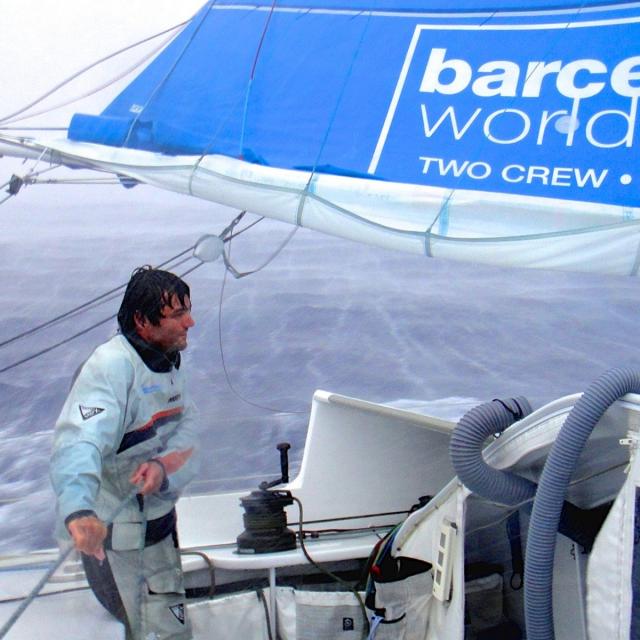
Strategies for winning. Meteorology in a round the world regatta (Coursera)

Strategies for winning. Meteorology in a round the world regatta (Coursera)

In this course you can learn about the mechanics of global weather, the foundations of ocean meteorology, predictive modeling and how sailors receive data via satellite and use high-performance navigation software.

Class Deals by MOOC List - Click here and see Coursera's Active Discounts, Deals, and Promo Codes.

This course looks at oceanic meteorology and climatology through the lens of the sport of sailing.
You will gain a basic knowledge of meteorology needed by sailors to take part in a regatta such as the Barcelona World Race, the only double-handed, round the world regatta with no stops.
You will learn about the strategies employed during a round the world regatta and how these are put to use on board the latest ocean racing yachts.

Syllabus

WEEK 1
Understanding maritime meteorology
In this module you will learn the foundations for an understanding of general and in particular maritime meteorology. What are the factors and engines powering the weather? What do we need to know to understand the weather phenomena we experience every day? What do ocean sailors need to know to predict the weather? Instructors: Tomàs Molina, Santi Serrat .

WEEK 2
Meteorological predictions
In this module you will learn: How meteorological predictions are made. What numerical weather models and equations look like. This will be explained by Tomàs Molina in Module 2.1 You will look at the forecasting structures that help us to interpret the information given by the models: Advection, troughs, ridges, barometric swamps and low pressure systems. These will be explained by Tomàs Molina in Module 2.2 What the basic prediction models used by sailors are. This will be explained by Marcel van Triest in Module 2.3 Remember you can access to the help forum
. If you are experiencing difficulty learning or accessing course content, or if you simply want more information.

WEEK 3
The sailor as meteorologist
In this module you will learn how sailors use meteorology to sail around the world and to win round the world regattas. All of their interest is focussed on the wind and they need theoretical, but above all practical, knowledge to help them to take the correct decisions at sea. Remember you can access to the help forum. If you are experiencing difficulty learning or accessing course content, or if you simply want more information.

WEEK 4
Ocean regattas and meteorology
The science of meteorology is a fundamental part of any type of ocean navigation. In the case of yacht racing, it's importance is even greater, given that the wind is the force propelling the boat and is the key factor in formulating the strategy and tactics needed to win. However, the lead role of meteorology in a regatta is for safety, and that is something that the race organisers always make a priority. In Module 4.1 the general climatology for a regatta such as the Barcelona World Race is described, as well as the preparations the skippers make with the sails, the boat and other personal kit. In Module 4.2 you will learn how the Race Management of a regatta work together with the meteorologist to ensure that the information reaches the boats and to guarantee the maximum safety levels for the crews. In Module 4.3 the type of information the crews receive whilst out on the oceans is described, as well as the telecommunications systems used to make this happen. In Module 4.4 you will learn how weather information impacts on safety and you will look at the specific case of ice detection in the Southern Ocean.

WEEK 5
Climatology and meteorology in the Barcelona World Race: From the Mediterranean Sea to the Indian Ocean
We begin now by going over the Barcelona World Race round the world route. In Module 5 you will learn about general and specific strategies for sailing from Barcelona to the Indian Ocean.

WEEK 6
Climatology and meteorology in the Barcelona World Race: From the Indian Ocean to Gibraltar
In this module we are going to study the meteorology and strategy for the seas of the south of the planet. Down in the Southern Ocean is where the sailors go up against the toughest sailing conditions in the regatta and where they must also abide by safety restrictions due to the danger of floating ice. On the following pages, Marcel van Triest will analyse general strategy and also look at case studies from the Barcelona World Race 2010/11. In that edition, ice gates were used to restrict the fleet's descent south and to avoid boats heading into danger zones. For the 2014/15 edition, however, ice gates have been substituted by a “restriction zone”, a polygon with some 72 sides surrounding the Antarctic. In this video Marcel explains the general context of the passage through the Southern Ocean and reviews the routes taken in the 2010/11 edition of the race. They key difference in this edition is that the regatta does not take the boats through Cook Strait (New Zealand).

Go to Class
MOOC List is learner-supported. When you buy through links on our site, we may earn an affiliate commission.

Related Courses

Machine Design Part I (Coursera) Coursera
Georgia Institute of Technology

Machine Design Part I (Coursera)

“Machine Design Part I” is the first course in an in-depth three course series of “Machine Design.” The “Machine Design” Coursera series covers fundamental mechanical design topics, such as static and fatigue failure theories, the analysis of shafts, fasteners, and gears, and the design of mechanical systems such as gearboxes. Throughout this series of courses we will examine a number of exciting design case studies, including the material selection of a total hip implant, the design and testing of the wing on the 777 aircraft, and the impact of dynamic loads on the design of an bolted pressure vessel. In this first course, you will learn robust analysis techniques to predict and validate design performance and life.

Sep 14th 2026
5-12 Weeks
The Science of the Solar System (Coursera) Coursera
Caltech

The Science of the Solar System (Coursera)

Learn about the science behind the current exploration of the solar system in this free class. Use principles from physics, chemistry, biology, and geology to understand the latest from Mars, comprehend the outer solar system, ponder planets outside our solar system, and search for habitability in our neighborhood and beyond. This course is generally taught at an advanced level assuming a prior knowledge of undergraduate math and physics, but the majority of the concepts and lectures can be understood without these prerequisites.

Sep 21st 2026
5-12 Weeks
Sustainable Development Goal 14: Life Below Water (CanopyLAB) CanopyLAB
SDG LAB

Sustainable Development Goal 14: Life Below Water (CanopyLAB)

You might not constantly think about it, but oceans are a crucial part of the ecosystem that makes Earth habitable for humans. More than half of the oxygen we breathe comes from algae, and the oceans absorb a large amount of the carbon dioxide released by human activities, thus mitigating the impact of climate change. The oceans are also a crucial source of food and livelihood for humans. Yet today, the oceans face multiple threats including climate change, environmental degradation, pollution, and overfishing. In this course, you will learn about the important role oceans play, their current state of deterioration, and what you can do to improve it.

Self Paced
Self-Paced
Sustainable Development Goal 13: Climate Action (CanopyLAB) CanopyLAB
SDG LAB

Sustainable Development Goal 13: Climate Action (CanopyLAB)

This course aims to give you an introduction to Goal 13, including a deep-dive into the magnitude of the problems caused by climate change, what needs to be done, and what progress has been made to address it. While Goal 13 emphasizes actions at high levels such as national or international, each individual has an important role to play to make Goal 13 successful. Find out why, and how to get involved, in this course.

Self Paced
Self-Paced
Come Rain or Shine: Understanding the Weather (FutureLearn) FutureLearn
University of Reading

Come Rain or Shine: Understanding the Weather (FutureLearn)

Understand and explore the physical processes behind the weather. Weather affects our lives almost every day through what we wear, what we eat and what we do. But why is it rainy, windy or sometimes even sunny? Explore some of the physical processes driving UK weather systems and get hands on in the world of weather with practical activities and fieldwork.

Self Paced
3 Weeks
Éducation par la recherche : climatologie à l'École (FUN) FUN
Université Sorbonne Paris Cité

Éducation par la recherche : climatologie à l'École (FUN)

Les Savanturiers – L’école de la Recherche est un programme éducatif qui vise à introduire les méthodes et l’éthique de la recherche dans les écoles et dans les ateliers périscolaires. Les élèves mènent des projets de recherche scientifique, guidés par leurs enseignants ou animateurs et par des chercheurs engagés pour l’innovation pédagogique. L’objectif de ce MOOC Éducation par la recherche : climatologie à l'École est de diffuser et de sensibiliser les enseignants, animateurs, formateurs au modèle de l’éducation par la recherche dans le domaine de la climatologie. Il s’agit notamment pour chaque participant de concevoir, mettre en oeuvre et consolider son projet Savanturiers.

No sessions available
5-12 Weeks
Oceanografía: una clave para entender mejor nuestro mundo (Coursera) Coursera
University of Barcelona

Oceanografía: una clave para entender mejor nuestro mundo (Coursera)

En este curso, el estudiante aprenderá las bases de la ciencia oceanográfica. Cómo se clasifica y se ha formado el fondo marino, cómo funcionan los actuales sistemas de análisis del mar por satélite, la química del océano y los procesos que han llevado a su formación.

Aug 31st 2026
5-12 Weeks
Mechanics: Motion, Forces, Energy and Gravity, from Particles to Planets (Coursera) Coursera
UNSW Sydney - University of New South Wales

Mechanics: Motion, Forces, Energy and Gravity, from Particles to Planets (Coursera)

Most of the phenomena in the world around you are, at the fundamental level, based on physics, and much of physics is based on mechanics. Mechanics begins by quantifying motion, and then explaining it in terms of forces, energy and momentum. This allows us to analyse the operation of many familiar phenomena around us, but also the mechanics of planets, stars and galaxies.

Sep 14th 2026
5-12 Weeks
Thermodynamique : fondements (Coursera) Coursera
École Polytechnique Fédérale de Lausanne

Thermodynamique : fondements (Coursera)

Ce cours vous apportera une compréhension des concepts fondamentaux de la thermodynamique du point de vue de la physique, de la chimie et de l’ingénierie. Il est scindé un deux MOOCs. Dans la première partie, le Professeur J.-Ph. Ansermet de l’EPFL et son collaborateur le Dr. Sylvain Bréchet ont rassemblé en quatre leçons tous les principes fondamentaux de la thermodynamique. La deuxième partie du MOOC illustre l’approche thermodynamique par une série d’applications présentées par des spécialistes provenant de diverses institutions partenaires du réseau RESCIF.

Sep 14th 2026
4 Weeks