Mechanics of Materials I: Fundamentals of Stress & Strain and Axial Loading (Coursera)

Mechanics of Materials I: Fundamentals of Stress & Strain and Axial Loading (Coursera)

This course explores the topic of solid objects subjected to stress and strain. The methods taught in the course are used to predict the response of engineering structures to various types of loading, and to analyze the vulnerability of these structures to various failure modes. Axial loading with be the focus in this course.

Class Deals by MOOC List - Click here and see Coursera's Active Discounts, Deals, and Promo Codes.

Syllabus

WEEK 1
Welcome
Stress and Strain Fundamentals
In this section, we will study the fundamentals of stress and strain as applied to Mechanics of Materials.

WEEK 2
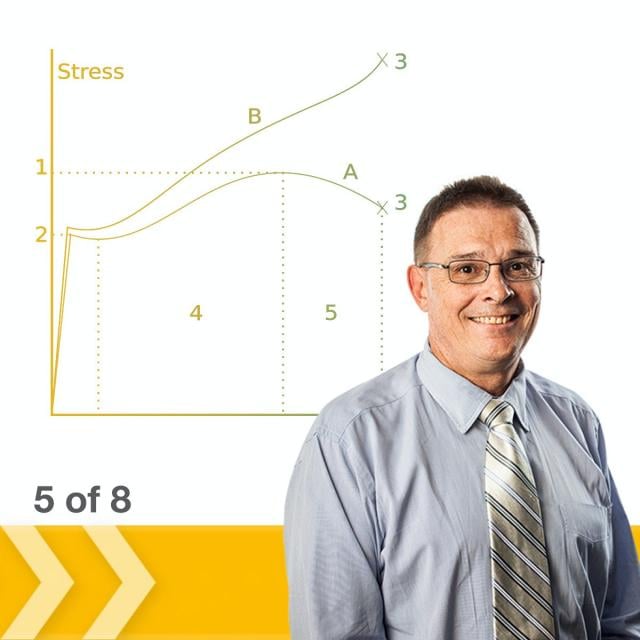
Stress-Strain Diagrams, Material Properties, and Shear Stress and Strain
In this section, we will develop stress-strain diagrams, discuss material properties, and look more in depth at shear stress and strain.

WEEK 3
Stresses on Inclined Planes
In this section, we will develop the stress transformation equations for inclined planes and introduce Mohr’s Circle for Plane Stress

WEEK 4
Stress concentrations, Mohr’s Circle for Plane Strain, and measuring strains
In this section, we will learn about stress concentrations, and discuss plane strain, develop Mohr’s Circle for Plane Strain, and explore methods of measuring strain.

WEEK 5
Generalized Hooke’s Laws, Factor of Safety, Non-linear behavior and Plasticity, Statically Indeterminate Structures, and Thermal Effects
In this section, we will conclude the course by discussing the topics of the generalize Hooke’s Laws for Isotropic materials, factors of safety, nonlinear behavior and plasticity, statically indeterminate structures, and thermal effects in mechanics of materials.


Go to Class
MOOC List is learner-supported. When you buy through links on our site, we may earn an affiliate commission.

Related Courses

Philosophy and the Sciences: Introduction to the Philosophy of Cognitive Sciences (Coursera) Coursera
University of Edinburgh

Philosophy and the Sciences: Introduction to the Philosophy of Cognitive Sciences (Coursera)

What is our role in the universe as human agents capable of knowledge? What makes us intelligent cognitive agents seemingly endowed with consciousness? This is the second part of the course 'Philosophy and the Sciences', dedicated to Philosophy of the Cognitive Sciences. Scientific research across the cognitive sciences has raised pressing questions for philosophers. The goal of this course is to introduce you to some of the main areas and topics at the key juncture between philosophy and the cognitive sciences. Each week we will introduce you to some of these important questions at the forefront of scientific research. We will explain the science behind each topic in a simple, non-technical way, while also addressing the philosophical and conceptual questions arising from it.

Oct 19th 2026
4 Weeks
Mécanique du point matériel (Coursera) Coursera
École Polytechnique Fédérale de Lausanne

Mécanique du point matériel (Coursera)

Pour illustrer les concepts introduits dans la première partie, on traite ici des problèmes pour lesquels le système mécanique peut être considéré comme un point matériel. Cette partie couvre notamment les problèmes à traiter en coordonnées cylindriques ou sphériques, le problème des orbites des planètes et les référentiels accélérés.

Nov 2nd 2026
5-12 Weeks
Understanding Research Methods (Coursera) Coursera
University of London,SOAS University of London

Understanding Research Methods (Coursera)

This MOOC is about demystifying research and research methods. It will outline the fundamentals of doing research, aimed primarily, but not exclusively, at the postgraduate level. It places the student experience at the centre of our endeavours by engaging learners in a range of robust and challenging discussions and exercises befitting SOAS, University of London's status as a research-intensive university and its rich research heritage.

Oct 19th 2026
4 Weeks
Understanding Obesity (Coursera) Coursera
University of Edinburgh

Understanding Obesity (Coursera)

In this course, we’ll look at the facts and misconceptions around obesity and discuss key physiological and psychological concepts around the brain’s control of appetite and body weight. We’ll consider the biological and environmental pressures that make it easy to gain weight (and hard to lose it!). Most importantly, we'll give you the opportunity to reflect on your own knowledge and assumptions around the subject.

Oct 19th 2026
4 Weeks
Philosophy and the Sciences: Introduction to the Philosophy of Physical Sciences (Coursera) Coursera
University of Edinburgh

Philosophy and the Sciences: Introduction to the Philosophy of Physical Sciences (Coursera)

What is the origin of our universe? What are dark matter and dark energy? This is the first part of the course 'Philosophy and the Sciences', dedicated to Philosophy of the Physical Sciences. Scientific research across the physical sciences has raised pressing questions for philosophers. The goal of this course is to introduce you to some of the main areas and topics at the key juncture between philosophy and the physical sciences.

Oct 19th 2026
4 Weeks
Understanding and Managing the Stresses of Police Work (Coursera) Coursera
University of Toronto

Understanding and Managing the Stresses of Police Work (Coursera)

This course has two goals. First, we want to inform officers how their stress system works and why they sometimes feel as they do. With this as a foundation we then describe some strategies officers can use to manage this system, giving themselves much needed breaks from the stress response and overall empowering them with a greater sense of control over how their bodies react to stress.

Oct 19th 2026
3 Weeks
Fundamentals of waves and vibrations (Coursera) Coursera
École Polytechnique

Fundamentals of waves and vibrations (Coursera)

Waves are everywhere. On water of course, but also in the air as you hear a plane, and under your feet during an earthquake certainly. Vibrations, too, are everywhere In your bike as you go over a bump, in you guitar as you play, and of course in your smartphone. You can guess that there is something in common behind all this. This is exactly the purpose of this course !

Oct 26th 2026
5-12 Weeks
Systems Thinking In Public Health (Coursera) Coursera
Johns Hopkins University

Systems Thinking In Public Health (Coursera)

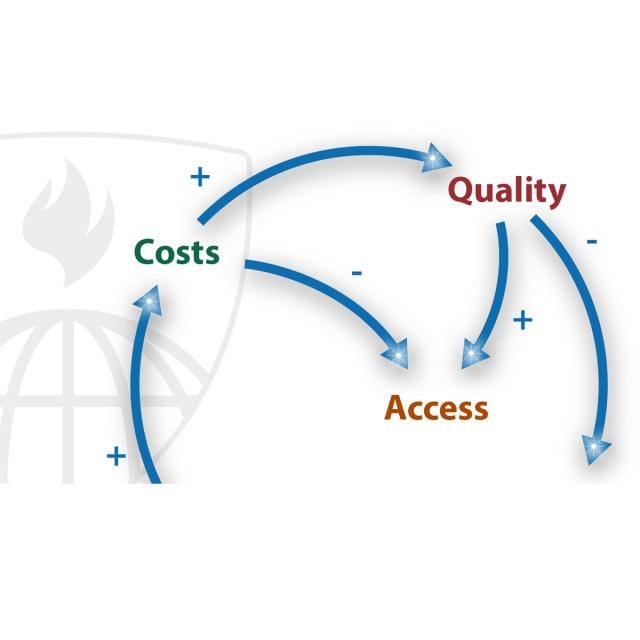
This course provides an introduction to systems thinking and systems models in public health. Problems in public health and health policy tend to be complex with many actors, institutions and risk factors involved. If an outcome depends on many interacting and adaptive parts and actors the outcome cannot be analyzed or predicted with traditional statistical methods. Systems thinking is a core skill in public health and helps health policymakers build programs and policies that are aware of and prepared for unintended consequences.

Nov 2nd 2026
4 Weeks