EdX

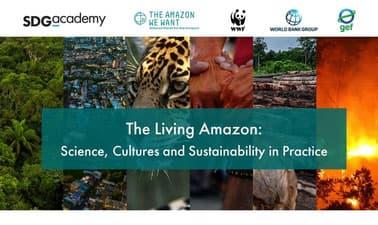
The Living Amazon: Science, Cultures and Sustainability in Practice (edX)

Offered by SDGAcademyX, SDG Academy,
The Living Amazon: Science, Cultures and Sustainability in Practice (edX)

Learn about the importance of the Amazon at local and global scales, the threats the region faces, and how sustainable development can help save its extraordinary biodiversity and peoples for current and future generations.

Class Deals by MOOC List - Click here and see EdX's Active Discounts, Deals, and Promo Codes.

The Amazon is the world’s largest rainforest and river system, vital to the planet’s climate stability and home to irreplaceable biodiversity. It provides critical ecosystem services to the entire globe and the eight sovereign countries and one overseas territory that directly encompass it. The Amazon is home to 47 million people, including more than two million Indigenous people, with their own cultural identities, territorial management practices, and 300 languages. Yet, the Amazon is facing historically unprecedented challenges. Deforestation, degradation, fragmentation, and criminality are on the rise in the region, putting the Amazon in danger of crossing a tipping point beyond which today’s forests can no longer exist.
This course, offered in English, Spanish, and Portuguese, provides an overview of the state of the Amazon’s ecosystems, current trends, threats and impacts, and how they will affect the long-term well-being of the region. After learning about what is putting the ecosystems and communities of the Amazon in danger, learners will explore key opportunities for conservation and sustainable development to protect the region for current and future generations.
Taught by renowned experts, the course spans various disciplines, with themes ranging across international development, agriculture and global commodity chains, fisheries, climate science and action, geology, anthropology, biodiversity, community engagement, and human rights. This course is for practitioners and professionals from all sectors, who may or may not be familiar with the Amazon, including those working in government, undergraduate and graduate students, civil society, academia, the private sector, and international agencies.
This MOOC is the product of a collaboration between the Science Panel for the Amazon (SPA), the World Wildlife Fund (WWF), and the World Bank (WB), with financial support from the Global Environment Facility (GEF). It builds on the flagship 2021 Amazon Assessment Report, produced by the Science Panel for the Amazon and launched at COP26 in Glasgow, and on several other SPA publications.

What you'll learn
By the end of the course, participants will be able to:

  • Describe how the Amazon was formed and why it is home to such a rich diversity of plants, animals, and cultures.
  • Understand the role the Amazon plays in the world's hydroclimate system and what it would mean for humanity to lose a significant portion of the forest.
  • Describe how Amazonian populations have influenced and sustainably managed the Amazon’s ecosystems over millennia.
  • List the main threats the Amazon currently faces and drivers of deforestation and land degradation.
  • Identify sustainable alternatives for development in the Amazon.
  • Be inspired to implement sustainable alternatives for development in the Amazon.

Syllabus

Module 1: Introduction to the Course
Module 2: The Amazon: 3 Billion Years in The Making
Module 3: Peoples of the Amazon
Module 4: Landscapes, Livelihoods and Policies in the Amazon
Module 5: Land-Use Impacts on Ecosystem Services and Human Well-Being
Module 6: Climate Change in the Amazon
Module 7: A Sustainable and Inclusive Vision for the Amazon
Module 8: Solutions for Conservation, Restoration, and a New Bioeconomy
Go to Class
MOOC List is learner-supported. When you buy through links on our site, we may earn an affiliate commission.

Related Courses

Minerals and Mining in a Sustainable World (edX) EdX
University of Queensland,UQx

Minerals and Mining in a Sustainable World (edX)

This course provides learners with an overview of the role of minerals in society, the history of the sustainable development agenda, and the emerging focus on the relationship between mineral development and the Sustainable Development Goals. What is the role of mining in a sustainable world? What challenges lie ahead, and how is the mining industry responding to meet our demand for minerals as well as our expectations of a sustainable future?

Self Paced
Self-Paced
Super-Earths And Life (edX) EdX
HarvardX,Harvard University

Super-Earths And Life (edX)

Learn about the Earth, life, and how we can search for life elsewhere in the universe. Are we alone in this universe? What new information and observations on exoplanets have we discovered? In the past decade, astronomers have made incredible advances in the discovery of planets outside our solar system. Thirty years ago, we knew only of the planets in our own solar system. Now we know of thousands circling nearby stars.

Self Paced
Self-Paced
Built environment sustainability assessment (edX) EdX
Universitat Politècnica de València,UPValenciaX

Built environment sustainability assessment (edX)

The course introduces the basic elements and trends for performing a through built environment assessment and develops the tools for urban sustainability policy impact analysis. The course introduces the basic elements and trends for performing a through built environment assessment and develops the tools for urban sustainability policy impact analysis.

Self Paced
Self-Paced
文物精品与文化中国:农业与制造业 | Relics in Chinese History - Part 1: Agriculture and Manufacturing (edX) EdX
Tsinghua University,TsinghuaX

文物精品与文化中国:农业与制造业 | Relics in Chinese History - Part 1: Agriculture and Manufacturing (edX)

Discover manufacturing and agriculture’s role in the history of China as we explore Chinese culture through artifacts and relics. 本课程以精品文物作引子,将学术界探索中华文明的过程作为线索,介绍古代中国在造船、玉器等诸多领域的杰出成就

Self Paced
Self-Paced
Ethics in Action (edX) EdX
SDGAcademyX,SDG Academy

Ethics in Action (edX)

What do the world’s great religious and secular philosophies have to say about ethical conduct? Which virtues are common across faiths? And what role do religious communities have to play in building a more just and sustainable world? The challenges of sustainable development are more than technical or political—they are also moral, calling on us to examine who we are as human beings, and who we want to be going forward.

Self Paced
Self-Paced
Industrial Biotechnology (edX) EdX
Delft University of Technology,DelftX

Industrial Biotechnology (edX)

Learn the basics of sustainable processing for biobased products to further understand their impact on global sustainability. As fossil-based fuels and raw materials contribute to climate change, the use of renewable materials and energy as an alternative is increasingly important and common. This transition is not a luxury, but rather a necessity.

Self Paced
Self-Paced
Bipedalism: The Science of Upright Walking (edX) EdX
DartmouthX

Bipedalism: The Science of Upright Walking (edX)

Upright walking is a hallmark of being human. Explore how this unusual form of locomotion evolved and why. Have you ever wondered why humans walk on two legs rather than four? In this course, we will explore how science investigates this unusual form of locomotion. We will start our investigation by looking at the mechanics of upright walking in humans and comparing that to bipedal locomotion in large birds, bears, and apes.

Self Paced
5-12 Weeks
The Korean Story: Secrets of an Economic Miracle (edX) EdX
SDGAcademyX,SDG Academy

The Korean Story: Secrets of an Economic Miracle (edX)

What can the world learn from the Korean development story? The Korean Story discusses the socio-political and historical context that has shaped the economic growth of South Korea. It probes into how South Korea, post the Second World War, was able to transform its economy within three decades to emerge as a leading innovation and technology center in the 21st century.

Self Paced
Self-Paced
Sustainability in Architecture: An Interdisciplinary Introduction (edX) EdX
Universitat Politècnica de València,UPValenciaX

Sustainability in Architecture: An Interdisciplinary Introduction (edX)

This course introduces the basic elements and trends that define sustainability practices in Architecture today. It follows an interdisciplinary approach that includes performance assessment and urban policies. This course offers an interdisciplinary approach to sustainability in Architecture. Learners will be introduced to the basic elements of sustainability assessments (first model layer), as well as trends informing the space today.

Self Paced
Self-Paced
Cities and the Challenge of Sustainable Development (edX) EdX
SDGAcademyX,SDG Academy

Cities and the Challenge of Sustainable Development (edX)

What is a sustainable city? Learn the basics here. According to the United Nations, urbanization and population growth could result in an increase of 2.5 billion people into urban populations by 2050, with associated impacts ranging from increased transportation needs to more building. How do we make cities sustainable to support this growth?

Self Paced
Self-Paced
From the Ground Up: Managing and Preserving Our Terrestrial Ecosystems (edX) EdX
SDGAcademyX,SDG Academy

From the Ground Up: Managing and Preserving Our Terrestrial Ecosystems (edX)

How can we preserve, restore, manage and sustainably use terrestrial ecosystems? Join us as we explore this question in the Brazilian Amazon and around the world. In this course, you’ll learn the science behind the capacities of various ecosystems including extinction rates, desertification and how their physical makeup has evolved with environmental shifts. You’ll experience the lives of local populations dependent upon these resources, from their economic activities to their societal norms.

Self Paced
Self-Paced
Globalization: Past and Future (edX) EdX
SDGAcademyX,SDG Academy

Globalization: Past and Future (edX)

Is globalization a new phenomenon or a cyclical pattern throughout human history? In this four-part mini-course, Professor Jeffrey Sachs argues that we have always lived in a global world. He takes students on a historical and anthropological tour of six distinct waves of globalization and outlines the key factors that drove innovation, technology dispersal and development during these epochs.

Self Paced
Self-Paced