Marine Biology (Coursera)

Marine Biology (Coursera)

This course is about life in the oceans, from the sunlit surface to the inky depths, from microscopic phytoplankton to the great blue whale. The ocean is among the world’s most inhospitable environments for scientific research, which is why we know as much about the surface of the moon as we do the bottom of the sea. This course uncovers the evolutionary history of marine organisms, adaptations to life in water, the behavior and functional morphology of sea animals, interactions between species, and current threats.

Class Deals by MOOC List - Click here and see Coursera's Active Discounts, Deals, and Promo Codes.

Throughout the course, we meet scientists who are developing ingenious solutions for overcoming challenges and are making remarkable discoveries. By evaluating these cases and analyzing real scientific data, we come to understand some of the ways that life has adapted to diverse ocean habitats, how it interacts with the physical environment and with other organisms, and why it matters to us.

Syllabus

How have organisms adapted to living in the ocean?
Module 1
Did life on Earth begin in the ocean? How diverse are marine organisms, compared to those on land? What are the forces that shaped their evolution, and what threats do they face? We begin our course by investigating questions whose answers are far less straightforward than you might think. Here we will meet our course authors and look through a porthole onto their scientific research. We will learn how destructive fishing techniques are affecting the ecosystems of squid species and how biofluorescence and bioluminescence help mysterious deep-sea creatures survive and reproduce.

What are the physical properties of the marine environment and how do they affect life?
Module 2
Just as life on land depends on the air we breathe, life in the ocean depends on water. What are the properties of seawater, and how are they important to life? This week we will examine seawater’s chemical and physical characteristics—things like temperature, salinity, acidity, pressure, and the transmission of sunlight—that profoundly affect the organisms living in it. We’ll study how water moves through the ocean and beyond, in a great global cycle that includes internal motion like tides and currents, but also processes like evaporation, precipitation, and wind, which take place outside the ocean. Then we will look at how organisms take advantage of all this motion. How do the water’s properties allow marine life to find food, escape from predators, meet mates, and spread their offspring? Finally, we will a visit with a bioengineer who designs her own equipment to create pulsing images of a previously little-studied organism, a gelatinous filter-feeder that’s enormously important in its ecosystem.

How do species interact in the ocean?
Module 3
This week we will examine another aspect of motion underwater: how matter and energy move through marine ecosystems, from the photosynthetic organisms that capture sunlight at the base of the food pyramid to the huge predators at the top, as well as the organisms that cycle waste and dead creatures back into the system. What lives where, and why? How do the movement of matter and energy affect the patterns of life in the ocean?We will take a closer look at principles of ecology and how they apply in marine environments. How do species interact within a community? How do they help and harm one another, and how do their interactions drive their evolution? In a case study, we will visit a marine scientist who studies dolphins that herd their prey and find out about the daily migrations those prey species make between deep and shallow waters.

Giants of the Sea: How did Blue Whales Get So Big? (A Case Study)
Module 4
Blue whales are the largest animals that ever lived and have among the longest migrations of any mammalian species. Their massive body size and range bring with them a unique set of challenges. How do blue whales get enough energy feasting on just tiny krill? A group of scientists, including biologist Jeremy Goldbogen at Hopkins Marine Station at Stanford University, has revolutionized the study of whale behavior by developing and deploying multi-sensor tags on whales. The scientists look for patterns in their data in order to understand what whales are doing during their deep dives, and what this behavior reveals about the ecosystems the whales inhabit.

How are Marine Ecosystems Important?
Module 5
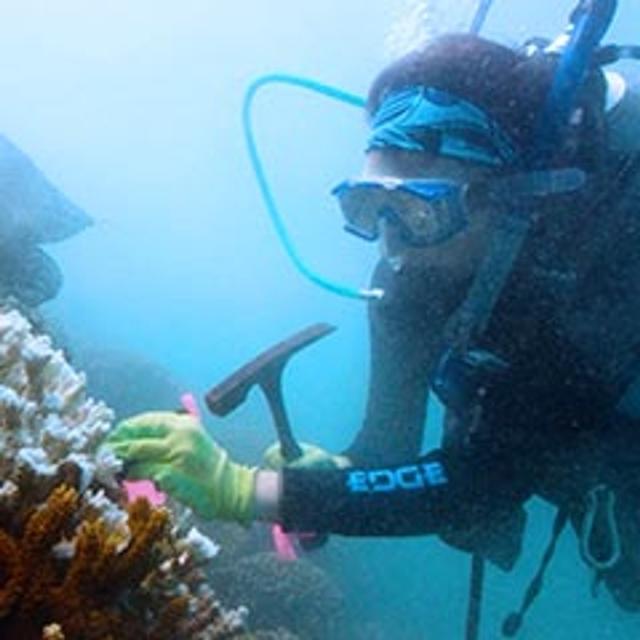
The threats to ocean life are numerous and dire, but they are not foretold. For example, “super corals” appear to be resistant to warming waters and scientists are successfully replanting samples in vulnerable reefs. This week we investigate the relationship between humans and the ocean: the services the oceans provide, how those services are threatened by human activity, and what might be done to mitigate these threats. We also look at a number of other scientists who are working from many disciplines on conservation strategies.
Go to Class
MOOC List is learner-supported. When you buy through links on our site, we may earn an affiliate commission.

Related Courses

Become ResponSEAble! (EMMA) EMMA
ResponSEAble

Become ResponSEAble! (EMMA)

What are the issues affecting our oceans? How can we change behavior? What is ocean literacy, and what could be its role in promoting this change? Enrolling in the RESPONSEABLE MOOC you will be able to explore answers to these and other questions, guided by a multidisciplinary team which includes marine biologists, ecologists, economists, social scientists, communication experts and ocean literacy experts.

No sessions available
5-12 Weeks
Transformation of the Global Food System (Coursera) Coursera
University of Copenhagen

Transformation of the Global Food System (Coursera)

The UN predicts we will be 9-10 billion people on Earth in 2050. Providing so many people with nutritious foods is a massive challenge and one that cannot be met by simply upscaling current practices regarding food production and consumption. Providing humanity with nutritional food is at the center of all decisions related to sustainable development.

Jun 29th 2026
5-12 Weeks
GIS Data Acquisition and Map Design (Coursera) Coursera
University of Toronto

GIS Data Acquisition and Map Design (Coursera)

In this course, you will learn how to find GIS data for your own projects, and how to create a well-designed map that effectively communicates your message. The first section focuses on the basic building blocks of GIS data, so that you know what types of GIS files exist, and the implications of choosing one type over another.

Jun 29th 2026
5-12 Weeks
The Earth in My Pocket: an Introduction to Geology (FutureLearn) FutureLearn
The Open University

The Earth in My Pocket: an Introduction to Geology (FutureLearn)

Get an introduction to geology. Discover where materials that make up everyday objects come from and how to use them sustainably. Everything we use that has not been grown either contains or relies on materials that have been sourced by a geoscientist. Whether we are standing out in the wilderness, in the middle of a city or in our home, geology and the Earth’s natural resources are all around us, forming an integral part of our everyday lives.

No sessions available
4 Weeks
One Planet, One Ocean (edX) EdX
SDGAcademyX,SDG Academy

One Planet, One Ocean (edX)

A holistic view of how the ocean functions, how human interactions with the ocean can be understood, and what solutions are available to support both sustainable use and stewardship of our blue planet. Is the ocean the real final frontier? Humans have a greater understanding of the surface of the moon than they do of the depths of these waters.

Self Paced
Self-Paced
Marine Biology (saylor.org) Saylor Academy
Saylor.org

Marine Biology (saylor.org)

Marine Biology is the study of ocean life. As you might expect, life in salt water is vastly different from life in a terrestrial or freshwater environment due to factors like salinity, water circulation, and atmospheric pressure. How, for example, can organisms living in salt water avoid dehydration? How do organisms living in the depths of the ocean handle the immense pressure? How do the environmental factors in marine communities affect biodiversity? How do some animals manage to alternate between the demands of terrestrial life and the demands of marine life? In this course, you will learn the answers to these questions and more. This course will touch on a number of different subfields of biological study (including biochemistry, physiology, zoology, botany, and ecology) within the context of the ocean environment.

Legacy Course
Self-Paced
Marine Litter MOOC (OU) Other Providers
Open Universiteit

Marine Litter MOOC (OU)

Marine litter is a global problem that affects our oceans. It is an environmental, human health and socio-economic problem that is symptomatic of a throw-away society. With worldwide growth in the amount of solid litter disposed of and slow rates of degradation, the amount of litter present in the marine environment is increasing exponentially. This MOOC is part of the Clean Seas Campaign and contributes to the mission of the Global Partnership on Marine Litter (GPML), which seeks to protect the global marine environment, human well-being and animal welfare by addressing the challenges of marine litter. The MOOC is available in 10 different languages.

No sessions available
2 Weeks
GIS Data Formats, Design and Quality (Coursera) Coursera
University of California, Davis

GIS Data Formats, Design and Quality (Coursera)

In this course, the second in the Geographic Information Systems (GIS) Specialization. What you will learn: design data tables and use separating and joining data in a relational database; write query strings to subset data; create and work with raster data; create web maps.

Jun 29th 2026
4 Weeks
Our Earth's Future (Coursera) Coursera
American Museum of Natural History

Our Earth's Future (Coursera)

Our Earth’s Future is about the science of climate change and how to talk about it. You will learn from scientists in the fields of climatology, oceanography, Earth science, and anthropology who study how climate change is affecting people, populations, and ways of life. Explore the multiple lines of evidence for the human-induced climate change that is happening today, and consider what that means for the future of our planet. At the end of this course you will be able to understand key scientific principles, identify and address misconceptions, and contribute confidently to conversations about climate change.

Jun 15th 2026
5-12 Weeks
Global Warming I: The Science and Modeling of Climate Change (Coursera) Coursera
University of Chicago

Global Warming I: The Science and Modeling of Climate Change (Coursera)

This class describes the science of global warming and the forecast for humans’ impact on Earth’s climate. Intended for an audience without much scientific background but a healthy sense of curiosity, the class brings together insights and perspectives from physics, chemistry, biology, earth and atmospheric sciences, and even some economics—all based on a foundation of simple mathematics (algebra).

Jun 29th 2026
5-12 Weeks