EdX

Science & Cooking: From Haute Cuisine to Soft Matter Science (physics) (edX)

Science & Cooking: From Haute Cuisine to Soft Matter Science (physics) (edX)

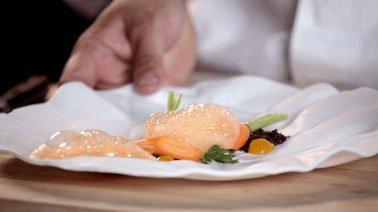
Top chefs and Harvard researchers explore how traditional and modernist cooking techniques can illuminate basic principles in chemistry, physics, and engineering. Learn about elasticity, viscosity, mayonnaise, baking, and more! In this course, which investigates physical transformations in food, we will be visited by world-famous chefs who use a number of different styles and techniques in their cooking. Each chef will demonstrate how he or she prepares delicious and interesting creations, and we will explore how fundamental scientific principles make them possible.

Class Deals by MOOC List - Click here and see EdX's Active Discounts, Deals, and Promo Codes.

Topics will include:

  • How cooking changes food texture
  • Making emulsions and foams
  • Phase changes in cooking

You will also have the opportunity to become an experimental scientist in your very own laboratory — your kitchen! By following along with the recipes of the week, taking precise measurements, and making skillful observations, you will learn to think like both a chef and a scientist. This practice will prepare you for the final project, when you will design and perform an experiment to analyze a recipe of your choice from a scientific perspective.
The lab is certainly one of the most unique components of this course — after all, in what other science course can you eat your experiments?

What you'll learn

  • The chemical and physical principles that underlie everyday cooking and haute cuisine techniques
  • How chefs can use enzymes to make foods that would otherwise be impossible
  • How to use the scientific method to learn how a recipe works, and find ways you could improve it
  • How to think like a chef AND a scientist.

Syllabus

Module 1: Elasticity
How do we describe food texture? In the first module of the course, we will explore the scientific concept of elasticity, which influences the texture of food, and how it changes during cooking. Discussions with Bill Yosses and Mark Ladner will address the role of gluten in dough and the challenges of working with gluten-free varieties.

Module 2: Viscosity
How can we make liquid foods more appealing? Just as solid foods can have different textures, so can liquids, largely determined by their viscosity, or thickness. Scientific discussions about what determines viscosity and demonstrations of different ways to change the viscosities of foods will allow us to explore this topic from different perspectives. We will hear from Harvard’s own Martin Breslin, Director for Culinary Operations, and Carles Tejedor, from Oillab and By restaurant in Barcelona.

Module 3: Emulsions and Foams
Emulsions and foams are some of the most interesting foods to think about from a scientific perspective, and we will investigate the physical principles that control their formation. Nandu Jubany will demonstrate how he uses emulsions and foams for a twist on traditional Catalan cuisine at his restaurant, Can Jubany. In the lab you can compete with other learners to see whose emulsion and foam rises the highest!

Module 4: Advanced Phase Behavior
The preparation of chocolate and frozen desserts such as ice cream are great illustrations of how chefs manipulate phase changes such as crystallization (freezing). In this module, we will discuss such concepts as nucleation of crystals and freezing point depression, and see how they can be used for chocolate tempering and making ice cream, which you will make yourself in the lab!

Module 5: Enzymes
The activity of enzymes can provide both benefits and challenges in the kitchen. After discussing the diverse roles that enzymes can play, we will investigate strategies to both restrict and exploit enzyme activity in cooking. Ted Russin and Wylie Dufresne will showcase some of their creative dishes that are only possible because of enzymes.

Module 6: Baking
To conclude the course, we will see how many of the topics that we have discussed come together in a popular cooking technique – baking! Joanne Chang and Christina Tosi will show us how to make delicious cakes, cookies, pies, and bread, and we will see how science makes it possible!

Go to Class
MOOC List is learner-supported. When you buy through links on our site, we may earn an affiliate commission.

Related Courses

Principles of Biochemistry (edX) EdX
HarvardX,Harvard University

Principles of Biochemistry (edX)

This introduction to biochemistry explores the molecules of life, starting at simple building blocks and culminating in complex metabolism. Principles of Biochemistry integrates an introduction to the structure of macromolecules and a biochemical approach to cellular function. Topics addressing protein function will include enzyme kinetics, the characterization of major metabolic pathways and their interconnection into tightly regulated networks, and the manipulation of enzymes and pathways with mutations or drugs.

Self Paced
Self-Paced
Practical Improvement Science in Health Care: A Roadmap for Getting Results (edX) EdX
HarvardX,Harvard University

Practical Improvement Science in Health Care: A Roadmap for Getting Results (edX)

Learn the skills and tools of improvement science to make positive changes in health, healthcare, and your daily life. Developed through a collaboration between HarvardX and the Institute for Healthcare Improvement, PH 556x: Practical Improvement Science in Health Care: A roadmap for getting results will provide learners with the valuable skills and simple, well-tested tools they need to translate promising innovations or evidence into practice.

Self Paced
Self-Paced
The Chemistry of Life (edX) EdX
Kyoto University,KyotoUx

The Chemistry of Life (edX)

Learn how to generate ideas at the interface between chemistry and biology. Chemistry and biology are traditionally taught as separate subjects at the high school level, where students memorize fundamental scientific principles that are universally accepted. However, at the university level and in industry, we learn that science is not as simple as we once thought. We are constantly confronted by questions about the unknown and required to use creative, integrated approaches to solve these problems.

Self Paced
Self-Paced
Human Reproduction: Sex, Science and Society (edX) EdX
The University of Newcastle, Australia,NewcastleX

Human Reproduction: Sex, Science and Society (edX)

A cross-disciplinary look at the biological factors that influence sex, fertility and making babies in modern society. Are you trying to conceive? Do you want to prevent conception (contraception)? Would you like to know more about your fertility? Have you considered how social factors influence the choices we make about sex and reproduction? What about the latest technological developments in assisted conception (otherwise known as IVF)? Join world leader in human reproduction, Laureate Professor John Aitken, as we explore the biological, technological, and social factors that influence human reproduction.

No sessions available
5-12 Weeks
Engineering for Your Classroom K – 3 (edX) EdX
The University of British Columbia,UBCx

Engineering for Your Classroom K – 3 (edX)

Self-paced, asynchronous course aimed to help educators introduce Science, Math, Engineering and Technology (STEM) concepts to K-3 students. This course is designed for educators to learn about ways to teach Engineering and STEM concepts to their students through fun, hands-on activities.

Self Paced
Self-Paced
Stand up for Science: Practical Approaches to Discussing Science that Matters (edX) EdX
University of Michigan,MichiganX

Stand up for Science: Practical Approaches to Discussing Science that Matters (edX)

In this Teach-Out, scientists and non-scientists reach out and RELATE to build communication skills to more effectively discuss knowledge. Everyone - non-scientists and scientists alike - has some form of expertise, but communicating across a gap in knowledge or experience is challenging. In this Teach-Out, we address this challenge by helping participants to develop core communication skills and more effectively communicate with one another.

No sessions available
1 Week
Macroeconomics of Climate Change: Science, Economics, and Policies (edX) EdX
International Monetary Fund - IMF,IMFx

Macroeconomics of Climate Change: Science, Economics, and Policies (edX)

Learn about the science and economics behind climate change, the framework for global climate action, and how the IMF engages on climate change issues. This online course, presented by the IMF’s Institute for Capacity Development, Fiscal Affairs Department, Research Department, and Strategy, Policy, and Review Department serves as the first module of a broader Macroeconomics of Climate Change (MCCx) course.

Self Paced
Self-Paced
Science: A Work in Progress (edX) EdX
Smithsonian,SmithsonianX

Science: A Work in Progress (edX)

Science: A Work in Progress - shows how science isn’t produced through one linear method, but through an interconnected set of practices, and examines ways that teachers can make learning science in the classroom more authentic. This online workshop: Science: A Work in Progress, is based on ideas presented in Good Thinking! an original animated series developed by the Smithsonian Science Education Center.

Self Paced
Self-Paced
Open Science: Sharing Your Research with the World (edX) EdX
Delft University of Technology,DelftX

Open Science: Sharing Your Research with the World (edX)

Explore ways to apply Open Science principles to academic work - including your own. Learn how to share your research effectively and responsibly, building greater visibility and impact. You can become a more visible, effective and impactful researcher by sharing your research data and publications openly. In this course, you will learn the objectives, main concepts, and benefits of Open Science principles along with practices for open data management and open data sharing.

Oct 25th 2023
5-12 Weeks