Skepticism (Coursera)

Skepticism (Coursera)

Skepticism is about doubt, and doubt is everywhere in the world around us today. There are doubts about whether man-made climate change is real, whether vaccinations are harmful, whether we can trust our politicians or our media, and so on. When is such skepticism warranted, and when does it stray into unreasonable territory? How widespread can such skepticism get while still being coherent? How might a radical skepticism have pernicious social consequences, such as by leading to relativism (and just what is relativism, and what is problematic about it)?

Class Deals by MOOC List - Click here and see Coursera's Active Discounts, Deals, and Promo Codes.

These are all questions that we will be engaging with in this course Along the way we will consider some important philosophical issues, such as what the nature of knowledge is, whether there are any good arguments that show that knowledge is impossible, and how a moderate skepticism might accord with an ancient conception of the good life of human flourishing, one that essentially involves the intellectual virtues.
This course is aimed at anyone who is interested in learning more about philosophy, along with those who are looking for strategies to combat extremism in their communities. Using these approaches, no matter what your skill levels in topics you would like to master, you can change your thinking and change your life.
What You Will Learn

  • Explore the concept of Skepticism
  • Discuss the role of Skepticism in contemporary society
  • Identify common responses to Skepticism
  • Compare/Contrast various forms of Skepticism
  • Apply knowledge of Skepticism to form a personal stance
  • Recognize why knowledge is more than just true belief

Syllabus

WEEK 1
What is Skepticism?
We will begin this course by exploring the nature of Skepticism through an investigation of foundational concepts of truth and knowledge. We'll also discuss how current issues in public debate (climate change denial, fake news etc) trade on Skepticism; but how a moderate skepticism can also be a force for good.

WEEK 2
Is Knowledge Impossible?
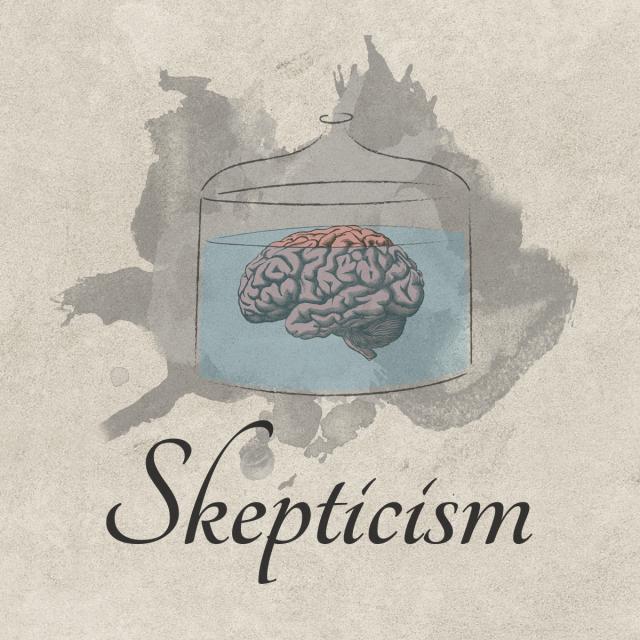
How does one know that we are not a Brain-in-a-Vat? And how can we know that we are or are not? In this module will explore what kinds of things can, and cannot, motivate skeptical doubt. We will also review the radical skeptical hypotheses, and why we can’t rule it out. We'll conclude by discussing the radical skeptical paradox.

WEEK 3
Defending Knowledge
So how does one respond to radical skepticism? In this module we will discuss strategies for responding to the idea that knowledge is impossible. We will also examine the contributions of the Austrian philosopher Ludwig Wittgenstein on the possibility of global rational evaluation.

WEEK 4
Skepticism as a Way of Life
What does Skepticism have to do with "the good life"? In this module we will learn from Aristotle, an Ancient philosopher that believed that the good life is a life of virtue. We will explore how intellectual vices and virtues go hand-in-hand with moderate Skepticism.

Go to Class
MOOC List is learner-supported. When you buy through links on our site, we may earn an affiliate commission.

Related Courses

Ethical Issues in Data Science (Coursera) Coursera
University of Colorado Boulder

Ethical Issues in Data Science (Coursera)

Computing applications involving large amounts of data – the domain of data science – impact the lives of most people in the U.S. and the world. These impacts include recommendations made to us by internet-based systems, information that is available about us online, techniques that are used for security and surveillance, data that is used in health care, and many more. In many cases, they are affected by techniques in artificial intelligence and machine learning.

Jun 8th 2026
5-12 Weeks
Intellectual Humility: Theory (Coursera) Coursera
University of Edinburgh

Intellectual Humility: Theory (Coursera)

Faced with difficult questions people often tend to dismiss and marginalize dissent. Political and moral disagreements can be incredibly polarizing, and sometimes even dangerous. And whether it’s Christian fundamentalism, Islamic extremism, or militant atheism, religious dialogue remains tinted by arrogance, dogma, and ignorance. The world needs more people who are sensitive to reasons both for and against their beliefs, and are willing to consider the possibility that their political, religious and moral beliefs might be mistaken. The world needs more intellectual humility.

Jun 8th 2026
3 Weeks
Serious Gaming (Coursera) Coursera
Erasmus University Rotterdam

Serious Gaming (Coursera)

Have you ever wondered how playing games can help us to train people, deal with societal challenges or raise awareness of contemporary social issues? In this MOOC you will learn the ins and outs of games that are designed with exactly those purposes in mind: serious games. We will define serious games and discuss the different types that have been developed. We will explain why people like to play them and what impact they may have.

Jun 8th 2026
5-12 Weeks
Relativism (Coursera) Coursera
University of California, Irvine

Relativism (Coursera)

Relativism is an ancient philosophical doctrine which has recurred time and again in the history of philosophy. It has also transcended the boundaries of that discipline, for it has shaped much of the methodology in anthropology and sociology, as well as in critical theory and literary studies. While often advocated for its supposed tolerance of differences, relativism has profound consequences for how we think of reality, for the possibility of knowledge, both in the factual and in the moral domain, and may engender the practice of double standard.

Jun 22nd 2026
4 Weeks
Alfabetização Midiática, Informacional e Diálogo Intercultural - UNESCO e UNICAMP (Coursera) Coursera
Universidade Estadual de Campinas - UNICAMP

Alfabetização Midiática, Informacional e Diálogo Intercultural - UNESCO e UNICAMP (Coursera)

Este curso quer pensar junto com você sobre um fenômeno recente no Brasil, que é a presença de uma grande quantidade de informação via mundo digital. Vamos mostrar diferentes caminhos do que podemos fazer com essa quantidade incrível de midias e como participar da construção de conteúdo digital de maneira sóbria e segura.

Jun 8th 2026
5-12 Weeks
Reason and Persuasion: Thinking Through Three Dialogues By Plato (Coursera) Coursera
National University of Singapore

Reason and Persuasion: Thinking Through Three Dialogues By Plato (Coursera)

In this course we will study Plato's ancient art of blowing up your beliefs as you go, to make sure they're built to last. We spend six weeks studying three Platonic dialogues, then two more weeks pondering a pair of footnotes to Plato; that is, we will consider some contemporary manifestations of issues Plato discusses. Our focus will be: moral theory and moral psychology.

Jan 6th 2025
5-12 Weeks
Humanidades digitales (Coursera) Coursera
Universitat Autònoma de Barcelona

Humanidades digitales (Coursera)

¿Te has planteado para qué sirven las humanidades en el siglo XXI? ¿Cómo el advenimiento de lo Digital ha cambiado nuestra forma de acercarnos a las Humanidades? ¿Y al revés? ¿De qué forma las Humanidades influencian sobre los diferentes aspectos de la Tecnología? Te ofrecemos el primer curso online que da respuesta a estas preguntas. Una visión de las Humanidades Digitales desde la filosofía, la historia, la arqueología, el arte,… y desde las ciencias computacionales y la visión por ordenador.

Jun 8th 2026
4 Weeks
Ancient Philosophy: Aristotle and His Successors (Coursera) Coursera
University of Pennsylvania

Ancient Philosophy: Aristotle and His Successors (Coursera)

What is philosophy? How does it differ from science, religion, and other modes of human discourse? This course traces the origins of philosophy in the Western tradition in the thinkers of Ancient Greece. We begin with the Presocratic natural philosophers who were active in Ionia in the 6th century BCE and are also credited with being the first scientists. Thales, Anaximander, and Anaximines made bold proposals about the ultimate constituents of reality, while Heraclitus insisted that there is an underlying order to the changing world.

Jun 1st 2026
5-12 Weeks
Ancient Philosophy: Plato & His Predecessors (Coursera) Coursera
University of Pennsylvania

Ancient Philosophy: Plato & His Predecessors (Coursera)

What is philosophy? How does it differ from science, religion, and other modes of human discourse? This course traces the origins of philosophy in the Western tradition in the thinkers of Ancient Greece. We begin with the Presocratic natural philosophers who were active in Ionia in the 6th century BCE and are also credited with being the first scientists.

Jun 22nd 2026
4 Weeks
The Modern and the Postmodern (Part 2) (Coursera) Coursera
Wesleyan University

The Modern and the Postmodern (Part 2) (Coursera)

This course examines how the idea of "the modern" develops at the end of the 18th century in European philosophy and literature, and how being modern (or progressive, or hip) became one of the crucial criteria for understanding and evaluating cultural change. Are we still in modernity, or have we moved beyond the modern to the postmodern?

Jun 15th 2026
5-12 Weeks
Philosophy, Science and Religion: Religion and Science (Coursera) Coursera
University of Edinburgh

Philosophy, Science and Religion: Religion and Science (Coursera)

Philosophy, Science and Religion mark three of the most fundamental modes of thinking about the world and our place in it. Are these modes incompatible? Put another way: is the intellectually responsible thing to do to ‘pick sides’ and identify with one of these approaches at the exclusion of others? Or, are they complementary or mutually supportive? As is typical of questions of such magnitude, the devil is in the details. For example, it is important to work out what is really distinctive about each of these ways of inquiring about the world. In order to gain some clarity here, we’ll be investigating what some of the current leading thinkers in philosophy, science and religion are actually doing.

Jun 16th 2026
5-12 Weeks