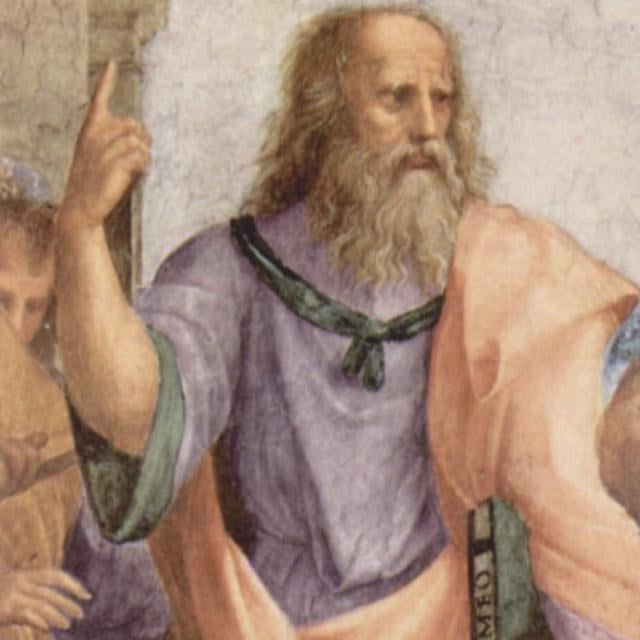
Ancient Philosophy: Plato & His Predecessors (Coursera)

Ancient Philosophy: Plato & His Predecessors (Coursera)

What is philosophy? How does it differ from science, religion, and other modes of human discourse? This course traces the origins of philosophy in the Western tradition in the thinkers of Ancient Greece. We begin with the Presocratic natural philosophers who were active in Ionia in the 6th century BCE and are also credited with being the first scientists.

Class Deals by MOOC List - Click here and see Coursera's Active Discounts, Deals, and Promo Codes.

Thales, Anaximander, and Anaximines made bold proposals about the ultimate constituents of reality, while Heraclitus insisted that there is an underlying order to the changing world. Parmenides of Elea formulated a powerful objection to all these proposals, while later Greek theorists (such as Anaxagoras and the atomist Democritus) attempted to answer that objection. In fifth-century Athens, Socrates insisted on the importance of the fundamental ethical question—“How shall I live?”—and his pupil, Plato, and Plato’s pupil, Aristotle, developed elaborate philosophical systems to explain the nature of reality, knowledge, and human happiness. After the death of Aristotle, in the Hellenistic period, Epicureans and Stoics developed and transformed that earlier tradition. We will study the major doctrines of all these thinkers. Part I will cover Plato and his predecessors. Part II will cover Aristotle and his successors.

Syllabus

WEEK 1
The Milesians & Heraclitus
Thales, Anaximander, Anaximenes and Xenophanes seek the material principle of the cosmos, and arrive at a radical new conception of the gods. Heraclitus distills the essence of their “naturalism” in his riddling slogans.

WEEK 2
Parmenides to Plato
Parmenides poses a fundamental philosophical challenge to all naturalistic inquiry when he denies the intelligibility of change. Later naturalists (Empedocles, Anaxagoras, and Democritus) respond to his challenge. Plato’s portrait of Socrates raises questions about the nature of philosophy, its role in public life, and the relation between morality and religion.

WEEK 3
Plato on Virtue, Teaching, & Justice
What is virtue, and how can it be taught? What is teaching anyway, and how could we ever acquire knowledge? Socrates gives a geometry lesson purporting to show that learning is recollection. Why should we act justly? What’s in it for us? An elaborate analogy between a city and a human soul seeks to convince us that crime never pays, even if the criminal can escape detection.

WEEK 4
Plato on Reality & Goodness
The ultimate realities are intelligible Forms, while the world of our experience is only an image of that reality. Goodness is a fundamental feature of the world. Plato’s cosmology: the creation of the universe (complete with a world soul) and the principles of mathematical perfection that structure it at every level.

Go to Class
MOOC List is learner-supported. When you buy through links on our site, we may earn an affiliate commission.

Related Courses

Intellectual Humility: Science (Coursera) Coursera
University of Edinburgh

Intellectual Humility: Science (Coursera)

It’s clear that the world needs more intellectual humility. But how do we develop this virtue? And why do so many people still end up so arrogant? Do our own biases hold us back from becoming as intellectually humble as we could be—and are there some biases that actually make us more likely to be humble? Which cognitive dispositions and personality traits give people an edge at being more intellectually humble - and are they stable from birth, learned habits, or something in between? And what can contemporary research on the emotions tell us about encouraging intellectual humility in ourselves and others?

Jul 20th 2026
4 Weeks
De-Mystifying Mindfulness (Coursera) Coursera
Leiden University

De-Mystifying Mindfulness (Coursera)

Interest in meditation, mindfulness, and contemplation has grown exponentially in recent years. Rather than being seen as mystical practices from ancient Buddhism or esoteric philosophy, they are increasingly seen as technologies rooted in evidence from psychology and neuroscience. Mindfulness has become the basis for numerous therapeutic interventions, both as a treatment in healthcare and as a means of enhancing well-being and happiness. For millions around the world, mindfulness has become a life-style choice, enhancing and enriching everyday experience. Mindfulness is big business.

Aug 10th 2026
5-12 Weeks
Ancient Philosophy: Aristotle and His Successors (Coursera) Coursera
University of Pennsylvania

Ancient Philosophy: Aristotle and His Successors (Coursera)

What is philosophy? How does it differ from science, religion, and other modes of human discourse? This course traces the origins of philosophy in the Western tradition in the thinkers of Ancient Greece. We begin with the Presocratic natural philosophers who were active in Ionia in the 6th century BCE and are also credited with being the first scientists. Thales, Anaximander, and Anaximines made bold proposals about the ultimate constituents of reality, while Heraclitus insisted that there is an underlying order to the changing world.

Jul 27th 2026
5-12 Weeks
A Life of Happiness and Fulfillment (Coursera) Coursera
Indian School of Business - ISB

A Life of Happiness and Fulfillment (Coursera)

What are the determinants of a happy and fulfilling life? This is surely one of life’s biggest questions, and a question that has interested many of our ancestors. Buddha famously gave up his kingdom in search of happiness. Several Greek philosophers (from Aristotle to Epicurus and Plato to Socrates) had their own views on what it takes to be happy. And of course, we all have our own theories about happiness too.

Jul 20th 2026
5-12 Weeks
Philosophy and the Sciences: Introduction to the Philosophy of Physical Sciences (Coursera) Coursera
University of Edinburgh

Philosophy and the Sciences: Introduction to the Philosophy of Physical Sciences (Coursera)

What is the origin of our universe? What are dark matter and dark energy? This is the first part of the course 'Philosophy and the Sciences', dedicated to Philosophy of the Physical Sciences. Scientific research across the physical sciences has raised pressing questions for philosophers. The goal of this course is to introduce you to some of the main areas and topics at the key juncture between philosophy and the physical sciences.

Jul 27th 2026
4 Weeks
Historia del Arte: Del Arte Prehistórico al Renacimiento (Coursera) Coursera
Universidad de Palermo

Historia del Arte: Del Arte Prehistórico al Renacimiento (Coursera)

El arte deriva de un deseo de la persona para comunicarse con otros” (Edvard Munch). Y es desde la prehistoria que el humano ha dejado impresas sus huellas a través del arte. ¿Qué características tienen esas huellas artísticas? ¿Qué nos comunican sobre el periodo de tiempo al que pertenecen? Sumergite en la historia del arte recorriendo este curso.

Aug 3rd 2026
4 Weeks
Skepticism (Coursera) Coursera
University of California, Irvine

Skepticism (Coursera)

Skepticism is about doubt, and doubt is everywhere in the world around us today. There are doubts about whether man-made climate change is real, whether vaccinations are harmful, whether we can trust our politicians or our media, and so on. When is such skepticism warranted, and when does it stray into unreasonable territory? How widespread can such skepticism get while still being coherent? How might a radical skepticism have pernicious social consequences, such as by leading to relativism (and just what is relativism, and what is problematic about it)?

Aug 10th 2026
4 Weeks
Re-imaging God in Korean Context (Coursera) Coursera
Yonsei University

Re-imaging God in Korean Context (Coursera)

This course will be an overview of a development of the theological methods in relation to Korea’s cultural context. Completing the course, the learners can understand cultural influences on the dynamic development of Korean churches and indigenous theology; they can also gain an insight into their own image of God and theological imagination in their own cultural context.

Jul 20th 2026
5-12 Weeks
Foundations of Teaching for Learning: Being a Professional (Coursera) Coursera
Commonwealth Education Trust

Foundations of Teaching for Learning: Being a Professional (Coursera)

The Foundations of Teaching for Learning programme is for anyone who is teaching, or who would like to teach, in any subject and any context - be it at school, at home or in the workplace. With dynamic lessons taught by established and respected professionals from across the Commonwealth, this eight course programme will see you develop and strengthen your skills in teaching, professionalism, assessment, and more. As you carry on through the programme, you will find yourself strengthening not only your skills, but your connection with colleagues across the globe. A professional development opportunity not to be missed.

Jul 27th 2026
5-12 Weeks
Philosophy, Science and Religion: Religion and Science (Coursera) Coursera
University of Edinburgh

Philosophy, Science and Religion: Religion and Science (Coursera)

Philosophy, Science and Religion mark three of the most fundamental modes of thinking about the world and our place in it. Are these modes incompatible? Put another way: is the intellectually responsible thing to do to ‘pick sides’ and identify with one of these approaches at the exclusion of others? Or, are they complementary or mutually supportive? As is typical of questions of such magnitude, the devil is in the details. For example, it is important to work out what is really distinctive about each of these ways of inquiring about the world. In order to gain some clarity here, we’ll be investigating what some of the current leading thinkers in philosophy, science and religion are actually doing.

Jul 14th 2026
5-12 Weeks
The Modern and the Postmodern (Part 2) (Coursera) Coursera
Wesleyan University

The Modern and the Postmodern (Part 2) (Coursera)

This course examines how the idea of "the modern" develops at the end of the 18th century in European philosophy and literature, and how being modern (or progressive, or hip) became one of the crucial criteria for understanding and evaluating cultural change. Are we still in modernity, or have we moved beyond the modern to the postmodern?

Aug 10th 2026
5-12 Weeks