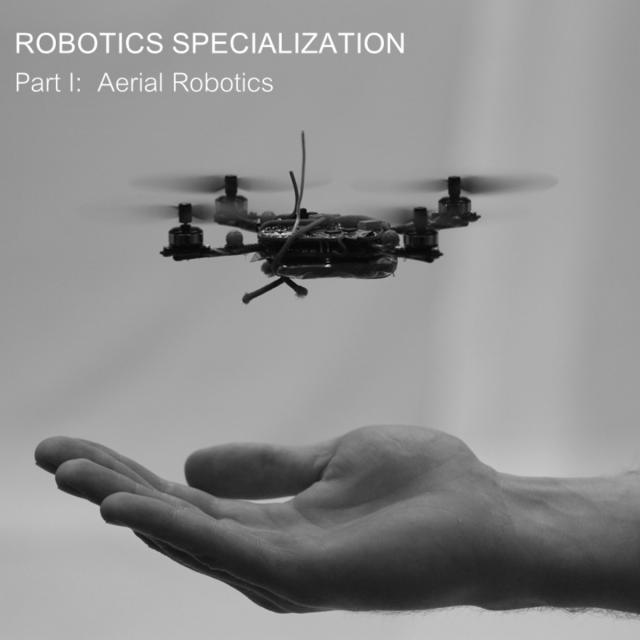
Robotics: Aerial Robotics (Coursera)

Robotics: Aerial Robotics (Coursera)

How can we create agile micro aerial vehicles that are able to operate autonomously in cluttered indoor and outdoor environments? You will gain an introduction to the mechanics of flight and the design of quadrotor flying robots and will be able to develop dynamic models, derive controllers, and synthesize planners for operating in three dimensional environments.

Class Deals by MOOC List - Click here and see Coursera's Active Discounts, Deals, and Promo Codes.

You will be exposed to the challenges of using noisy sensors for localization and maneuvering in complex, three-dimensional environments. Finally, you will gain insights through seeing real world examples of the possible applications and challenges for the rapidly-growing drone industry.
Mathematical prerequisites: Students taking this course are expected to have some familiarity with linear algebra, single variable calculus, and differential equations.
Programming prerequisites: Some experience programming with MATLAB or Octave is recommended (we will use MATLAB in this course.) MATLAB will require the use of a 64-bit computer.

Course 1 of 6 in the Robotics Specialization.

Syllabus

WEEK 1
Introduction to Aerial Robotics
Welcome to Week 1! In this week, you will be introduced to the exciting field of Unmanned Aerial Robotics (UAVs) and quadrotors in particular. You will learn about their basic mechanics and control strategies and realize how careful component selection and design affect the vehicles' performance. This week also provides you with instructions on how to download and install Matlab. This software will be used throughout this course in exercises and assignments, so it is strongly recommended to familiarize yourself with Matlab soon. Tutorials to help you get started are also provided in this week.

WEEK 2
Geometry and Mechanics
Welcome to Week 2 of the Robotics: Aerial Robotics course! We hope you are having a good time and learning a lot already! In this week, we will first focus on the kinematics of quadrotors. Then, you will learn how to derive the dynamic equations of motion for quadrotors. To build a better understanding on these notions, some essential mathematical tools are discussed in supplementary material lectures. In this week, you will also complete your first programming assignment on 1-D quadrotor control. If you have not done so already, please download, install, and learn about Matlab before starting the assignment.

WEEK 3
Planning and Control
Welcome to Week 3! We have developed planar and three-dimensional dynamic models of the quadrotor. This week, you will learn more about how to develop linear controllers for these models. With this knowledge, you will be required to complete the second programming assignment of this course, which focuses on controlling the quadrotor in two dimensions. We encourage you to start working on the assignment soon. This week ends with a discussion on motion planning for quadrotors.

WEEK 4
Advanced Topics
Welcome to Week 4! So far, we have gone over the basics of developing linear controllers for quadrotors and motion planning. In this last week of the course, we will discuss some more advanced material on how to enable quadrotors to perform more agile maneuvers and to operate autonomously in teams. Note that the last programming assignment on quadrotor control in three dimensions uses material from the previous weeks. It is strongly recommended to start the assignment as soon as possible.


Go to Class
MOOC List is learner-supported. When you buy through links on our site, we may earn an affiliate commission.

Related Courses

Numerical Methods for Engineers (Coursera) Coursera
The Hong Kong University of Science and Technology - HKUST

Numerical Methods for Engineers (Coursera)

Numerical Methods for Engineers covers the most important numerical methods that an engineer should know. We derive basic algorithms in root finding, matrix algebra, integration and interpolation, ordinary and partial differential equations. We learn how to use MATLAB to solve numerical problems. Access to MATLAB online and the MATLAB grader is given to all students who enroll. We assume students are already familiar with the basics of matrix algebra, differential equations, and vector calculus. Students should have already studied a programming language, and be willing to learn MATLAB.

Jun 29th 2026
5-12 Weeks
Robotic Path Planning and Task Execution (Coursera) Coursera
University of Colorado Boulder

Robotic Path Planning and Task Execution (Coursera)

This course, which is the last and final course in the Introduction to Robotics with Webots specialization, will teach you basic approaches for planning robot trajectories and sequence their task execution. In "Robotic Path Planning and Task Execution", you will develop standard algorithms such as Breadth-First Search, Dijkstra's, A* and Rapidly Exploring Random Trees through guided exercises. You will implement Behavior Trees for task sequencing and experiment with a mobile manipulation robot "Tiago Steel".

Jun 29th 2026
5-12 Weeks
Data Science Companion (Coursera) Coursera
MathWorks

Data Science Companion (Coursera)

The Data Science Companion provides an introduction to data science. You will gain a quick background in data science and core machine learning concepts, such as regression and classification. You’ll be introduced to the practical knowledge of data processing and visualization using low-code solutions, as well as an overview of the ways to integrate multiple tools effectively to solve data science problems.

Jul 3rd 2026
4 Weeks
Introdução ao Controle Moderno (Coursera) Coursera
Instituto Tecnológico de Aeronáutica

Introdução ao Controle Moderno (Coursera)

Este curso lhe dará a base necessária para entender técnicas mais avançadas de controle moderno. Você aprenderá como representar a dinâmica de um sistema no espaço de estados, como analisar um sistema no espaço de estados, como projetar uma realimentação de estado e como projetar um observador de estado.

Jun 29th 2026
5-12 Weeks
Ethical Issues in Computing Applications (Coursera) Coursera
University of Colorado Boulder

Ethical Issues in Computing Applications (Coursera)

Computing systems and technologies fundamentally impact the lives of most people in the world, including how we communicate, get information, socialize, and receive healthcare. This course is the third of a three course sequence that examines ethical issues in the design and implementation of computing systems and technologies, and reflects upon the broad implication of computing on our society. It covers medical applications, uses of robotics, autonomous vehicles, and the future of work.

Jun 29th 2026
5-12 Weeks
Robotic Mapping and Trajectory Generation (Coursera) Coursera
University of Colorado Boulder

Robotic Mapping and Trajectory Generation (Coursera)

In this second course of the Introduction to Robotics specialization, "Robotic Mapping and Trajectory Generation", you will learn how to perform basic inverse kinematics of (non-)holonomic systems using a feedback control approach. You will also learn how to process multi-dimensional sensor signals such as laser range scanners for mapping. Additionally, you will apply the overarching focus of mechanisms and sensors as sources of uncertainty and gain techniques to how to model and control them.

Jun 29th 2026
5-12 Weeks
Basic Robotic Behaviors and Odometry (Coursera) Coursera
University of Colorado Boulder

Basic Robotic Behaviors and Odometry (Coursera)

"Basic Robotic Behaviors and Odometry" provides you with an introduction to autonomous mobile robots, including forward kinematics (“odometry”), basic sensors and actuators, and simple reactive behavior. This course is centered around exercises in the realistic, physics-based simulator, “Webots”, where you will experiment in a hands-on manner with simple reactive behaviors for collision avoidance and line following, state machines, and basic forward kinematics of non-holonomic systems.

Jun 29th 2026
5-12 Weeks
Mastering Programming with MATLAB (Coursera) Coursera
Vanderbilt University

Mastering Programming with MATLAB (Coursera)

The course builds on the foundation laid by the first course of the Specialization called “Introduction to Programming with MATLAB.” It covers more advanced programming concepts such as recursion, vectorization, function handles, algorithm efficiency and others. At the same time, it presents many features that make MATLAB a powerful programming environment for engineering and scientific computing, such as its support for object oriented programming, the new user interface design environment and Live Scripts.

Jun 22nd 2026
5-12 Weeks
Data Science Project: MATLAB for the Real World (Coursera) Coursera
MathWorks

Data Science Project: MATLAB for the Real World (Coursera)

Like most subjects, practice makes perfect in Data Science. In the capstone project, you will apply the skills learned across courses in the Practical Data Science with MATLAB specialization to explore, process, analyze, and model data. You will choose your own pathway to answer key questions with the provided data. To complete the project, you must have mastery of the skills covered in other courses in the specialization. The project will test your ability to import and explore your data, prepare the data for analysis, train a predictive model, evaluate and improve your model, and communicate your results.

Jun 29th 2026
4 Weeks