Deep Learning for Object Detection (Coursera)

Offered by MathWorks,
Deep Learning for Object Detection (Coursera)

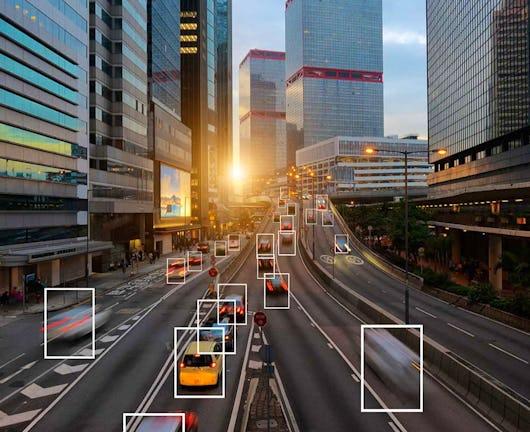
Detecting and locating objects is one of the most common uses of deep learning for computer vision. Applications include helping autonomous systems navigate complex environments, locating medical conditions like tumors, and identifying ready-to-harvest crops in agriculture.

Class Deals by MOOC List - Click here and see Coursera's Active Discounts, Deals, and Promo Codes.

In the course projects, you will apply detection models to real-world scenarios and train a model to detect various parking signs. Completing this course will give you the skills to train detection models for your application.
By the end of this course, you will be able to:
• Explain how deep learning networks locate and classify objects in images
• Retrain popular YOLO deep learning models for your application
• Use a variety of metrics to evaluate prediction results
• Visualize results to gain insights into model performance
• Improve model performance by adjusting important model parameters
• Analyze labeled images to identify and fix potential shortcomings in your data
For the duration of the course, you will have free access to MATLAB, software used by top employers worldwide. The courses draw on the applications using MATLAB, so you spend less time coding and more time applying deep learning concepts.
This course is part of the Deep Learning for Computer Vision Specialization.

What you'll learn

  • Retrain popular YOLO deep learning models for your applications
  • Visualize results to gain insights into model performance
  • Evaluate detection models by examining both class and location accuracy.
  • Analyze labeled images to identify and fix potential data shortcomings

Syllabus

Detecting Objects with Pre-trained Models
Get started with object detection by using pre-trained models

Training Object Detection Models
Use transfer learning to retrain YOLO models for new applications

Evaluating Object Detection Models
Use metrics like recall, precision, and mean average precision to evaluate your models

Final Project: Train and Evaluate a Detection Model
Apply the full object detection workflow on a final project

Go to Class
MOOC List is learner-supported. When you buy through links on our site, we may earn an affiliate commission.

Related Courses

Mastering Programming with MATLAB (Coursera) Coursera
Vanderbilt University

Mastering Programming with MATLAB (Coursera)

The course builds on the foundation laid by the first course of the Specialization called “Introduction to Programming with MATLAB.” It covers more advanced programming concepts such as recursion, vectorization, function handles, algorithm efficiency and others. At the same time, it presents many features that make MATLAB a powerful programming environment for engineering and scientific computing, such as its support for object oriented programming, the new user interface design environment and Live Scripts.

Jun 8th 2026
5-12 Weeks
Advanced Computer Vision with TensorFlow (Coursera) Coursera
DeepLearning.AI

Advanced Computer Vision with TensorFlow (Coursera)

In this course, you will: a) Explore image classification, image segmentation, object localization, and object detection. Apply transfer learning to object localization and detection; b) Apply object detection models such as regional-CNN and ResNet-50, customize existing models, and build your own models to detect, localize, and label your own rubber duck images; c) Implement image segmentation using variations of the fully convolutional network (FCN) including U-Net and d) Mask-RCNN to identify and detect numbers, pets, zombies, and more; d) Identify which parts of an image are being used by your model to make its predictions using class activation maps and saliency maps and apply these ML interpretation methods to inspect and improve the design of a famous network, AlexNet.

Jun 8th 2026
4 Weeks
Machine Learning Foundations for Product Managers (Coursera) Coursera
Duke University

Machine Learning Foundations for Product Managers (Coursera)

In this first course of the AI Product Management Specialization offered by Duke University's Pratt School of Engineering, you will build a foundational understanding of what machine learning is, how it works and when and why it is applied. To successfully manage an AI team or product and work collaboratively with data scientists, software engineers, and customers you need to understand the basics of machine learning technology.

Jun 8th 2026
5-12 Weeks
Deep learning in Electronic Health Records - CDSS 2 (Coursera) Coursera
University of Glasgow

Deep learning in Electronic Health Records - CDSS 2 (Coursera)

Overview of the main principles of Deep Learning along with common architectures. Formulate the problem for time-series classification and apply it to vital signals such as ECG. Applying this methods in Electronic Health Records is challenging due to the missing values and the heterogeneity in EHR, which include both continuous, ordinal and categorical variables. Subsequently, explore imputation techniques and different encoding strategies to address these issues. Apply these approaches to formulate clinical prediction benchmarks derived from information available in MIMIC-III database.

Jun 8th 2026
4 Weeks
AI Strategy and Governance (Coursera) Coursera
University of Pennsylvania

AI Strategy and Governance (Coursera)

In this course, you will discover AI and the strategies that are used in transforming business in order to gain a competitive advantage. You will explore the multitude of uses for AI in an enterprise setting and the tools that are available to lower the barriers to AI use. You will get a closer look at the purpose, function, and use-cases for explainable AI. This course will also provide you with the tools to build responsible AI governance algorithms as faculty dive into the large datasets that you can expect to see in an enterprise setting and how that affects the business on a greater scale.

Jun 8th 2026
4 Weeks
Introduction to Artificial Intelligence (AI) (Coursera) Coursera
IBM

Introduction to Artificial Intelligence (AI) (Coursera)

In this course you will learn what Artificial Intelligence (AI) is, explore use cases and applications of AI, understand AI concepts and terms like machine learning, deep learning and neural networks. You will be exposed to various issues and concerns surrounding AI such as ethics and bias, & jobs, and get advice from experts about learning and starting a career in AI. You will also demonstrate AI in action with a mini project.

Jun 8th 2026
4 Weeks
Modern Robotics, Course 6: Capstone Project, Mobile Manipulation (Coursera) Coursera
Northwestern University

Modern Robotics, Course 6: Capstone Project, Mobile Manipulation (Coursera)

The capstone project of the Modern Robotics specialization is on mobile manipulation: simultaneously controlling the motion of a wheeled mobile base and its robot arm to achieve a manipulation task. This project integrates several topics from the specialization, including trajectory planning, odometry for mobile robots, and feedback control. Beginning from the Modern Robotics software library provided to you (written in Python, Mathematica, and MATLAB), and software you have written for previous courses, you will develop software to plan and control the motion of a mobile manipulator to perform a pick and place task.

Jun 8th 2026
4 Weeks
Cloud Computing Applications, Part 2: Big Data and Applications in the Cloud (Coursera) Coursera
University of Illinois at Urbana-Champaign

Cloud Computing Applications, Part 2: Big Data and Applications in the Cloud (Coursera)

Welcome to the Cloud Computing Applications course, the second part of a two-course series designed to give you a comprehensive view on the world of Cloud Computing and Big Data! In this second course we continue Cloud Computing Applications by exploring how the Cloud opens up data analytics of huge volumes of data that are static or streamed at high velocity and represent an enormous variety of information. Cloud applications and data analytics represent a disruptive change in the ways that society is informed by, and uses information.

Jun 8th 2026
4 Weeks
Probabilistic Graphical Models 1: Representation (Coursera) Coursera
Stanford University

Probabilistic Graphical Models 1: Representation (Coursera)

Probabilistic graphical models (PGMs) are a rich framework for encoding probability distributions over complex domains: joint (multivariate) distributions over large numbers of random variables that interact with each other. These representations sit at the intersection of statistics and computer science, relying on concepts from probability theory, graph algorithms, machine learning, and more. They are the basis for the state-of-the-art methods in a wide variety of applications, such as medical diagnosis, image understanding, speech recognition, natural language processing, and many, many more. They are also a foundational tool in formulating many machine learning problems.

Jun 8th 2026
5-12 Weeks