Modern Robotics, Course 5: Robot Manipulation and Wheeled Mobile Robots (Coursera)

Modern Robotics, Course 5: Robot Manipulation and Wheeled Mobile Robots (Coursera)

Do you want to know how robots work? Are you interested in robotics as a career? Are you willing to invest the effort to learn fundamental mathematical modeling techniques that are used in all subfields of robotics? If so, then the "Modern Robotics: Mechanics, Planning, and Control" specialization may be for you. This specialization, consisting of six short courses, is serious preparation for serious students who hope to work in the field of robotics or to undertake advanced study. It is not a sampler.

Class Deals by MOOC List - Click here and see Coursera's Active Discounts, Deals, and Promo Codes.

In Course 5 of the specialization, Robot Motion Planning and Wheeled Mobile Robots, we delve into advanced topics in robotics. Chapter 12, Grasping and Manipulation, of the "Modern Robotics" textbook covers the modeling of kinematics and forces between rigid bodies in contact, and applies the modeling to analysis and planning of robot grasping and other manipulation tasks. Chapter 13, Wheeled Mobile Robots, covers modeling, motion planning, and feedback control of omnidirectional and nonholonomic wheeled mobile robots, and concludes by addressing control of mobile manipulators consisting of a wheeled mobile base and a robot arm.

Course 5 of 6 in the Modern Robotics: Mechanics, Planning, and Control Specialization.

Syllabus

WEEK 1
Chapter 12: Grasping and Manipulation (Part 1 of 2)
Kinematics of contact, contact types (rolling, sliding, and breaking), graphical methods for representing kinematic constraints in the plane, and form-closure grasping (complete kinematic constraint).

WEEK 2
Chapter 12: Grasping and Manipulation (Part 2 of 2)
Coulomb friction, friction cones, graphical methods for representing forces and torques in the plane, force closure grasping, and examples of manipulation other than grasping.

WEEK 3
Chapter 13: Wheeled Mobile Robots (Part 1 of 2)
Kinematic models of omnidirectional and nonholonomic wheeled mobile robots.

WEEK 4
Chapter 13: Wheeled Mobile Robots (Part 2 of 2)
Controllability, motion planning, and feedback control of nonholonomic wheeled mobile robots; odometry for wheeled mobile robots; and mobile manipulation.


Go to Class
MOOC List is learner-supported. When you buy through links on our site, we may earn an affiliate commission.

Related Courses

Robotic Path Planning and Task Execution (Coursera) Coursera
University of Colorado Boulder

Robotic Path Planning and Task Execution (Coursera)

This course, which is the last and final course in the Introduction to Robotics with Webots specialization, will teach you basic approaches for planning robot trajectories and sequence their task execution. In "Robotic Path Planning and Task Execution", you will develop standard algorithms such as Breadth-First Search, Dijkstra's, A* and Rapidly Exploring Random Trees through guided exercises. You will implement Behavior Trees for task sequencing and experiment with a mobile manipulation robot "Tiago Steel".

Jun 1st 2026
5-12 Weeks
Robotics: Computational Motion Planning (Coursera) Coursera
University of Pennsylvania

Robotics: Computational Motion Planning (Coursera)

Robotic systems typically include three components: a mechanism which is capable of exerting forces and torques on the environment, a perception system for sensing the world and a decision and control system which modulates the robot's behavior to achieve the desired ends. In this course we will consider the problem of how a robot decides what to do to achieve its goals.

Jan 6th 2025
4 Weeks
Intro to Artificial Intelligence (Udacity) Udacity
Udacity

Intro to Artificial Intelligence (Udacity)

This course will introduce you to the basics of AI. Topics include machine learning, probabilistic reasoning, robotics, computer vision, and natural language processing. Artificial Intelligence (AI) is a field that has a long history but is still constantly and actively growing and changing. In this course, you’ll learn the basics of modern AI as well as some of the representative applications of AI.

Self Paced
Self-Paced
Robotics With Raspberry Pi: Build and Program Your First Robot Buggy (FutureLearn) FutureLearn
Raspberry Pi Foundation,National Centre for Computing Education

Robotics With Raspberry Pi: Build and Program Your First Robot Buggy (FutureLearn)

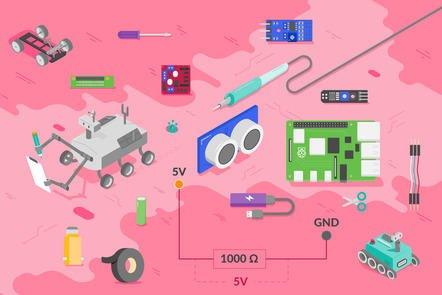
Build and program your first robot buggy using a Raspberry Pi, learning how to connect motors, add sensors and write algorithms. Learn robotics by building a robot buggy and controlling it with a Raspberry Pi. On this course from the Raspberry Pi Foundation, you’ll build a robot buggy controlled by a Raspberry Pi.

Jan 2nd 2023
3 Weeks
Begin Robotics (FutureLearn) FutureLearn
University of Reading

Begin Robotics (FutureLearn)

Learn robotics by exploring the history, anatomy and intelligence of robots and test drive robots using exciting simulations Explore our introduction to robotics. Robots today are roving Mars, hoovering our floors, building cars and entertaining us in films. You may even share Stephen Hawking’s world view that super-intelligent ones may one day bring about the end of the human race.

Jan 16th 2023
4 Weeks
Robot Mechanics and Control, Part I (edX) EdX
Seoul National University,SNUx

Robot Mechanics and Control, Part I (edX)

A mathematical introduction to the mechanics and control of robots. This course provides a mathematical introduction to the mechanics and control of robots that can be modeled as kinematic chains. Topics covered include the concept of a robot’s configuration space and degrees of freedom, static grasp analysis, the description of rigid body motions, kinematics of open and closed chains, and the basics of robot control.

No sessions available
4 Weeks
Artificial Intelligence (saylor.org) Saylor Academy
Saylor.org

Artificial Intelligence (saylor.org)

This course introduces the field of artificial intelligence (AI). Materials on AI programming, logic, search, game playing, machine learning, natural language understanding, and robotics introduce the student to AI methods, tools, and techniques, their application to computational problems, and their contribution to understanding intelligence.

Self Paced
Self-Paced
Artificial Intelligence for Robotics (Udacity) Udacity
Udacity

Artificial Intelligence for Robotics (Udacity)

Learn how to program all the major systems of a robotic car. Topics include planning, search, localization, tracking, and control. Learn how to program all the major systems of a robotic car from the leader of Google and Stanford's autonomous driving teams. This class will teach you basic methods in Artificial Intelligence, including: probabilistic inference, planning and search, localization, tracking and control, all with a focus on robotics. Extensive programming examples and assignments will apply these methods in the context of building self-driving cars.

Self Paced
Self-Paced
Building Arduino robots and devices (Coursera) Coursera
Moscow Institute of Physics and Technology

Building Arduino robots and devices (Coursera)

For many years now, people have been improving their tools, studying the forces of nature and bringing them under control, using the energy of the nature to operate their machines. Last century is noted for the creation of machines which can operate other machines. Nowadays the creation of devices that interact with the physical world is available to anyone. Our course consists of a series of practical problems on making things that work independently: they make their own decisions, act, move, communicate with each other and people around, and control other devices. We will demonstrate how to assemble such devices and programme them using the Arduino platform as a basis.

May 9th 2022
5-12 Weeks
Ethical Issues in Computing Applications (Coursera) Coursera
University of Colorado Boulder

Ethical Issues in Computing Applications (Coursera)

Computing systems and technologies fundamentally impact the lives of most people in the world, including how we communicate, get information, socialize, and receive healthcare. This course is the third of a three course sequence that examines ethical issues in the design and implementation of computing systems and technologies, and reflects upon the broad implication of computing on our society. It covers medical applications, uses of robotics, autonomous vehicles, and the future of work.

Jun 1st 2026
5-12 Weeks