Art of Ancient Greece and Rome (saylor.org)

Offered by Saylor.org,
Art of Ancient Greece and Rome (saylor.org)

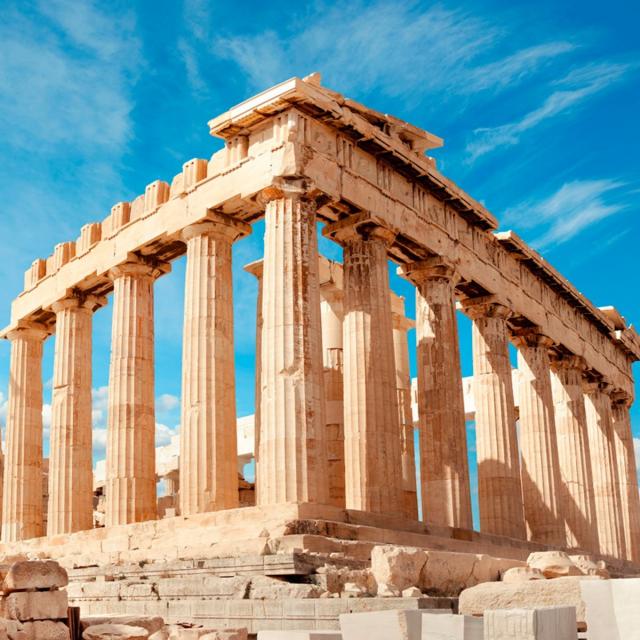
In this course, we will study the art of Classical Antiquity. The different units of the course reflect the main chronological stages in art development in Ancient Greece and Rome, from the coming together of the Greek city-state and the emergence of “geometric art” (around 900 B.C.) to the fourth century A.D. shift that took place within Roman culture and art due to the growing influence of Christianity.

We will begin by underlining the unity of our subject matter: Rome not only conquered Greece, but it assimilated Greece’s cultural and artistic accomplishments. In fact, much of what we know of Greek art today we learned through Roman copies.
We will also explore the development of Greek architecture, sculpture, and painting up to the Hellenistic period, when Greek art began to influence new parts of the globe through the conquests of Alexander the Great. We will also study the ways in which naturalism and idealism came together as Greek art developed over time. Next, we will turn our attention to Roman art, studying its development from the time of the Roman Republic, a period that overlaps with Greece’s Classical and Hellenistic periods, to the waning of the Western Roman Empire. You will learn that while Roman art was, to a large extent, inspired by Greek art, it also developed its own distinctive characteristics. The artistic traditions of Ancient Greece and Rome ultimately served as the foundation for the art of the Western world; these traditions continue to reverberate to the present day.
Upon successful completion of this course, the student will be able to:

  • Explain why ancient Greek and Roman art can be studied together as “the art of Classical Antiquity.”
  • Trace the timeline of major events in Ancient Greece and Rome.
  • Link important developments in the history of Ancient Greece and Rome to specific geographical contexts.
  • Explain how important historical developments and social-historical contexts had an impact on art’s evolution in Ancient Greece and Rome.
  • Identify the important stylistic and technical developments of Ancient Greek and Roman art.
  • Discuss important artworks, presenting relevant information on each work’s historical context and constitution.
  • Discuss important artists in terms of the style of their work.

Course Requirements: Have completed Art Appreciation and Techniques, Introduction to Western Art History: Pre-Historic to High Gothic, and Introduction to Western Art History: Proto-Renaissance to Contemporary Art.
Go to Class
MOOC List is learner-supported. When you buy through links on our site, we may earn an affiliate commission.

Related Courses

Fashion as Design (Coursera) Coursera
The Museum of Modern Art

Fashion as Design (Coursera)

Among all objects of design, our clothes are the most universal and intimate. Like other kinds of design, fashion thrives on productive tensions between form and function, automation and craftsmanship, standardization and customization, universality and self-expression, and pragmatism and utopian vision. It exists in the service of others, and it can have profound consequences—social, political, cultural, economic, and environmental.

Jun 29th 2026
5-12 Weeks
History of Roman Law (edX) EdX
University of Naples Federico II,FedericaX

History of Roman Law (edX)

Explore Roman Law, its History, its Juridical Scienceand Codes, and see how relevant it could be for international legal culture today! “ Globalisation is paving the way for the increasingly international legal transactions and disputes. As a result, solicitors [and lawyers] are required to work across numerous jurisdictions. Knowledge not only of languages but also of some of the relevant legal concepts of these jurisdictions is beneficial. Due to the fact that the French, German, Italian and a vast number of other legal systems have kept alive many of the Roman legal rules and principles , studying Roman law gives students a solid grounding in the fundamental principles of these jurisdictions.…

Self Paced
Self-Paced
ART of the MOOC: Activismo y Movimientos Sociales (Coursera) Coursera
Duke University,Creative Time

ART of the MOOC: Activismo y Movimientos Sociales (Coursera)

Este curso es para activistas, artistas y pensadores que deseen entender mejor el cambio social y participar en él. El contenido del curso enfoca en la coincidencia prolífica y emocionante entre el arte socialmente comprometido y prácticas culturales generadas por recientes movimientos sociales en todo el mundo. Más que evaluar la eficacia política de actividades como el luto, la escucha, la organización, el baile, o la fiesta, las conferencias examinan tales actividades culturales al lado y dentro de la práctica artística contemporánea.

Sep 14th 2026
5-12 Weeks
Rome: a Virtual Tour of the Ancient City (FutureLearn) FutureLearn
University of Reading

Rome: a Virtual Tour of the Ancient City (FutureLearn)

Explore the architecture and history of Rome, walking around a 3D digital model of the ancient city, with this free online course. Explore ancient Rome through a unique, historically accurate 3D model. Take a guided tour around ancient Rome with expert Professor Matthew Nicholls, using his detailed and award-winning 3D digital model of the city.

Self Paced
5-12 Weeks
Health and Wellbeing in the Ancient World (FutureLearn) FutureLearn
The Open University

Health and Wellbeing in the Ancient World (FutureLearn)

Use literary and archaeological evidence to see how ancient Greeks and Romans approached health, well-being and societal issues. What did being healthy in ancient Rome or Greece look like? How can we tell what well-being meant in ancient times? This online course will help you investigate these questions, using both literary and archaeological evidence, to uncover details of real life in ancient societies.

Self Paced
5-12 Weeks
Ancient Philosophy: Aristotle and His Successors (Coursera) Coursera
University of Pennsylvania

Ancient Philosophy: Aristotle and His Successors (Coursera)

What is philosophy? How does it differ from science, religion, and other modes of human discourse? This course traces the origins of philosophy in the Western tradition in the thinkers of Ancient Greece. We begin with the Presocratic natural philosophers who were active in Ionia in the 6th century BCE and are also credited with being the first scientists. Thales, Anaximander, and Anaximines made bold proposals about the ultimate constituents of reality, while Heraclitus insisted that there is an underlying order to the changing world.

Sep 21st 2026
5-12 Weeks
Age of Cathedrals (Coursera) Coursera
Yale University

Age of Cathedrals (Coursera)

An introduction to some of the most astonishing architectural monuments the world has ever known—Gothic cathedrals. We shall study the art, literature, intellectual life, economics, and new social arrangements that arose in the shadow of the cathedrals and that were such an important part of the revival of cities in the twelfth and thirteenth centuries. The goal of the course is a better appreciation of the High Middle Ages, a world that is still recognizably our own.

Aug 31st 2026
5-12 Weeks
ART of the MOOC: Activism and Social Movements (Coursera) Coursera
Duke University,Creative Time

ART of the MOOC: Activism and Social Movements (Coursera)

This course is for activists, artists, and thinkers who wish to better understand and participate in social change. We will focus on the prolific and exciting overlap between socially engaged art and cultural practices generated by recent social movements around the world. Rather than assess the political efficacy of activities like mourning, listening, organizing, dancing, or partying, the lectures examine such cultural activities next to, and within, contemporary art practice.

Sep 14th 2026
5-12 Weeks