Agroforestry IV: Climate, Carbon Storage and Agroforestry (Coursera)

Offered by University of Florida,
Agroforestry IV: Climate, Carbon Storage and Agroforestry (Coursera)

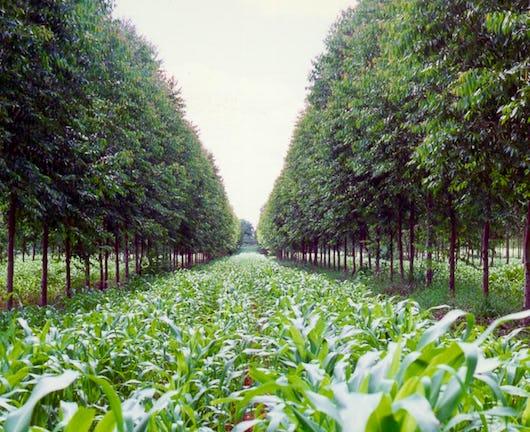
Welcome to Agroforestry IV: Climate Change, Carbon Storage and Agroforestry Systems, a detailed review of fundamental principles and best practices for successful agroforestry projects. This interdisciplinary module, presented by leading experts in the field, is the fourth in the five-module course covering the various aspects of agroforestry including the global distribution of the practices, their underlying principles, and major scientific advances during the past nearly five decades.

Class Deals by MOOC List - Click here and see Coursera's Active Discounts, Deals, and Promo Codes.

Students will gain extensive knowledge and skills related to agroforestry systems, best practices and scientific management that can be useful in promoting their professional development and sharpening their land management skills.
This course is part of the Agroforestry Specialization.

Syllabus

Course Introduction
Welcome to Agroforestry IV: Climate Change, Carbon Storage and Agroforestry Systems, a detailed review of fundamental principles and best practices for successful agroforestry projects. This interdisciplinary module, presented by leading experts in the field, is the fourth in the five-module course covering the various aspects of agroforestry including the global distribution of the practices, their underlying principles, and major scientific advances during the past nearly five decades. Students will gain extensive knowledge and skills related to agroforestry systems, best practices and scientific management that can be useful in promoting their professional development and sharpening their land management skills.

Go to Class
MOOC List is learner-supported. When you buy through links on our site, we may earn an affiliate commission.

Related Courses

Public Health Perspectives on Sustainable Diets (Coursera) Coursera
Johns Hopkins University

Public Health Perspectives on Sustainable Diets (Coursera)

What we eat and how we produce that food have significant effects on human health and the sustainability of our planet. But what is a ‘sustainable’ diet? A sustainable diet, as defined by the FAO, promotes health and well-being and provides food security for the present population while sustaining human and natural resources for future generations. This short course looks at the urgent need to address the sustainability of our food systems, including better understanding the complex relationship between diet and climate change. We’ll explore current research on dietary shifts needed in high, middle, and low-income countries to achieve both sustainability and food security goals and discuss evidence-based strategies to promote sustainable diets.

Jun 15th 2026
3 Weeks
Engineering Life: Synbio, Bioethics & Public Policy (Coursera) Coursera
Johns Hopkins University

Engineering Life: Synbio, Bioethics & Public Policy (Coursera)

Synbio is a diverse field with diverse applications, and the different contexts (e.g., gain-of-function research, biofuels) raise different ethical and governance challenges. The objective of this course is to increase learners’ awareness and understanding of ethical and policy/governance issues that arise in the design, conduct and application of synthetic biology. The course will begin with a short history of recombinant DNA technology and how governance of that science developed and evolved, and progress through a series of areas of application of synbio.

Jun 15th 2026
5-12 Weeks
Climate and Climate Change in New Jersey (Coursera) Coursera
American Museum of Natural History

Climate and Climate Change in New Jersey (Coursera)

Welcome to the American Museum of Natural History's (AMNH) primer called Climate and Climate Change in New Jersey! This primer includes numerous elements that will provide you with an understanding of our climate system and climate change in New Jersey, and encourage you to think about viable solutions for climate change impacts. It is divided into four parts, which may be completed sequentially as it was designed or in your sequence. We estimate that it will take approximately 2.5 hours to complete. We are also happy to inform you that you can receive 2.5 professional development hours and a Certificate of Attendance upon successful completion of this course.

Jun 15th 2026
4 Weeks
Nanotechnology and Nanosensors, Part 1 (Coursera) Coursera
Technion - Israel Institute of Technology

Nanotechnology and Nanosensors, Part 1 (Coursera)

Nanotechnology and nanosensors are broad, interdisciplinary areas that encompass (bio)chemistry, physics, biology, materials science, electrical engineering and more. The present course will provide a survey on some of the fundamental principles behind nanotechnology and nanomaterials and their vital role in novel sensing properties and applications. The course will discuss interesting interdisciplinary scientific and engineering knowledge at the nanoscale to understand fundamental physical differences at the nanosensors.

Jun 15th 2026
5-12 Weeks
Act on Climate: Steps to Individual, Community, and Political Action (Coursera) Coursera
University of Michigan

Act on Climate: Steps to Individual, Community, and Political Action (Coursera)

Are you concerned about climate change? Would you like to learn how to address and respond to this challenge? If so, this course is for you. Act on Climate: Steps to Individual, Community, and Political Action is intended to help learners understand, address and respond to climate change as individuals and in partnership with their communities and political leaders.

Jun 15th 2026
5-12 Weeks
Climate Aware Investing (Coursera) Coursera
EDHEC Business School

Climate Aware Investing (Coursera)

Finance may have a central role to play against climate change on the condition that risks are properly measured and managed. In this course you will be introduced to the latest academic research findings and the most commonly used methods in industry to cope with climate change financial risks. How do we assess these kinds of risks? Can our portfolios perform well and at the same time contribute to the transition towards a low-carbon economy? How do climate change risks affect financial markets?

Jun 15th 2026
5-12 Weeks
Advanced Neurobiology I (Coursera) Coursera
Peking University

Advanced Neurobiology I (Coursera)

Hello everyone! Welcome to advanced neurobiology! Neuroscience is a wonderful branch of science on how our brain perceives the external world, how our brain thinks, how our brain responds to the outside of the world, and how during disease or aging the neuronal connections deteriorate. We’re trying to understand the molecular, cellular nature and the circuitry arrangement of how nervous system works.

Jun 15th 2026
5-12 Weeks
Urban Climate Governance Towards 1.5 Degrees (Coursera) Coursera
Lund University

Urban Climate Governance Towards 1.5 Degrees (Coursera)

Welcome to this course where you will explore how cities can and are addressing the climate crisis. In this course we will explore the science behind the 1.5°C goal, as well as useful local governance and technical tools to help cities align to it. This course will highlight the importance of renewable energy together with energy efficiency considerations. We will also look at the importance of cities’ physical layout and its relationship to energy systems, in particular, the role of integrated urban planning and transport planning to support more sustainable energy solutions.

Jun 15th 2026
4 Weeks
How Do We Manage Climate Change? (Coursera) Coursera
University of Colorado Boulder

How Do We Manage Climate Change? (Coursera)

In this course, learners will identify the types of actions that we can pursue to address climate change. These actions fall into two broad categories: 1) mitigation, which refers to efforts to reduce greenhouse gas emissions or enhance carbon sinks, and 2) adaptation, which refers to our preparations for climate impacts. We will explore the technologies, programs, and policies related to both mitigation and adaptation. Learners should leave the course with an improved ability to identify and evaluate climate actions undertaken by communities, governments, and businesses.

Jun 15th 2026
3 Weeks
Planning with Climate Change in Mind (Coursera) Coursera
University of Colorado Boulder

Planning with Climate Change in Mind (Coursera)

This course focuses on the climate impacts occurring and expected to occur across the United States. Our approach will be regional and sectoral, with consideration of impacts on water resources, transportation, energy, agriculture, forests, health, and coastal/marine resources. We will also look at how you can apply information about climate risks to motivate climate action in your household, in your community, or in your workplace.

Jun 15th 2026
3 Weeks
Climate Change and Water in Mountains: A Global Concern (Coursera) Coursera
University of Geneva

Climate Change and Water in Mountains: A Global Concern (Coursera)

What is climate change? How are mountain regions affected by the evolution of water resources and their uses? What kind of risks need to be considered? Mountains are recognized as particularly sensitive physical environments where intense and rapid changes have in the past, and may increasingly in the future, place pressure on their resource base.

Jun 15th 2026
5-12 Weeks
Greening the Economy: Lessons from Scandinavia (Coursera) Coursera
Lund University

Greening the Economy: Lessons from Scandinavia (Coursera)

How can we live a good life on one planet with over seven billion people? This course will explore greening the economy on four levels – individual, business, city, and nation. We will look at the relationships between these levels and give many practical examples of the complexities and solutions across the levels. Scandinavia, a pioneering place advancing sustainability and combating climate change, is a unique starting point for learning about greening the economy. We will learn from many initiatives attempted in Scandinavia since the 1970s, which are all potentially helpful and useful for other countries and contexts.

Jun 15th 2026
5-12 Weeks