EdX

The Tabernacle in Word & Image: An Italian Jewish Manuscript Revealed (edX)

The Tabernacle in Word & Image: An Italian Jewish Manuscript Revealed (edX)

Alessandro Guetta (Paris) uses anItalian Hebrewcommentary on the biblical description of the ancient Israelite Tabernacle ( mishkan ), Tavnit ha-mishkan by Malkiel Ashkenazi,as a case studyinhowmanuscripts can be used by intellectual historians.

Class Deals by MOOC List - Click here and see EdX's Active Discounts, Deals, and Promo Codes.

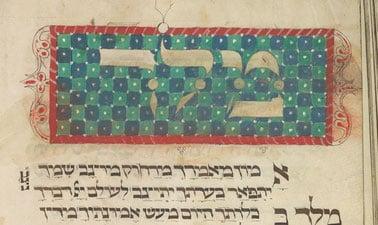
This mini-course introduces the use of early modern manuscripts for intellectual history—that is, the history of how ideas and the communication of those ideas changes over time. Professor Alessandro Guetta presents a case study constructed on a single, remarkable Hebrew manuscript from 17th-century Mantua, Malkiel Ashkenazi’s Tavnit ha-mishkan (University of Pennsylvania CAJS Rar Ms 460).
By examining this work, an extended commentary on the structure and implements of the ancient Israelite Tabernacle ( mishkan ), Professor Guetta explores how the manuscript can help us understand early modern Jewish intellectual life. Written in Renaissance Italy, he explains that the textual “reconstruction” of the Tabernacle and Temple was in part a Jewish response to the importance of buildings and architectural expression for early Modern Italians. He also considers how other manuscript copies of the same text can be studied to determine the history of the text’s transmission and development across time, thus shedding light on the historical context in which they were produced. This course comprises five short video lectures (10–12 minutes each) that explore this manuscript, its editions, and how it opens a window into Italian Jewish intellectual life only possible by attention to the physical manuscript.
No previous knowledge of Jewish history, intellectual history, or manuscript studies is required. Nevertheless, this course will be most interesting to advanced students of Jewish and Early Modern history, and those interested in censorship, Jewish life in Early Modern Italy, and biblical commentary. It also introduces a fascinating, freely browsable, Italian Jewish text in the collection of the University of Pennsylvania.

What you'll learn

  • How manuscripts help a scholar to write intellectual history.
  • The basics of a remarkable Mantuan Jewish manuscript containing a copy of Malkiel Ashkenazi’s Tavnit ha-mishkan, and its historical context.
  • Some of the most important characteristics of early modern Jewish intellectual life.
  • How to reconstruct text editions from the signs of editorial processes.

Syllabus

A lecture in five parts delivered by Alessandro Guetta.
Accompanying multiple-choice quizzes.
Plus Discussion questions and bibliography to guide future inquiry.


Go to Class
MOOC List is learner-supported. When you buy through links on our site, we may earn an affiliate commission.

Related Courses

Biblical Archaeology: The archaeology of ancient Israel and Judah (edX) EdX
IsraelX

Biblical Archaeology: The archaeology of ancient Israel and Judah (edX)

Join me as I share with you my passion for archaeological discovery and learn about the exciting methods of modern archaeology. Explore how archaeology illuminates biblical Israel and Judah, and the archaeological finds relate to the bible. Join me for an introductory course on biblical archaeology of ancient Israel and Judah during the Iron Age (ca. 1200-586 BCE).

Nov 1st 2022
5-12 Weeks
Journey of the Universe: The Unfolding of Life (Coursera) Coursera
Yale University

Journey of the Universe: The Unfolding of Life (Coursera)

Journey of the Universe weaves together the discoveries of the evolutionary sciences together with humanities such as history, philosophy, art, and religion. The course draws on the Emmy-award winning film, Journey of the Universe, and the book from Yale University Press. Journey explores cosmic evolution as a creative process based on connection, interdependence, and emergence. It examines a range of dynamic interactions in the unfolding of galaxies, Earth, life, and human communities. It investigates ways in which we understand evolutionary processes and the implications for humans and our ecological future.

Sep 14th 2026
5-12 Weeks
The Civil War and Reconstruction - 1850-1861: A House Divided (edX) EdX
Columbia University,ColumbiaX

The Civil War and Reconstruction - 1850-1861: A House Divided (edX)

Discover how the issue of slavery came to dominate American politics, and how political leaders struggled and failed to resolve the growing crisis in the nation. A House Divided: The Road to Civil War, 1850-1861 begins by examining how generations of historians have explained the crisis of the Union. After discussing the institution of slavery and its central role in the southern and national economies, it turns to an account of the political and social history of the 1850s.

Self Paced
Self-Paced
Søren Kierkegaard - Subjectivity, Irony and the Crisis of Modernity (Coursera) Coursera
University of Copenhagen

Søren Kierkegaard - Subjectivity, Irony and the Crisis of Modernity (Coursera)

In this course created by former associate professor at the Søren Kierkegaard Research Centre, Jon Stewart, we will explore how Kierkegaard deals with the problems associated with relativism, the lack of meaning and the undermining of religious faith that are typical of modern life. His penetrating analyses are still highly relevant today and have been seen as insightful for the leading figures of Existentialism, Post-Structuralism and Post-Modernism.

Sep 14th 2026
5-12 Weeks
Claves para leer imágenes (edX) EdX
Universidad Autonoma de Madrid,UAMx

Claves para leer imágenes (edX)

Vivimos en la era de la revolución icónica. Necesitamos métodos para comprender las imágenes. Los mapas, los paisajes, las obras de arte, los medios de masas, las películas de cine y las páginas de internet nos hablan, por lo que debemos conocer sus códigos para entenderlas. Conoce las claves para analizar las imágenes históricas que hemos producido los seres humanos. Tenemos dos objetivos: enseñar a utilizarlas como documentos históricos y emplearlas como recursos didácticos.

Self Paced
Self-Paced
Deciphering Secrets: Unlocking the Manuscripts of Medieval Toledo (Spain) (edX) EdX
Universidad Carlos III de Madrid - UC3M

Deciphering Secrets: Unlocking the Manuscripts of Medieval Toledo (Spain) (edX)

Explore the medieval city of Toledo (Spain) and assess its history of Jewish, Christian, and Muslim religious and cultural coexistence. This course evaluates the medieval history of Toledo from the reign of King Alfonso “The Wise” (1252-1284) until the creation of the blood purity statutes in the 1450s.

No sessions available
5-12 Weeks
PredictionX: Diviner’s Guide (edX) EdX
HarvardX,Harvard University

PredictionX: Diviner’s Guide (edX)

This course is an overview of divination systems, ranging from ancient Chinese bone burning to modern astrology. Humans have always sought to know their own future, be it the destiny of an empire or an individual's fate. Across cultures and history, we find people trying to find their place in the Universe by attempting to gaze into the future.

Self Paced
Self-Paced
Visualizing the Birth of Modern Tokyo (edX) EdX
MIT,MITx

Visualizing the Birth of Modern Tokyo (edX)

See Tokyo’s modernization through the “100 views” tradition, from the gas-lit 1870s to the jazz era 1930s. From MIT Visualizing Cultures, with the Smithsonian Institution. This course shows the emergence of modern Tokyo through artist renderings of its neighborhoods, daily life and nightlife, nested between its recurring destruction by natural disasters and war.

Self Paced
Self-Paced
Del trazo caligráfico al método paleográfico: experimentando la materialidad de los manuscritos históricos (edX) EdX
Universidad Carlos III de Madrid - UC3M,UC3Mx

Del trazo caligráfico al método paleográfico: experimentando la materialidad de los manuscritos históricos (edX)

Práctica paleográfica y caligráfica en ciclos de escritura histórica y procesos materiales de creación del manuscrito, conservación e interpretación. El tiempo y el espacio son elementos vertebradores de toda la propuesta de contenidos en torno al mundo del manuscrito histórico. En esta ocasión, la identificación de procesos, la materialidad de los testimonios y los modos de hacer (escritura caligráfica, lectura paleográfica) se suman a la familiaridad con lugares de escritura en momentos concretos del pasado.

Self Paced
Self-Paced
Changing Minds: Geographic Discoveries and New Worlds through the Eyes of a Renaissance Jewish Scholar (edX) EdX
University of Pennsylvania,PennX

Changing Minds: Geographic Discoveries and New Worlds through the Eyes of a Renaissance Jewish Scholar (edX)

This course will situate a manuscript in the context of the world from which it was produced so that we better understand both. The Italian Renaissance was a time of scientific discovery and artistic revolution, it was also a time of world exploration, religious ferment, and technological changes such as the broad dissemination of print. By understanding a single thinker, Jewish polymath Abraham ben Mordecai Farissol, and one of his most important manuscripts, Iggeret Orhot ‘Olam , in context, this course will offer a fresh.

Self Paced
Self-Paced
The Worldview of Thomas Berry: The Flourishing of the Earth Community (Coursera) Coursera
Yale University

The Worldview of Thomas Berry: The Flourishing of the Earth Community (Coursera)

Thomas Berry (1914-2009) was a historian of world religions and an early voice awakening moral sensibilities to the environmental crisis. He is known for articulating a “new story” of the universe that explores the implications of the evolutionary sciences and cultural traditions for creating a flourishing future. This course investigates Berry’s life and thought in relation to the Journey of the Universe project.

Sep 14th 2026
5-12 Weeks
Pyramids of Giza: Ancient Egyptian Art and Archaeology (edX) EdX
HarvardX,Harvard University

Pyramids of Giza: Ancient Egyptian Art and Archaeology (edX)

Explore the archaeology, history, art, and hieroglyphs surrounding the famous Egyptian Pyramids at Giza. Learn about Old Kingdom pharaohs and elites, tombs, temples, the Sphinx, and how new technology is unlocking their secrets. Where is Giza? How were the Pyramids built? How did the cemeteries and hundreds of decorated tombs around them develop? What was Giza’s contribution to this first great age of ancient Egyptian civilization, the Old Kingdom?

Self Paced
Self-Paced