EdX

Antes de Noé: El diluvio en la Antigua Babilonia (edX)

Antes de Noé: El diluvio en la Antigua Babilonia (edX)

Los documentos más antiguos sobre un diluvio universal, que casi elimina la vida de la faz de la tierra, provienen de Babilonia. En este curso, exploraremos las viejas historias del diluvio, cuyos primeros ejemplares tienen hoy unos 3700 años.

Class Deals by MOOC List - Click here and see EdX's Active Discounts, Deals, and Promo Codes.

La existencia de una versión babilónica del diluvio se hizo pública el 3 de diciembre de 1872. En esa fecha, George Smith anunció en la Sociedad de Arqueología Bíblica de Londres que había descubierto fragmentos de esa historia entre las tablillas del Museo Británico provenientes de la biblioteca del rey asirio Aššurbanipal (ca. 668-627 a.C.), hallada en las ruinas de Nínive.
Los invitamos a sumarse a este curso online para conocer las raíces escritas más remotas sobre la historia del diluvio, el contexto histórico en el que se originó y sus varias transformaciones.

What you'll learn

  • Conocer las fuentes escritas más antiguas de las que se dispone en la actualidad para conocer la historia del diluvio
  • Vamos a explicar el contexto geográfico e histórico en el que se ubican estas historias, así como el sistema de escritura y las lenguas en las que están escritas
  • Se trabajarán cuatro textos. Estos textos son: “La épica de Atra-ḫasīs”, “La tablilla del arca”, “La historia sumeria del diluvio” (provenientes de la primera mitad del segundo milenio antes de nuestra era), y la tablilla XI de “El poema de Gilgameš” (de la primera mitad del primer milenio antes de nuestra era)
  • Para cada uno de los textos presentaremos los manuscritos más representativos, proporcionaremos información sobre la distribución geográfica y temporal de esos ejemplares
  • Se presentarán, un resumen del contenido, los detalles y motivos literarios más relevantes de esas historias
  • Veremos la manera cómo la historia del diluvio se relaciona con otros textos literarios que eran aproximadamente contemporáneos y hacen referencia o reescriben sobre esa catástrofe
  • Hablaremos también de la importancia que la historia del diluvio ha tenido dentro de la tradición literaria de la Mesopotamia antigua

Syllabus

Introducción:
Este curso tiene por objetivo presentar y contextualizar las fuentes documentales más antiguas sobre la historia del diluvio que provienen de Babilonia a partir de la primera mitad del segundo milenio antes de nuestra era. Esos manuscritos, descubiertos en la segunda mitad del siglo XIX d.C., son importantes para comprender el papel de las historias sobre el diluvio en las tradiciones culturales y políticas del Cercano Oriente antiguo, así como su presencia en otros textos y tradiciones culturales.

Módulo 1:
Se explicarán las características generales de las tablillas cuneiformes sobre las que se escribieron los manuscritos y de las lenguas en las que fueron escritas las historias más tempranas sobre el diluvio. Asimismo, se hablará sobre el primer descubrimiento de la historia del diluvio antes de la Biblia y se presentarán los cuatro textos que se discutirán en los módulos siguientes, es decir, “La épica de Atra-ḫasīs”, la llamada “Tablilla del arca”, “La historia sumeria del diluvio” y, por último, la tablilla XI de “El poema de Gilgameš”.

Módulo 2:
Se trabajará el texto conocido como “La épica de Atra-ḫasīs”, partiendo de la distribución espacio-temporal de los manuscritos y el significado del título moderno y del antiguo que se usan para denominar a esta obra. Se explicará el contenido del texto y se darán detalles de los episodios más destacados.

Módulo 3:
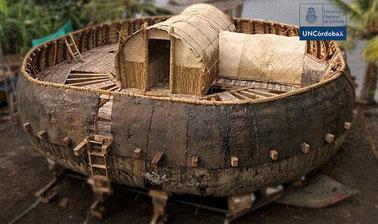
Comenzaremos con un ejemplar único, “La tablilla del arca”, un texto publicado en 2014 que proporciona las dimensiones y la forma de la embarcación con la que se salvaron del exterminio una familia y todos los animales que llevaron a bordo. Luego veremos “La historia sumeria del diluvio”, las características distintivas de este texto y sus relaciones con “La épica de Atra-ḫasīs”. Estos tres textos provienen de la primera mitad del segundo milenio antes de nuestra era.

Módulo 4:
El último texto es la tablilla XI de Gilgameš escrita en el dialecto babilónico estándar que data del primer milenio a.C. Veremos cómo se inserta la historia del diluvio en otro texto cuyas historias habían experimentado transformaciones previas. Reflexionaremos sobre las similitudes y diferencias con los textos discutidos en los dos módulos anteriores.

Módulo 5:
Finalmente, repasamos los puntos de mayor relevancia presentados previamente, reflexionamos sobre la antigüedad de estos textos, la posibilidad de tradiciones aún más remotas, y el uso del diluvio como evento que separa los tiempos míticos de los tiempos históricos en documentos como la Lista Real Sumeria.


Go to Class
MOOC List is learner-supported. When you buy through links on our site, we may earn an affiliate commission.

Related Courses

PredictionX: Diviner’s Guide (edX) EdX
HarvardX,Harvard University

PredictionX: Diviner’s Guide (edX)

This course is an overview of divination systems, ranging from ancient Chinese bone burning to modern astrology. Humans have always sought to know their own future, be it the destiny of an empire or an individual's fate. Across cultures and history, we find people trying to find their place in the Universe by attempting to gaze into the future.

Self Paced
Self-Paced
A Journey through Western Christianity: from Persecuted Faith to Global Religion (200 - 1650) (Coursera) Coursera
Yale University

A Journey through Western Christianity: from Persecuted Faith to Global Religion (200 - 1650) (Coursera)

This course follows the extraordinary development of Western Christianity from its early persecution under the Roman Empire in the third century to its global expansion with the Jesuits of the early modern world. We explore the dynamic and diverse character of a religion with an enormous cast characters. We will meet men and women who tell stories of faith as well as of violence, suppression, and division.

Aug 10th 2026
5-12 Weeks
Words Spun Out of Images: Visual and Literary Culture in Nineteenth Century Japan (Coursera) Coursera
The University of Tokyo

Words Spun Out of Images: Visual and Literary Culture in Nineteenth Century Japan (Coursera)

In their ambition to capture “real life,” Japanese painters, poets, novelists and photographers of the nineteenth century collaborated in ways seldom explored by their European contemporaries. This course offers learners the chance to encounter and appreciate behavior, moral standards and some of the material conditions surrounding Japanese artists in the nineteenth century, in order to renew our assumptions about what artistic “realism” is and what it meant.

Aug 10th 2026
4 Weeks
The Holocaust - An Introduction (II): The Final Solution (Coursera) Coursera
Tel Aviv University,Yad Vashem

The Holocaust - An Introduction (II): The Final Solution (Coursera)

The Holocaust was an inconceivable historical event, which forever robbed Western culture of its innocence. As civilized human beings, we fail to understand how events of such horror could have taken place, and how an idea so inhumanly warped could have spread like wildfire through an entire continent, instigating the systematic annihilation of millions of Jews.

Aug 10th 2026
3 Weeks
Terrorism and Counterterrorism: Comparing Theory and Practice (Coursera) Coursera
Leiden University

Terrorism and Counterterrorism: Comparing Theory and Practice (Coursera)

Terrorism has arguably been one of the defining factors of our age. It frequently makes headlines, threatening or attacking governments, private business and ordinary citizens. And in many parts of the world, it has been one of the most important threats to peace, security and stability. But what does this exactly mean? What is the nature of this threat? Who or what is threatened, how, by whom and why? What can be done about it or how can we at least limit the impact of terrorism and make sure that terrorists do not make headlines and manage to scare us? These are just a handful of questions that will be addressed in this course that consists of three parts.

Aug 10th 2026
5-12 Weeks
Deciphering Secrets: Unlocking the Manuscripts of Medieval Burgos (Spain) (edX) EdX
Universidad Carlos III de Madrid - UC3M,UC3Mx

Deciphering Secrets: Unlocking the Manuscripts of Medieval Burgos (Spain) (edX)

Explore the medieval city of Burgos (Spain) and assess its history of Jewish, Christian, and Muslim religious and cultural coexistence. This history course delves into the medieval history of the city of Burgos, from its inception in 884 c.e. as the homeland of the Spanish Kingdom of Castile and Leon, until the completion of the Spanish Reconquista in 1492.

No sessions available
5-12 Weeks
Sensing Planet Earth - Water and Ice (edX) EdX
Chalmers University of Technology,ChalmersX

Sensing Planet Earth - Water and Ice (edX)

Learn how to measure and monitor the Earth’s water and ice masses to deepen your understanding of global change. Global warming. Rising sea levels. Droughts. Flooding. The melting of the polar ice caps. In this energy and earth science course, you will learn how continental water and ice masses are measured and monitored through remote sensing.

Self Paced
5-12 Weeks
China’s First Empires and the Rise of Buddhism (edX) EdX
HarvardX,Harvard University

China’s First Empires and the Rise of Buddhism (edX)

Learn about the Qin and Han dynasties, and how Buddhism and ideas of self-realization influenced the medieval period. This course, the second in a collection on Chinese history and culture, addresses how the Qin dynasty conquered China and established a new system of government and how the Han dynasty built a stable, centralized empire that lasted for hundreds of years. We cover the early history of Buddhism in China and how the rising feudal aristocracy responded to the loss of empire by looking inward.

Self Paced
Self-Paced
Arab-Islamic History: From Tribes to Empires (edX) EdX
Tel Aviv University,IsraelX,TAUx

Arab-Islamic History: From Tribes to Empires (edX)

Learn about the history of the Arab and Muslim world during its first millennium, including political, social and cultural aspects. You will study this course in two parts. The first presents the main political events that set the chronological framework for the course, namely 6th century to the arrival of the Ottomans in the Middle East in the beginning of the 16th century. The second part delves into social and cultural realities of the medieval Middle East.

Self Paced
Self-Paced