EdX

In the Margins of a Medieval Jewish Prayer Book: What Can Physical Manuscripts Tell Us about History? (edX)

In the Margins of a Medieval Jewish Prayer Book: What Can Physical Manuscripts Tell Us about History? (edX)

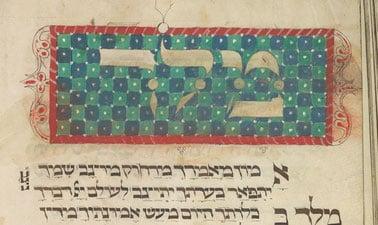
This course is a case study of how a particular manuscript, a Jewish prayer book for high holidays, can provide historians with vital insights about Jewish communal life, the way a manuscript can help us map cultural change and continuity in the Middle Ages, and the history of the physical object itself. Elisabeth Hollender (Goethe University, Frankfurt) guides students through the examination of a late 13th century manuscript from Western Ashkenaz, focusing on how the manifold signs of change left in the manuscript illustrate and illuminate the history of a Jewish community in the Rhineland.

Class Deals by MOOC List - Click here and see EdX's Active Discounts, Deals, and Promo Codes.

The course asks the following questions (and more):

  • How can we locate a particular manuscript within a larger liturgical tradition?
  • What sorts of information can be gained about a community by looking at a manuscript as a physical object?
  • What do manuscripts tell us about the experience of medieval Jewish liturgical practice?
  • What physical changes to manuscripts present problems and opportunities for interpretation?

What you'll learn

  • Acquire knowledge of medieval Asheknazi (originating in the German-speaking lands) and surrounding liturgical traditions
  • Understand the process of using a manuscript as a material object to understand the history of religious culture
  • Gain familiarity with a particular manuscript (CAJS Rare MS 382) and its unique features and problems

Syllabus

  1. An Introduction to Jewish Prayer Books
  2. What Page Layout Can Teach Us about How the Book Was Used
  3. Jewish Geography and the Different Prayer Rites
  4. Times Were Changing—How about the Manuscript? Reading the Notes Jotted in the Margins
  5. Fire and Theft! Interpreting the Scars on the Physical Manuscript

Prerequisites:
There are no prerequisites for taking this course. However, we encourage learners to explore edX DemoX if they are unfamiliar with the edX platform.
Though this course can stand alone, it is the fifth part of a series exploring what can be learned from studying Jewish manuscripts. Part 1 is by Professor Y. Tzvi Langermann (PennX–Katz1.1x), part 2 is by Professor Alessandro Guetta (PennX–Katz1.2x), part 3 is by Professor Fabrizio Lelli (PennX–Katz1.3x), and part 4 is by Professor Judith Schlanger (PennX-Katz1.4x).
Go to Class
MOOC List is learner-supported. When you buy through links on our site, we may earn an affiliate commission.

Related Courses

Israel State and Society  (Coursera) Coursera
Hebrew University of Jerusalem

Israel State and Society (Coursera)

Israel is a country that draws a lot of public attention around the globe. Nevertheless, both those who support Israel and those who are critical of its geopolitical standing and policies, usually have a very limited knowledge about the Israeli society and its political system. This course presents Israel from multiple perspectives - political, social, economic and cultural - in an attempt to expose the learners to a cutting edge academic research on the country.

Aug 24th 2026
13-24 Weeks
Jewish Diaspora in Modern China (Coursera) Coursera
Nanjing University

Jewish Diaspora in Modern China (Coursera)

Jewish Diaspora in China is a unique experience for world Jewry, as China is the only country in Far East that has had Jews living in its society for over 1,000 years. Documentary evidence shows that Jews started to live in China no later than the Tang Dynasty (618–907). The famous Kaifeng Jewish community, which was established in Kaifeng, the Chinese capital of the Song Dynasty (960-1279), is but a best-known example.

No upcoming session
5-12 Weeks
Literati China: Examinations, Neo-Confucianism, and Later Imperial China (edX) EdX
HarvardX,Harvard University

Literati China: Examinations, Neo-Confucianism, and Later Imperial China (edX)

Explore China’s imperial period, with a focus on the Song dynasty and the role of the exam system in government. Fundamental changes in government, the economy, and broader society took place between the 8th and 11th centuries in China. The state aristocracy gave way to new literati elite: educated men who sought to enter government through competitive examinations. A new kind of Confucianism also took shape, which prized the moral autonomy of individuals. With this, the later imperial period of China’s history begins.

Self Paced
Self-Paced
Early Modern Scottish Palaeography: Reading Scotland's Records (FutureLearn) FutureLearn
University of Glasgow

Early Modern Scottish Palaeography: Reading Scotland's Records (FutureLearn)

Travel back in time through Scottish history by examining early modern Scottish handwriting. Explore Scottish history and learn more about using historical sources. Palaeography is the study of ancient handwriting and a vital skill in the historian’s toolkit. It is essential when conducting research on early modern Scotland – a period of profound political, religious and social change the effects of which can still be felt today.

Self Paced
3 Weeks
The Book of Kells: Exploring an Irish Medieval Masterpiece (FutureLearn) FutureLearn
Trinity College Dublin

The Book of Kells: Exploring an Irish Medieval Masterpiece (FutureLearn)

Discover medieval Ireland using the Book of Kells, a ninth-century manuscript featuring the four gospels of the new testament. The Book of Kells manuscript, housed at Trinity College Dublin is world famous - it attracts almost one million visitors a year. But what can this book tell us about Irish history? And what significance is the manuscript in today’s world?

Self Paced
4 Weeks
Writing and Editing: Polishing a Manuscript | Learn with Wattpad (Skillshare) Skillshare
Skillshare

Writing and Editing: Polishing a Manuscript | Learn with Wattpad (Skillshare)

Join one of Wattpad's most successful writers Ali Novak for a fun, straightforward class on editing and revising your writing. While writing a draft is a feat in itself, revising and editing your work is when your story takes shape and the real writing begins! In this 25-minute class, Ali walks through the process of polishing a manuscript for publication.

Self Paced
Self-Paced
Cosmopolitan Tang: Aristocratic Culture in China (edX) EdX
HarvardX,Harvard University

Cosmopolitan Tang: Aristocratic Culture in China (edX)

Explore the reunification of China under the Tang with a focus on aristocratic culture — from poetry to calligraphy to literature. By the Tang period, China was divided into northern and southern dynasties with different rulers and political systems. The north was conquered by relatively unsophisticated barbarians, but in the south, the aristocratic families established a refined appreciation of writing and literature.

Self Paced
Self-Paced
First Nights: Monteverdi’s L’Orfeo and the Birth of Opera (edX) EdX
HarvardX,Harvard University

First Nights: Monteverdi’s L’Orfeo and the Birth of Opera (edX)

Learn about Claudio Monteverdi’s L’Orfeo, one of the first operas ever written. Claudio Monteverdi’s L’Orfeo premiered in Mantua in 1607, and continues to be regarded as one of the most important examples of early opera. With L’Orfeo, Monteverdi helped to establish the techniques and traditions that continue to inform the genre of opera to this day.

Self Paced
Self-Paced
Deciphering Secrets: Unlocking the Manuscripts of Medieval Toledo (Spain) (edX) EdX
Universidad Carlos III de Madrid - UC3M

Deciphering Secrets: Unlocking the Manuscripts of Medieval Toledo (Spain) (edX)

Explore the medieval city of Toledo (Spain) and assess its history of Jewish, Christian, and Muslim religious and cultural coexistence. This course evaluates the medieval history of Toledo from the reign of King Alfonso “The Wise” (1252-1284) until the creation of the blood purity statutes in the 1450s.

No sessions available
5-12 Weeks