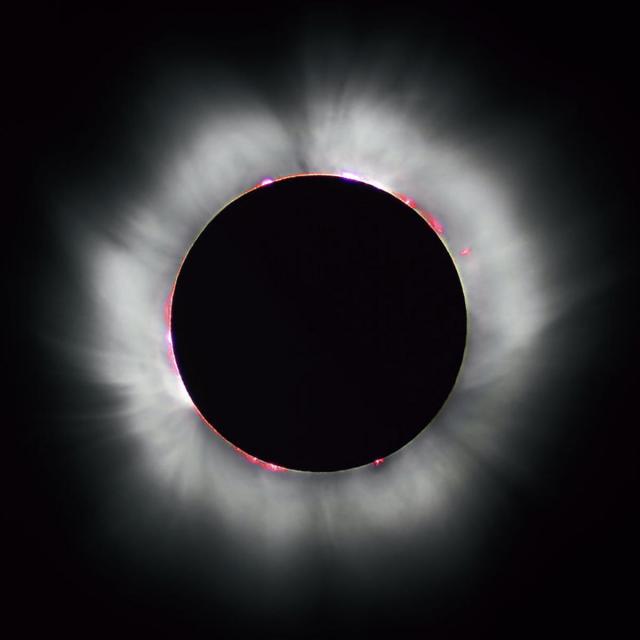
The Sun and the Total Eclipse of August 2017 (Coursera)

The Sun and the Total Eclipse of August 2017 (Coursera)

A total eclipse is one of the most spectacular sights you can ever see! It looks like the end of the world may be at hand. There is a black hole in the sky where the sun should be. Pink flames of solar prominences and long silver streamers of the sun's corona stretch across the sky. It gets cold, and animals do strange things. People scream and shout and cheer, and remember the experience their whole life. But total eclipses are important scientifically as well.

Class Deals by MOOC List - Click here and see Coursera's Active Discounts, Deals, and Promo Codes.

They let us see parts of the sun’s atmosphere that are otherwise invisible. A total eclipse presented the first chance to test Einstein’s prediction that matter can bend space – like near a black hole. The best total eclipse in the United States in 40 years happens August 21st, 2017.
This course has two primary goals:
1) to get you excited for the total solar eclipse coming in August 2017 and prepare you and your community to safely view it
2) to provide an inviting overview of the science of the sun and the physics of light
If you are most interested in preparing for the eclipse, you can hop right into Week 5! If you want the full course experience, and to get some fun scientific context for what you'll be seeing on August 21st, start with Week 1 and move through the course week by week!
[Note: if you start with Week 1, you can skip through some of the repeated material once you get to Week 5.]
Overall this course will prepare you to...

  • Safely view the total or partial solar eclipse
  • Help others watch safely and even make money by leading a “neighborhood watch” of the eclipse
  • Review fundamental sun science, including the physics of light, how astronomers study the sun, how it formed, how we know what’s inside it, and where the energy that supports life on earth is generated

Syllabus

WEEK 1
Introduction to the Sun and Eclipses
In this module we describe what causes eclipses, how rare it is for any one place to experience a total eclipse, the dramatic difference between a total or a partial eclipse, and encourage you to see the total eclipse on Aug. 21, 2017. We also review the upcoming course topics, demonstrate how large the sun is, and introduce sunspots.

WEEK 2
Most of what we know about the Sun is learned from Light
In this module we explain how astronomers use visible and invisible light (ultraviolet and X-rays) to study the sun. We learn that all light comes from atoms, and that the quantum world of atoms is like nothing you’ve ever seen! We see how the properties of light let us determine the sun’s temperature, its composition, and the important role of its magnetic fields.

WEEK 3
How does the Sun work? What makes it shine? What’s inside?
We can’t see inside the sun with visible light, but there are ways to infer or even see down to the sun’s center, where vast amount of energy are generated, making possible life on earth.

WEEK 4
How did the sun form?
When you look at Hubble Space Telescope images of beautiful clouds of gas in space you are seeing what happened in our own solar system 4 ½ billion years ago when the sun formed. This week we explain how that process works.

WEEK 5
The Aug. 21, 2017 “Great American Total Solar Eclipse”
This Week 5 presentation concentrates on what will happen during the Great American Eclipse of Aug. 21, 2017. It may be viewed alone, or after Weeks 1-4. Weeks 1-4 give a lot of explanation of what you will see, so I hope you take the full course, but if you are in a hurry, this week alone will prepare you.
Go to Class
MOOC List is learner-supported. When you buy through links on our site, we may earn an affiliate commission.

Related Courses

Introduction to Thermodynamics: Transferring Energy from Here to There (Coursera) Coursera
University of Michigan

Introduction to Thermodynamics: Transferring Energy from Here to There (Coursera)

This course provides an introduction to the most powerful engineering principles you will ever learn - Thermodynamics: the science of transferring energy from one place or form to another place or form. We will introduce the tools you need to analyze energy systems from solar panels, to engines, to insulated coffee mugs. More specifically, we will cover the topics of mass and energy conservation principles; first law analysis of control mass and control volume systems; properties and behavior of pure substances; and applications to thermodynamic systems operating at steady state conditions.

Sep 21st 2026
5-12 Weeks
Archaeoastronomy (Coursera) Coursera
Politecnico di Milano

Archaeoastronomy (Coursera)

Archaeoastronomy is the “science of stars and stones”: it studies the relationships between the ancient monuments and the sky, in order to gain a better understanding of the ideas of the architects of the past and of their religious and symbolic world. The course provides the first complete, easy introduction to this fascinating discipline.

Sep 14th 2026
5-12 Weeks
From the Big Bang to Dark Energy (Coursera) Coursera
The University of Tokyo

From the Big Bang to Dark Energy (Coursera)

We have learned a lot recently about how the Universe evolved in 13.7 billion years since the Big Bang. More than 80% of matter in the Universe is mysterious Dark Matter, which made stars and galaxies to form. The newly discovered Higgs-boson became frozen into the Universe a trillionth of a second after the Big Bang and brought order to the Universe.

Sep 7th 2026
4 Weeks
AstroTech: The Science and Technology behind Astronomical Discovery (Coursera) Coursera
University of Edinburgh

AstroTech: The Science and Technology behind Astronomical Discovery (Coursera)

Modern astronomy has made some astonishing discoveries - how stars burn and how black holes form; galaxies from the edge of the universe and killer rocks right next door; where the elements come from and how the expanding universe is accelerating. But how do we know all that? The truth is that astronomy would be impossible without technology, and every advance in astronomy is really an advance in technology. But the technology by itself is not enough. We have to apply it critically with a knowledge of physics to unlock the secrets of the Universe.

Sep 21st 2026
5-12 Weeks
Kinematics: Describing the Motions of Spacecraft (Coursera) Coursera
University of Colorado Boulder

Kinematics: Describing the Motions of Spacecraft (Coursera)

The movement of bodies in space (like spacecraft, satellites, and space stations) must be predicted and controlled with precision in order to ensure safety and efficacy. Kinematics is a field that develops descriptions and predictions of the motion of these bodies in 3D space. This course in Kinematics covers four major topic areas: an introduction to particle kinematics, a deep dive into rigid body kinematics in two parts (starting with classic descriptions of motion using the directional cosine matrix and Euler angles, and concluding with a review of modern descriptors like quaternions and Classical and Modified Rodrigues parameters).

Sep 7th 2026
4 Weeks
The Diversity of Exoplanets (Coursera) Coursera
University of Geneva

The Diversity of Exoplanets (Coursera)

In this MOOC, you will have the opportunity to practice several methods of detection and characterisation of exoplanets. You will discover their statistical properties and the current state of knowledge we have in this very recent field of research. You will also understand the limitations and biases of the different detection techniques.

Sep 21st 2026
5-12 Weeks
Particle Physics: an Introduction (Coursera) Coursera
University of Geneva

Particle Physics: an Introduction (Coursera)

This course introduces you to subatomic physics, i.e. the physics of nuclei and particles. More specifically, the following questions are addressed: What are the concepts of particle physics and how are they implemented?; What are the properties of atomic nuclei and how can one use them?; How does one accelerate and detect particles and measure their properties?; What does one learn from particle reactions at high energies and particle decays?; How do electromagnetic interactions work and how can one use them?; How do strong interactions work and why are they difficult to understand?; How do weak interactions work and why are they so special?; What is the mass of objects at the subatomic level and how does the Higgs boson intervene?; How does one search for new phenomena beyond the known ones?; What can one learn from particle physics concerning astrophysics and the Universe as a whole?

Sep 7th 2026
5-12 Weeks
Understanding Modern Physics III: Simplicity and Complexity (Coursera) Coursera
The Hong Kong University of Science and Technology - HKUST

Understanding Modern Physics III: Simplicity and Complexity (Coursera)

The 20th century was known as the century of physics. In the past 120 years, concepts such as space, time, energy, entropy and particles were understood to much deeper levels. New paradigms of thinking such as relativity and quantum mechanics emerged. This course is the third course in the Understanding Modern Physics series, which covers an introduction to action principle, fundamental particle physics, entropy & information and complexity.

Sep 7th 2026
4 Weeks
Magic in the Middle Ages (Coursera) Coursera
University of Barcelona

Magic in the Middle Ages (Coursera)

Magical thought has always attracted human imagination. In this course we will introduce you to the Middle Ages through a wide conception of magic. Students will have an approach to medieval culture, beliefs and practices from the perspective of History and History of Science. Popular magic, as well as learned magic (alchemy, geomancy and necromancy) will be addressed. Moreover, we will also deal with how eastern practices and texts influenced western culture. In July 2016, the course will contain a brand-new module devoted to astrology. Magic in the Middle Ages offers a captivating overview of medieval society and promotes reflection about certain stereotypes associated with this period.

Sep 14th 2026
5-12 Weeks
Flight mechanics - The basis (Coursera) Coursera
ISAE-SUPAERO

Flight mechanics - The basis (Coursera)

More than one century after the Wright brothers' first flight, the flight still defy our intuition. You will learn here how to name the different parts of the airplane and how to describe and quantify its geometry. For that, we need now to share a precise vocabulary to describe the airplane's movement and attitude in space, and a refresher on basic general mechanic principles. You will remind how Newton's 2nd law allows you to determine what force must be applied on an apple - or on an airplane, to modify the magnitude and direction of its speed.

Sep 21st 2026
3 Weeks