How Things Work: An Introduction to Physics (Coursera)

How Things Work: An Introduction to Physics (Coursera)

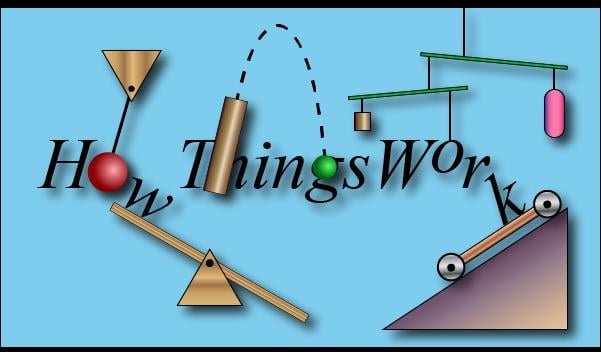
An introduction to physics in the context of everyday objects.

Class Deals by MOOC List - Click here and see Coursera's Active Discounts, Deals, and Promo Codes.

Syllabus

WEEK 1
Course Introduction

WEEK 2
Skating
Professor Bloomfield examines the principle of inertia through skate boarding. Objects at rest tend to remain at rest while objects in motion, tend to remain in motion. Why does a stationary skater remain stationary? Why does a moving skater tend to continue moving? How can we describe the fluid, effortless motion of a coasting skater? How does a skater start, stop, or turn? Why does a skater need ice or wheels in order to skate? Physics concepts covered include Newton's first and second laws and 5 physical quantities: position, velocity, acceleration, force, and mass.

WEEK 3
Falling Balls
Professor Bloomfield examines the physics concepts of gravity, weight, constant acceleration, and projectile motion working with falling balls.

WEEK 4
Ramps
Professor Bloomfield examines the physics concepts of Newton's third law including conserved quantities, support forces, work, energy, and mechanical advantage working with ramps.

WEEK 5
Seesaws
Professor Bloomfield illustrates the physics concepts of rotational versus translational motion, Newton's law of rotation, and 5 physical quantities: angular position, angular velocity, angular acceleration, torque, and rotational mass using seesaws.

WEEK 6
Wheels
Professor Bloomfield illustrates the physics concept of frictional forces through experiments with wheels.

WEEK 7
Bumper Cars
Professor Bloomfield examines the physics concepts of momentum, impulse, angular momentum, angular impulse, and the relationship between potential energy and force using bumper cars.

WEEK 8
Final
This is the final exam.

Go to Class
MOOC List is learner-supported. When you buy through links on our site, we may earn an affiliate commission.

Related Courses

Energy Justice: Fostering More Equitable Energy Futures (Coursera) Coursera
Dartmouth College

Energy Justice: Fostering More Equitable Energy Futures (Coursera)

Are you motivated by the idea that social justice can be served by the energy transition, but are not sure how to make this happen? Do you want to grow your ability to recognize - and do something about - injustice in the energy space? Are you a sustainability or environmental professional eager to help design just energy systems? Do you wonder how to help advance equity in your community’s energy decisions? This course is for you!

Jun 22nd 2026
3 Weeks
Ressources minérales et transition (Coursera) Coursera
Institut Mines-Telecom

Ressources minérales et transition (Coursera)

Ce MOOC sur les ressources minérales et les transitions invite à se questionner sur la soutenabilité de nos choix technologiques. Les transitions énergétiques et numériques sont en effet confrontées aux enjeux d'approvisionnement des ressources minérales et aux impacts que leur cycle de vie génère sur l’environnement et la société.

Jun 22nd 2026
4 Weeks
Control of Nonlinear Spacecraft Attitude Motion (Coursera) Coursera
University of Colorado Boulder

Control of Nonlinear Spacecraft Attitude Motion (Coursera)

This course trains you in the skills needed to program specific orientation and achieve precise aiming goals for spacecraft moving through three dimensional space. First, we cover stability definitions of nonlinear dynamical systems, covering the difference between local and global stability. We then analyze and apply Lyapunov's Direct Method to prove these stability properties, and develop a nonlinear 3-axis attitude pointing control law using Lyapunov theory. Finally, we look at alternate feedback control laws and closed loop dynamics.

Jun 22nd 2026
4 Weeks
Oscillators and Waves (Coursera) Coursera
Rice University

Oscillators and Waves (Coursera)

This first course serves as an introduction to the physics of waves and light. Upon completion, learners will understand how mathematical laws and conservation principles describe wave propagation and light in the context of both geometrical and physical optics. Learners will gain experience in solving physics problems with tools such as graphical analysis, algebra, vector analysis, and calculus.

Jun 22nd 2026
4 Weeks
Physics 102 - Electric Charges and Fields (Coursera) Coursera
Rice University

Physics 102 - Electric Charges and Fields (Coursera)

This course serves as an introduction to the physics of electricity and magnetism. Upon completion, learners will have an understanding of how the forces between electric charges are described by fields, and how these fields are related to electrical circuits. They will gain experience in solving physics problems with tools such as graphical analysis, algebra, vector analysis, and calculus. The course follows the typical progression of topics of a first-semester university physics course: charges, electric forces, electric fields potential, magnetic fields, currents, magnetic moments, electromagnetic induction, and circuits.

Jun 22nd 2026
4 Weeks
Physics 102 - Electric Potential and DC Circuits (Coursera) Coursera
Rice University

Physics 102 - Electric Potential and DC Circuits (Coursera)

This course serves as an introduction to the physics of electricity and magnetism. Upon completion, learners will have an understanding of how the forces between electric charges are described by fields, and how these fields are related to electrical circuits. They will gain experience in solving physics problems with tools such as graphical analysis, algebra, vector analysis, and calculus.

Jun 22nd 2026
3 Weeks
Tinkering Fundamentals: Motion and Mechanisms (Coursera) Coursera
Exploratorium

Tinkering Fundamentals: Motion and Mechanisms (Coursera)

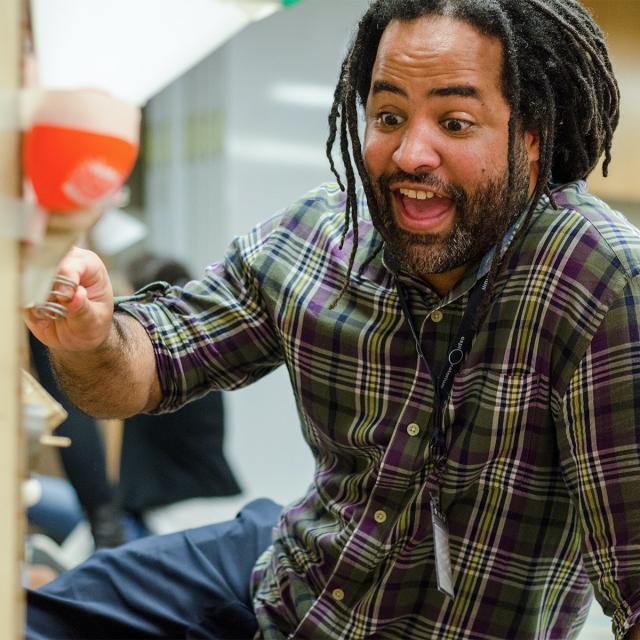
The Tinkering Fundamentals course will offer educators and enthusiasts an opportunity to develop a practice of tinkering and making. We see tinkering as a serious endeavor—one that is generalizable across content and especially good at interweaving disciplines in a way that leads to complex projects and individualized learning opportunities.

Jun 22nd 2026
5-12 Weeks
Mechanics: Motion, Forces, Energy and Gravity, from Particles to Planets (Coursera) Coursera
UNSW Sydney - University of New South Wales

Mechanics: Motion, Forces, Energy and Gravity, from Particles to Planets (Coursera)

Most of the phenomena in the world around you are, at the fundamental level, based on physics, and much of physics is based on mechanics. Mechanics begins by quantifying motion, and then explaining it in terms of forces, energy and momentum. This allows us to analyse the operation of many familiar phenomena around us, but also the mechanics of planets, stars and galaxies.

Jun 22nd 2026
5-12 Weeks
Physics 102 - AC Circuits and Maxwell's Equations (Coursera) Coursera
Rice University

Physics 102 - AC Circuits and Maxwell's Equations (Coursera)

This course serves as an introduction to the physics of electricity and magnetism. Upon completion, learners will have an understanding of how the forces between electric charges are described by fields, and how these fields are related to electrical circuits. They will gain experience in solving physics problems with tools such as graphical analysis, algebra, vector analysis, and calculus. The course follows the typical progression of topics of a first-semester university physics course: charges, electric forces, electric fields potential, magnetic fields, currents, magnetic moments, electromagnetic induction, and circuits.

Jun 22nd 2026
3 Weeks