Origens da Vida no Contexto Cósmico (Coursera)

Origens da Vida no Contexto Cósmico (Coursera)

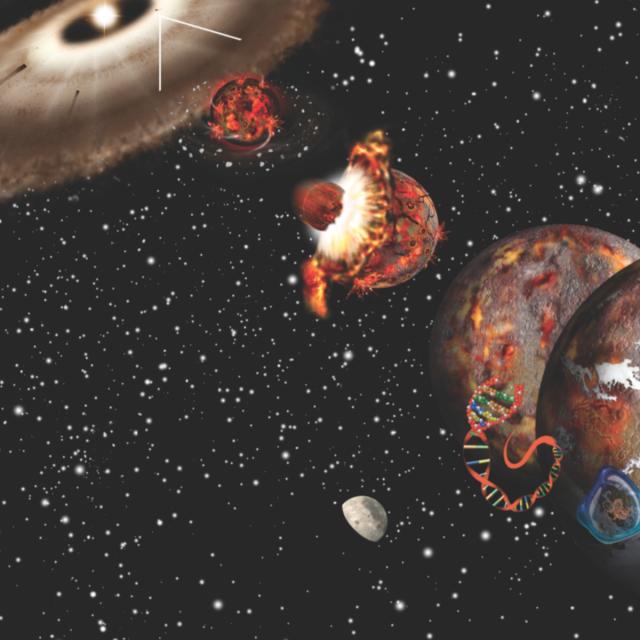
Origens da vida no contexto cósmico é um curso desenvolvido no Instituto de Astronomia, Geofísica e Ciências Atmosféricas da Universidade de São Paulo, com o objetivo de apresentar os mais recentes avanços científicos na compreensão deste intrigante assunto. É um curso com formato multidisciplinar que o levará a compreender melhor os aspectos envolvidos no surgimento de vida na Terra e no possível surgimento de vida em outros planetas.

Class Deals by MOOC List - Click here and see Coursera's Active Discounts, Deals, and Promo Codes.

Como o curso está sendo oferecido em sessões contínuas, não haverá interação dos professores no fórum.

Syllabus

WEEK 1
Olá! Nesta primeira semana do curso “Origens da vida no contexto cósmico” seremos guiados pelo fantástico espetáculo da diversidade da vida na Terra. Seria a vida fruto de um ato de criação ou o resultado de transformações químicas? E o nosso sistema solar? Sempre existiu? Sempre foi assim, ou surgiu em um determinado momento, por meio de processos cósmicos que poderíamos observar em outros pontos do universo? Compreenderemos um pouco melhor o que é o nosso universo e as escalas de distância envolvidas na medição dos grandes fenômenos cósmicos, como o nosso sistema solar, as galáxias e aglomerados. Será que podemos medir o tamanho do universo? E sua idade, seria possível sabermos o quão antigo é? Inicie sua jornada assistindo os vários vídeos que foram disponibilizados essa semana. Leia o artigo “Origens da vida”, que é um recurso extra muito importante para seu aprofundamento no curso. Em seguida faça o teste proposto. Estaremos esperando vocês em nosso fórum ! A grande jornada vai começar. Venha conosco!

WEEK 2
Já aprendemos sobre os cenários antagônicos que discutem a origem da vida. Vimos que nosso sistema solar surgiu como vestígio da formação do Sol, a nossa estrela, além disso, também pudemos compreender melhor as escalas empregadas na medição do universo. Nesta semana vamos compreender como os elementos químicos que constituem o Sol, os planetas e a nós mesmo foram formados. Compreenderemos um pouco melhor o processo de formação do sistema solar e dos corpos menores que o constituem, os cometas e asteroides, além disso vamos compreender a primeira forma experimental usada para simular e explicar a origem da vida na Terra – o experimento de Urey e Miller – e porque este experimento falhou nesta explicação. Ainda há muito o que aprendermos. Vamos lá, nos vemos no fórum!

WEEK 3
Olá! Preparados para continuarmos em nossa jornada do conhecimento? Antes de mais nada, vamos recapitular que na última semana tratamos de assuntos de extrema importância, como cometas, meteoritos e o experimento de Urey e Miller. Nesta semana vamos usar nossa habilidade de detetives: buscando pistas que nos levam a reconstruir a história da vida na Terra. Será que encontraremos com facilidade estas evidências? Onde estariam? Seria possível estuda-las? Será que a vida na origem era similar a vida tal qual a conhecemos hoje? Talvez as coisas não sejam tão elementares, meu caro Watson! Nos vemos no fórum.

WEEK 4
Estamos chegando ao final de nossa jornada. Vimos, na última semana, as grandes dificuldades envolvidas na tentativa de reconstrução da vida até seus primórdios em nosso planeta, mas será que a vida que conhecemos na Terra seria a única forma de vida possível? Será que novos instrumentos de observação e prospecção do espaço poderiam nos dar mais pistas sobre a compreensão da vida em um contexto mais amplo? Exoplanetas, grandes telescópios e a compreensão da vida como um fenômeno cósmico serão os grandes temas desta semana, mas lembrem-se, o final desta jornada é o início de outra jornada. Agora é com você !
Go to Class
MOOC List is learner-supported. When you buy through links on our site, we may earn an affiliate commission.

Related Courses

Mechanics: Motion, Forces, Energy and Gravity, from Particles to Planets (Coursera) Coursera
UNSW Sydney - University of New South Wales

Mechanics: Motion, Forces, Energy and Gravity, from Particles to Planets (Coursera)

Most of the phenomena in the world around you are, at the fundamental level, based on physics, and much of physics is based on mechanics. Mechanics begins by quantifying motion, and then explaining it in terms of forces, energy and momentum. This allows us to analyse the operation of many familiar phenomena around us, but also the mechanics of planets, stars and galaxies.

Aug 17th 2026
5-12 Weeks
Philosophy, Science and Religion: Religion and Science (Coursera) Coursera
University of Edinburgh

Philosophy, Science and Religion: Religion and Science (Coursera)

Philosophy, Science and Religion mark three of the most fundamental modes of thinking about the world and our place in it. Are these modes incompatible? Put another way: is the intellectually responsible thing to do to ‘pick sides’ and identify with one of these approaches at the exclusion of others? Or, are they complementary or mutually supportive? As is typical of questions of such magnitude, the devil is in the details. For example, it is important to work out what is really distinctive about each of these ways of inquiring about the world. In order to gain some clarity here, we’ll be investigating what some of the current leading thinkers in philosophy, science and religion are actually doing.

Aug 11th 2026
5-12 Weeks
The Diversity of Exoplanets (Coursera) Coursera
University of Geneva

The Diversity of Exoplanets (Coursera)

In this MOOC, you will have the opportunity to practice several methods of detection and characterisation of exoplanets. You will discover their statistical properties and the current state of knowledge we have in this very recent field of research. You will also understand the limitations and biases of the different detection techniques.

Jul 27th 2026
5-12 Weeks
From the Big Bang to Dark Energy (Coursera) Coursera
The University of Tokyo

From the Big Bang to Dark Energy (Coursera)

We have learned a lot recently about how the Universe evolved in 13.7 billion years since the Big Bang. More than 80% of matter in the Universe is mysterious Dark Matter, which made stars and galaxies to form. The newly discovered Higgs-boson became frozen into the Universe a trillionth of a second after the Big Bang and brought order to the Universe.

Aug 10th 2026
4 Weeks
AstroTech: The Science and Technology behind Astronomical Discovery (Coursera) Coursera
University of Edinburgh

AstroTech: The Science and Technology behind Astronomical Discovery (Coursera)

Modern astronomy has made some astonishing discoveries - how stars burn and how black holes form; galaxies from the edge of the universe and killer rocks right next door; where the elements come from and how the expanding universe is accelerating. But how do we know all that? The truth is that astronomy would be impossible without technology, and every advance in astronomy is really an advance in technology. But the technology by itself is not enough. We have to apply it critically with a knowledge of physics to unlock the secrets of the Universe.

Jul 27th 2026
5-12 Weeks
Tesoros de la Física y sus Descubridores I (Coursera) Coursera
Universidad de los Andes

Tesoros de la Física y sus Descubridores I (Coursera)

¿Sabes cómo vuelan los aviones, tan pesados y no se caen mientras vuelan? ¿Sabes que viajamos por el espacio sobre el planeta Tierra que se traslada y gira muy rápido y no lo percibimos? ¿O acaso, notas efectos de su movimiento? ¿Cuál es nuestro lugar en el universo? ¿Podemos viajar en el tiempo? ¡Preguntas, muchas preguntas! Con espíritu de descubridores nuestra curiosidad nos motiva a buscar respuestas, a explorar nuestro entorno, a entrar a lo desconocido y hallar nuevo conocimiento.

Aug 3rd 2026
5-12 Weeks
Control of Nonlinear Spacecraft Attitude Motion (Coursera) Coursera
University of Colorado Boulder

Control of Nonlinear Spacecraft Attitude Motion (Coursera)

This course trains you in the skills needed to program specific orientation and achieve precise aiming goals for spacecraft moving through three dimensional space. First, we cover stability definitions of nonlinear dynamical systems, covering the difference between local and global stability. We then analyze and apply Lyapunov's Direct Method to prove these stability properties, and develop a nonlinear 3-axis attitude pointing control law using Lyapunov theory. Finally, we look at alternate feedback control laws and closed loop dynamics.

Aug 3rd 2026
4 Weeks
Planet Earth ... and You! (Coursera) Coursera
University of Illinois at Urbana-Champaign

Planet Earth ... and You! (Coursera)

Earthquakes, volcanoes, mountain building, ice ages, landslides, floods, life evolution, plate motions—all of these phenomena have interacted over the vast expanses of deep time to sculpt the dynamic planet that we live on today. Planet Earth presents an overview of several aspects of our home, from a geological perspective. We begin with earthquakes—what they are, what causes them, what effects they have, and what we can do about them. We will emphasize that plate tectonics—the grand unifying theory of geology—explains how the map of our planet's surface has changed radically over geologic time, and why present-day geologic activity—including a variety of devastating natural disasters such as earthquakes—occur where they do. We consider volcanoes, types of eruptions, and typical rocks found there.

Jul 27th 2026
5-12 Weeks
Particle Physics: an Introduction (Coursera) Coursera
University of Geneva

Particle Physics: an Introduction (Coursera)

This course introduces you to subatomic physics, i.e. the physics of nuclei and particles. More specifically, the following questions are addressed: What are the concepts of particle physics and how are they implemented?; What are the properties of atomic nuclei and how can one use them?; How does one accelerate and detect particles and measure their properties?; What does one learn from particle reactions at high energies and particle decays?; How do electromagnetic interactions work and how can one use them?; How do strong interactions work and why are they difficult to understand?; How do weak interactions work and why are they so special?; What is the mass of objects at the subatomic level and how does the Higgs boson intervene?; How does one search for new phenomena beyond the known ones?; What can one learn from particle physics concerning astrophysics and the Universe as a whole?

Aug 10th 2026
5-12 Weeks
The Worldview of Thomas Berry: The Flourishing of the Earth Community (Coursera) Coursera
Yale University

The Worldview of Thomas Berry: The Flourishing of the Earth Community (Coursera)

Thomas Berry (1914-2009) was a historian of world religions and an early voice awakening moral sensibilities to the environmental crisis. He is known for articulating a “new story” of the universe that explores the implications of the evolutionary sciences and cultural traditions for creating a flourishing future. This course investigates Berry’s life and thought in relation to the Journey of the Universe project.

Aug 17th 2026
5-12 Weeks