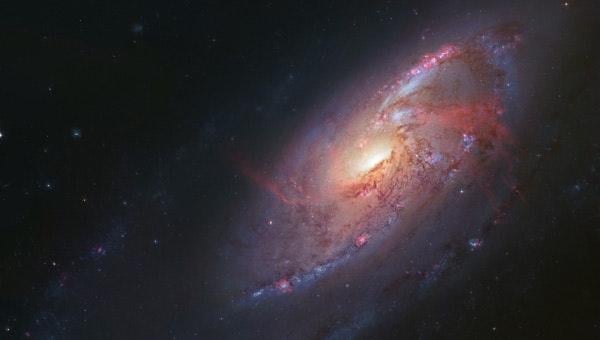
Confronting The Big Questions: Highlights of Modern Astronomy (Coursera)

Confronting The Big Questions: Highlights of Modern Astronomy (Coursera)

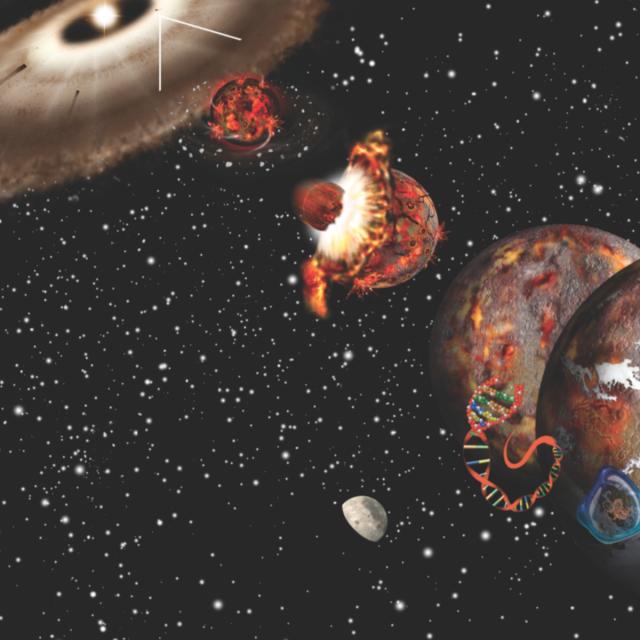
An introduction to modern astronomy's most important questions. The four sections of the course are Planets and Life in The Universe; The Life of Stars; Galaxies and Their Environments; The History of The Universe.

Class Deals by MOOC List - Click here and see Coursera's Active Discounts, Deals, and Promo Codes.

Syllabus

Week 1
Are we alone in the Universe?
Planets and Life in The Universe - Exoplanets searches, exoplanet census, astrobiology

Week 2
How do Stars Evolve and Die?
The Life of Stars - Star formation, fusion and stellar middle age, black holes and stellar death-

Week 3
What Exists Outside our Galaxy?
Galaxies and Their Environments - Galaxy types, Active Galactic Nuclei, Clusters of Clusters of Galaxies

Week 4
What is the Fate of the Universe?
The History of The Universe - Why the Big Bang? A History of Time, What Happened Before the Big Bang

Go to Class
MOOC List is learner-supported. When you buy through links on our site, we may earn an affiliate commission.
Related Courses

Density Functional Theory (Coursera) Coursera
École Polytechnique

Density Functional Theory (Coursera)

The aim of this course is to give a thorough introduction to Density Functional Theory (DFT). DFT is today the most widely used method to study interacting electrons, and its applicability ranges from atoms to solid systems, from nuclei to quantum fluids. In this course, we introduce the most important concepts underlying DFT, its foundation, and basic ideas. We will in particular stress the features and reasons that lead DFT to become the dominant method for simulating quantum mechanical systems.

Jul 27th 2026
3 Weeks
AstroTech: The Science and Technology behind Astronomical Discovery (Coursera) Coursera
University of Edinburgh

AstroTech: The Science and Technology behind Astronomical Discovery (Coursera)

Modern astronomy has made some astonishing discoveries - how stars burn and how black holes form; galaxies from the edge of the universe and killer rocks right next door; where the elements come from and how the expanding universe is accelerating. But how do we know all that? The truth is that astronomy would be impossible without technology, and every advance in astronomy is really an advance in technology. But the technology by itself is not enough. We have to apply it critically with a knowledge of physics to unlock the secrets of the Universe.

Jul 27th 2026
5-12 Weeks
Electrodynamics: An Introduction (Coursera) Coursera
Korea Advanced Institute of Science and Technology - KAIST

Electrodynamics: An Introduction (Coursera)

The depth and breadth of electromagnetism, the foundation for many fields including materials science, electrical engineering, and physical chemistry, requires a long, steep, and steady learning curve. This course aims to bridge the gap between the fundamental principles taught in electromagnetism and its practical application to specific fields such as materials, physics, and chemistry related to energy storage and harvesting.

Aug 3rd 2026
5-12 Weeks
Global Warming I: The Science and Modeling of Climate Change (Coursera) Coursera
University of Chicago

Global Warming I: The Science and Modeling of Climate Change (Coursera)

This class describes the science of global warming and the forecast for humans’ impact on Earth’s climate. Intended for an audience without much scientific background but a healthy sense of curiosity, the class brings together insights and perspectives from physics, chemistry, biology, earth and atmospheric sciences, and even some economics—all based on a foundation of simple mathematics (algebra).

Jul 27th 2026
5-12 Weeks
The Discovery of the Higgs Boson (Coursera) Coursera
University of Edinburgh

The Discovery of the Higgs Boson (Coursera)

The discovery of a new fundamental particle at the Large Hadron Collider (LHC), CERN is the latest step in a long quest seeking to answer one of physics’ most enduring questions: why do particles have mass? The experiments’ much anticipated success confirms predictions made decades earlier by Peter Higgs and others, and offers a glimpse into a universe of physics beyond the Standard Model.

Aug 3rd 2026
5-12 Weeks
From the Big Bang to Dark Energy (Coursera) Coursera
The University of Tokyo

From the Big Bang to Dark Energy (Coursera)

We have learned a lot recently about how the Universe evolved in 13.7 billion years since the Big Bang. More than 80% of matter in the Universe is mysterious Dark Matter, which made stars and galaxies to form. The newly discovered Higgs-boson became frozen into the Universe a trillionth of a second after the Big Bang and brought order to the Universe.

Aug 10th 2026
4 Weeks
Vers l'infiniment petit (Coursera) Coursera
École Polytechnique

Vers l'infiniment petit (Coursera)

Partez à la découverte de l'infiniment petit, en compagnie de physiciens et de physiciennes qui vont vous faire découvrir les secrets de la matière quand on l'étudie aux distances les plus courtes, aux énergies les plus élevées. Vous vous initierez aux progrès les plus récents de la recherche en physique nucléaire et de la physique des particules, et vous découvrirez les principes des accélérateurs et des détecteurs avec lesquels on a pu étudier la matière à ces échelles, pour arriver jusqu'à la découverte du boson de Higgs en 2012 auprès du collisionneur de particules du CERN, le LHC.

Jul 27th 2026
4 Weeks
The Sun and the Total Eclipse of August 2017 (Coursera) Coursera
University of Colorado Boulder

The Sun and the Total Eclipse of August 2017 (Coursera)

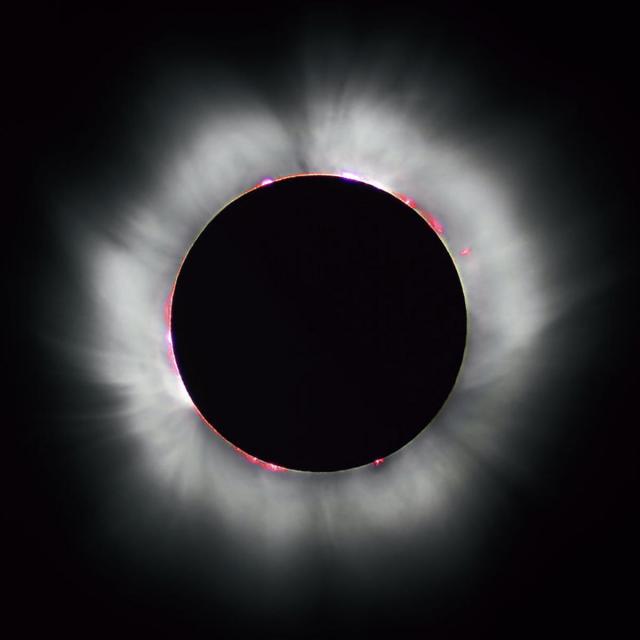
A total eclipse is one of the most spectacular sights you can ever see! It looks like the end of the world may be at hand. There is a black hole in the sky where the sun should be. Pink flames of solar prominences and long silver streamers of the sun's corona stretch across the sky. It gets cold, and animals do strange things. People scream and shout and cheer, and remember the experience their whole life. But total eclipses are important scientifically as well.

Aug 3rd 2026
5-12 Weeks
Understanding Modern Physics II: Quantum Mechanics and Atoms (Coursera) Coursera
The Hong Kong University of Science and Technology - HKUST

Understanding Modern Physics II: Quantum Mechanics and Atoms (Coursera)

The 20th century was known as the century of physics. In the past 120 years, concepts such as space, time, energy, entropy and particles were understood to much deeper levels. New paradigms of thinking such as relativity and quantum mechanics emerged. This course is the second course in the Understanding Modern Physics series, which covers an introduction to quantum mechanics, atomic physics and quantum information.

Aug 3rd 2026
4 Weeks
Fundamentals of Fluid-Solid Interactions (Coursera) Coursera
École Polytechnique

Fundamentals of Fluid-Solid Interactions (Coursera)

What is fluid-solid interactions ? It is what happens when the motions of a fluid and of a solid are somehow coupled. This happens all the time, around you when leaves flutter in the wind, inside you when your heart beats, above you when wings of a plane vibrate, under the sea... The idea behind this MOOC is to give you the basic tools to be able to predict and eventually mitigate things called flutter, galloping, sloshing, vortex-induced vibrations, added mass, to cite a few. We are going to consider any possible domains of applications such as civil engineering, aerospace engineering, nuclear engineering , ocean engineering, biomechanics and even food processing !

Aug 10th 2026
5-12 Weeks