Statistical Molecular Thermodynamics (Coursera)

Statistical Molecular Thermodynamics (Coursera)

This introductory physical chemistry course examines the connections between molecular properties and the behavior of macroscopic chemical systems.

Class Deals by MOOC List - Click here and see Coursera's Active Discounts, Deals, and Promo Codes.

Syllabus

WEEK 1
This module includes philosophical observations on why it's valuable to have a broadly disseminated appreciation of thermodynamics, as well as some drive-by examples of thermodynamics in action, with the intent being to illustrate up front the practical utility of the science, and to provide students with an idea of precisely what they will indeed be able to do themselves upon completion of the course materials (e.g., predictions of pressure changes, temperature changes, and directions of spontaneous reactions). The other primary goal for this week is to summarize the quantized levels available to atoms and molecules in which energy can be stored. For those who have previously taken a course in elementary quantum mechanics, this will be a review. For others, there will be no requirement to follow precisely how the energy levels are derived--simply learning the final results that derive from quantum mechanics will inform our progress moving forward. Homework problems will provide you the opportunity to demonstrate mastery in the application of the above concepts.

WEEK 2
This module begins our acquaintance with gases, and especially the concept of an "equation of state," which expresses a mathematical relationship between the pressure, volume, temperature, and number of particles for a given gas. We will consider the ideal, van der Waals, and virial equations of state, as well as others. The use of equations of state to predict liquid-vapor diagrams for real gases will be discussed, as will the commonality of real gas behaviors when subject to corresponding state conditions. We will finish by examining how interparticle interactions in real gases, which are by definition not present in ideal gases, lead to variations in gas properties and behavior. Homework problems will provide you the opportunity to demonstrate mastery in the application of the above concepts.

WEEK 3
This module delves into the concepts of ensembles and the statistical probabilities associated with the occupation of energy levels. The partition function, which is to thermodynamics what the wave function is to quantum mechanics, is introduced and the manner in which the ensemble partition function can be assembled from atomic or molecular partition functions for ideal gases is described. The components that contribute to molecular ideal-gas partition functions are also described. Given specific partition functions, derivation of ensemble thermodynamic properties, like internal energy and constant volume heat capacity, are presented. Homework problems will provide you the opportunity to demonstrate mastery in the application of the above concepts.

WEEK 4
This module connects specific molecular properties to associated molecular partition functions. In particular, we will derive partition functions for atomic, diatomic, and polyatomic ideal gases, exploring how their quantized energy levels, which depend on their masses, moments of inertia, vibrational frequencies, and electronic states, affect the partition function's value for given choices of temperature, volume, and number of gas particles. We will examine specific examples in order to see how individual molecular properties influence associated partition functions and, through that influence, thermodynamic properties. Homework problems will provide you the opportunity to demonstrate mastery in the application of the above concepts.

WEEK 5
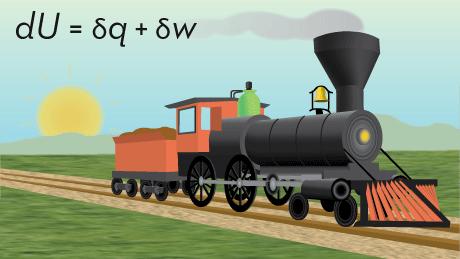
This module is the most extensive in the course, so you may want to set aside a little extra time this week to address all of the material. We will encounter the First Law of Thermodynamics and discuss the nature of internal energy, heat, and work. Especially, we will focus on internal energy as a state function and heat and work as path functions. We will examine how gases can do (or have done on them) pressure-volume (PV) work and how the nature of gas expansion (or compression) affects that work as well as possible heat transfer between the gas and its surroundings. We will examine the molecular level details of pressure that permit its derivation from the partition function. Finally, we will consider another state function, enthalpy, its associated constant pressure heat capacity, and their utilities in the context of making predictions of standard thermochemistries of reaction or phase change. Homework problems will provide you the opportunity to demonstrate mastery in the application of the above concepts.

WEEK 6
This module introduces a new state function, entropy, that is in many respects more conceptually challenging than energy. The relationship of entropy to extent of disorder is established, and its governance by the Second Law of Thermodynamics is described. The role of entropy in dictating spontaneity in isolated systems is explored. The statistical underpinnings of entropy are established, including equations relating it to disorder, degeneracy, and probability. We derive the relationship between entropy and the partition function and establish the nature of the constant β in Boltzmann's famous equation for entropy. Finally, we consider the role of entropy in dictating the maximum efficiency that can be achieved by a heat engine based on consideration of the Carnot cycle. Homework problems will provide you the opportunity to demonstrate mastery in the application of the above concepts.

WEEK 7
This module is relatively light, so if you've fallen a bit behind, you will possibly have the opportunity to catch up again. We examine the concept of the standard entropy made possible by the Third Law of Thermodynamics. The measurement of Third Law entropies from constant pressure heat capacities is explained and is compared for gases to values computed directly from molecular partition functions. The additivity of standard entropies is exploited to compute entropic changes for general chemical changes. Homework problems will provide you the opportunity to demonstrate mastery in the application of the above concepts.

WEEK 8
This last module rounds out the course with the introduction of new state functions, namely, the Helmholtz and Gibbs free energies. The relevance of these state functions for predicting the direction of chemical processes in isothermal-isochoric and isothermal-isobaric ensembles, respectively, is derived. With the various state functions in hand, and with their respective definitions and knowledge of their so-called natural independent variables, Maxwell relations between different thermochemical properties are determined and employed to determine thermochemical quantities not readily subject to direct measurement (such as internal energy). Armed with a full thermochemical toolbox, we will explain the behavior of an elastomer (a rubber band, in this instance) as a function of temperature. Homework problems will provide you the opportunity to demonstrate mastery in the application of the above concepts. The final exam will offer you a chance to demonstrate your mastery of the entirety of the course material.

WEEK 9
Final Exam
This is the final graded exercise (20 questions) for the course. There is no time limit to take the exam.

Go to Class
MOOC List is learner-supported. When you buy through links on our site, we may earn an affiliate commission.

Related Courses

Introduction to Sustainability (Coursera) Coursera
University of Illinois at Urbana-Champaign

Introduction to Sustainability (Coursera)

This course introduces the academic approach of Sustainability and explores how today’s human societies can endure in the face of global change, ecosystem degradation and resource limitations. The course focuses on key knowledge areas of sustainability theory and practice, including population, ecosystems, global change, energy, agriculture, water, environmental economics and policy, ethics, and cultural history.

Aug 31st 2026
5-12 Weeks
Energy Harvesting (Coursera) Coursera
Sungkyunkwan University - SKKU

Energy Harvesting (Coursera)

Joining this course presents opportunity to learn about energy harvesting that refers to a technology that converts the energy discarded in our daily lives into useful electrical energy that we can use. As we all know, most of low-power electronics, such as remote sensors, are driven by batteries. However, even when it comes to long-lasting batteries, they face an issue that is a regular replacement. It can turn out to be costly as there are hundreds of sensors in remote locations.

Sep 7th 2026
4 Weeks
Energy, Environment, and Everyday Life (Coursera) Coursera
University of Illinois at Urbana-Champaign

Energy, Environment, and Everyday Life (Coursera)

This course teaches you everything you need to know about energy, the environment, and at least a number of things in everyday life. It starts by talking about energy itself and where it comes from. This includes how much we have, who has it, who uses it, and what that all means. The video clips are produced in a fast-paced multimedia format during which Professor Ruzic throws in fun and demonstrations. There are multiple-choice questions to check your understanding and some more in-depth exercises to guide you deeper into the subject.

Aug 31st 2026
5-12 Weeks
Fundamentals of Materials Science (Coursera) Coursera
Shanghai Jiao Tong University

Fundamentals of Materials Science (Coursera)

Materials are the physical foundations for the development of science and technology. The human civilizations are historically designated by the evolution of materials, such as the Stone Age, the Bronze Age and the Iron Age. Nowadays, materials science and technology support most of the industrial sectors, including aerospace, telecommunications, transportation, architecture, infrastructure and so on. Fundamentals of Materials Science is a core module for undergraduates majored in materials science and engineering.

Aug 31st 2026
13-24 Weeks
Reasoning Across the Disciplines (Coursera) Coursera
University of North Carolina

Reasoning Across the Disciplines (Coursera)

Critical reasoning skills are a key success factor for students entering their first year of college. They must be able to think logically and form arguments. This course, designed with incoming college freshmen in mind but open to anyone, provides an essential grounding in critical reasoning skills. Faculty from multiple disciplines at the University of North Carolina at Chapel Hill offer guidance on applying critical thinking skills in the context of specific disciplines. By developing these skills, students will learn more, enjoy their courses more, and experience greater academic success.

Sep 7th 2026
5-12 Weeks
Information Theory (Coursera) Coursera
The Chinese University of Hong Kong

Information Theory (Coursera)

At the completion of this course, the student should be able to: demonstrate knowledge and understanding of the fundamentals of information theory; appreciate the notion of fundamental limits in communication systems and more generally all systems; develop deeper understanding of communication systems; apply the concepts of information theory to various disciplines in information science.

Sep 7th 2026
13-24 Weeks
Materials Data Sciences and Informatics (Coursera) Coursera
Georgia Institute of Technology

Materials Data Sciences and Informatics (Coursera)

This course aims to provide a succinct overview of the emerging discipline of Materials Informatics at the intersection of materials science, computational science, and information science. Attention is drawn to specific opportunities afforded by this new field in accelerating materials development and deployment efforts.

Sep 7th 2026
5-12 Weeks
Oil & Gas Industry Operations and Markets (Coursera) Coursera
Duke University

Oil & Gas Industry Operations and Markets (Coursera)

The oil and gas industry has an enormous impact on all aspects of daily life. Individuals, corporations, and national governments make financial and policy decisions based on the cost, use, and availability of these two natural resources. This two-week course looks at the two most fundamental aspects of the oil and gas industry, its operations and markets, each of which is addressed as a separate module in the course.

Sep 2nd 2026
2 Weeks
Fundamentals of Fluid Power (Coursera) Coursera
University of Minnesota

Fundamentals of Fluid Power (Coursera)

In this course, you will be introduced to the fundamental principles and analytical modeling of fluid power components, circuits, and systems. You will learn the benefits and limitations of fluid power compared with other power transmission technologies; the operation, use, and symbols of common hydraulic components; how to formulate and analyze models of hydraulic components and circuits; and how to design and predict the performance of fluid power circuits.

Aug 31st 2026
5-12 Weeks
Photovoltaic solar energy (Coursera) Coursera
École Polytechnique

Photovoltaic solar energy (Coursera)

The course is an introduction to the photovoltaic (PV) applications in the general mix energetic context dominated by climate warming mitigation. The various uses of solar energy are firstly presented before a short description of the principle of the direct solar photon conversion into electricity (PV). The various PV technologies are reviewed in the current context dominated by crystalline silicon cells. The perspectives of the various technologies are then analysed in terms of R&D investments.

Aug 31st 2026
3 Weeks
Nanotechnology and Nanosensors, Part 2 (Coursera) Coursera
Technion - Israel Institute of Technology

Nanotechnology and Nanosensors, Part 2 (Coursera)

Learn about novel sensing tools that make use of nanotechnology to screen, detect and monitor various events in personal or professional life. Together, we will lay the groundwork for infinite innovative applications, starting from diagnosis and treatments of diseases, continuing with quality control of goods and environmental aspects, and ending with monitoring security issues.

Sep 7th 2026
5-12 Weeks
Introduction to Molecular Spectroscopy (Coursera) Coursera
University of Manchester

Introduction to Molecular Spectroscopy (Coursera)

The course introduces the three key spectroscopic methods used by chemists and biochemists to analyse the molecular and electronic structure of atoms and molecules. These are UV/Visible , Infra-red (IR) and Nuclear Magnetic Resonance (NMR) spectroscopies. The content is presented using short focussed and interactive screencast presentations accompanied by formative quizzes to probe understanding of the key concepts presented. Numerous exercises are provided to facilitate mastery of each topic. A unique virtual spectroscopic laboratory is made available to enable students to measure and analyse spectra online. Assessment is via summative quizzes completed during the course period.

Sep 7th 2026
4 Weeks