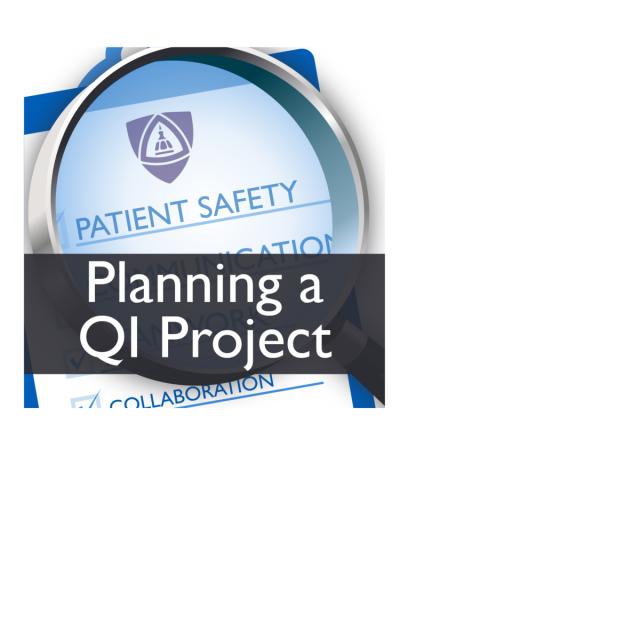
Planning a Patient Safety or Quality Improvement Project (Patient Safety III) (Coursera)

Planning a Patient Safety or Quality Improvement Project (Patient Safety III) (Coursera)

This course provides students with a set of tools and methodologies to plan and initiate a Problem Solving or Quality Improvement project. The first module presents methods for selecting, scoping and structuring a project before it is even initiated. It also introduces the project classifications of implementation and discovery. The second module describes the A3 problem solving methodology and the tool itself. Further in that same module, the student is shown tools to identify problems in flow, defects, and waste and to discover causes, brainstorm, and prioritize interventions. Module 3 shows a methodology within the implementation class. These methods are designed to overcome emotional and organizational barriers to translating evidence-based interventions into practice. The fourth and last module looks at one more way to approach improvement projects in the discovery class. These tools are specifically for new, out-of-the-box design thinking.

Class Deals by MOOC List - Click here and see Coursera's Active Discounts, Deals, and Promo Codes.

What You Will Learn

  • Describe approaches for selecting and scoping a patient safety or quality improvement project.
  • Compare and contrast QI/PI approaches: A3 Thinking, Design Thinking, and Translating Research into Practice (TRiP).
  • Create a project charter or A3 using SMART goals.
  • Explain the usage of several root cause identification tools in the course of running a project.

Course 3 of 7 in the Patient Safety Specialization

Syllabus

WEEK 1
Project Selection Strategy and Tools You Can Use
In this module, you will see the process for defining, scoping, selecting and prioritizing improvement initiatives. Further, you will learn necessary team characteristics and organizational support structures.

WEEK 2
A3 Thinking
In this module, you will be introduced to the process and format of A3 problem solving. You will learn the key components of an A3 for to define and start an improvement project to maximize your chances of success. Additionally, a set of tools will be covered that are commonly used in the actual improvement project, which will identify underlying process issues and their root causes.

WEEK 3
Translating Research Into Practice
This module explains the Translating Research into Practice (TRiP) model. It is a methodology to facilitate the adoption and use of evidence-based therapies. This model itself uses a collaborative knowledge translation model for wider sharing of knowledge into practice.

WEEK 4
Design Thinking
In this module, we will cover a process called Design Thinking. It is a human-centered design approach that fosters out-of the-box thinking to create innovative solutions. The process builds the design iteratively in a highly collaborative team approach. The five steps of design thinking will be covered: Learn, Define, Ideate, Protype, and Test.


Go to Class
MOOC List is learner-supported. When you buy through links on our site, we may earn an affiliate commission.

Related Courses

Introduction to Programming with MATLAB (Coursera) Coursera
Vanderbilt University

Introduction to Programming with MATLAB (Coursera)

This course teaches computer programming to those with little to no previous experience. It uses the programming system and language called MATLAB to do so because it is easy to learn, versatile and very useful for engineers and other professionals. MATLAB is a special-purpose language that is an excellent choice for writing moderate-size programs that solve problems involving the manipulation of numbers.

Jun 8th 2026
5-12 Weeks
Primeros Auxilios Psicológicos (PAP) (Coursera) Coursera
Universitat Autònoma de Barcelona

Primeros Auxilios Psicológicos (PAP) (Coursera)

Este curso on-demand (ABIERTO, se puede cursar en cualquier momento), impartido en castellano por la Universidad Autónoma de Barcelona y el Centro de Crisis de Barcelona, está destinado a entrenar en la aplicación de primeros auxilios psicológicos (PAP) a personas afectadas por situaciones altamente estresantes, abarcando tanto emergencias cotidianas (incidentes críticos estadísticamente frecuentes que afectan de manera muy intensa: un accidente de tráfico, una hospitalización, una agresión o la muerte traumática o repentina de una persona, etc.) como emergencias comunitarias y/o masivas (sucesos infrecuentes, que afectan a muchas personas o a una comunidad entera y que sobrepasan con mucho lo que sucede habitualmente en ella: una catástrofe natural, un accidente ferroviario o aéreo o un atentado).

Jun 8th 2026
5-12 Weeks
Cómo resolver problemas y tomar decisiones con eficacia (Coursera) Coursera
University of California, Irvine

Cómo resolver problemas y tomar decisiones con eficacia (Coursera)

El pensamiento crítico (la aplicación de métodos científicos y del razonamiento lógico) constituye la base para resolver problemas y tomar decisiones con eficacia. El pensamiento crítico nos permite evitar escollos frecuentes, verificar la validez de nuestras creencias y suposiciones y corregir las distorsiones que pueden haberse producido en nuestros procesos mentales.

Jun 8th 2026
4 Weeks
Gestión de proyectos: las bases del éxito (Coursera) Coursera
University of California, Irvine

Gestión de proyectos: las bases del éxito (Coursera)

En este curso se combinan los elementos esenciales de la gestión de proyectos y el liderazgo de equipo en un único contenido. A través de la participación y reflexión en clase, adquirirás una mayor comprensión de las responsabilidades que conlleva el liderazgo y una mejor preparación para aplicar este conocimiento en el entorno de un proyecto.

Jun 8th 2026
4 Weeks
Understanding Clinical Research: Behind the Statistics (Coursera) Coursera
University of Cape Town

Understanding Clinical Research: Behind the Statistics (Coursera)

If you’ve ever skipped over`the results section of a medical paper because terms like “confidence interval” or “p-value” go over your head, then you’re in the right place. You may be a clinical practitioner reading research articles to keep up-to-date with developments in your field or a medical student wondering how to approach your own research. Greater confidence in understanding statistical analysis and the results can benefit both working professionals and those undertaking research themselves.

Jun 8th 2026
5-12 Weeks
Agile Meets Design Thinking (Coursera) Coursera
University of Virginia

Agile Meets Design Thinking (Coursera)

Despite everyone's good intentions, hard work and solid ideas, too many projects end up creating unneeded, unusable, and unsellable products. But it doesn't have to be this way. Agile and design thinking offer a different--and effective--approach to product development, one that results in valuable solutions to meaningful problems. In this course, you’ll learn how to determine what's valuable to a user early in the process--to frontload value--by focusing your team on testable narratives about the user and creating a strong shared perspective.

Jun 8th 2026
4 Weeks
The New Nordic Diet - from Gastronomy to Health (Coursera) Coursera
University of Copenhagen

The New Nordic Diet - from Gastronomy to Health (Coursera)

The New Nordic Diet is a new food culture developed in 2009-13 with key emphasis on gastronomy, health, and environment. Major research in its effect on acceptability, behaviour and learning skills, and disease prevention have been conducted by the OPUS centre at the University of Copenhagen and the people behind the award-winning restaurant Noma in Copenhagen. This course will give the participants the opportunity to experience a healthy and palatable new food and eating concept diet “The New Nordic Diet” and an understanding of how food and diets can affect mental and physical health and ensure the foundation for a healthier life style for future generations with a regional based diet and food culture.

Jun 8th 2026
5-12 Weeks
Game Theory (Coursera) Coursera
Stanford University,The University of British Columbia

Game Theory (Coursera)

Popularized by movies such as "A Beautiful Mind," game theory is the mathematical modeling of strategic interaction among rational (and irrational) agents. Beyond what we call `games' in common language, such as chess, poker, soccer, etc., it includes the modeling of conflict among nations, political campaigns, competition among firms, and trading behavior in markets such as the NYSE.

Jun 8th 2026
5-12 Weeks
Project Execution: Running the Project (Coursera) Coursera
Google

Project Execution: Running the Project (Coursera)

This is the fourth course in the Google Project Management Certificate program. This course will delve into the execution and closing phases of the project life cycle. You will learn what aspects of a project to track and how to track them. You will also learn how to effectively manage and communicate changes, dependencies, and risks. As you explore quality management, you will learn how to measure customer satisfaction and implement continuous improvement and process improvement techniques. Next, you will examine how to prioritize data, how to use data to inform your decision-making, and how to effectively present that data.

Jun 10th 2026
5-12 Weeks
Mastering the Software Engineering Interview (Coursera) Coursera
University of California, San Diego

Mastering the Software Engineering Interview (Coursera)

You’ve hit a major milestone as a computer scientist and are becoming a capable programmer. You now know how to solve problems, write algorithms, and analyze solutions; and you have a wealth of tools (like data structures) at your disposal. You may now be ready for an internship or (possibly) an entry-level software engineering job. But can you land the internship/job? It depends in part on how well you can solve new technical problems and communicate during interviews. How can you get better at this? Practice!

Jun 8th 2026
4 Weeks
Introduction to the Biology of Cancer (Coursera) Coursera
Johns Hopkins University

Introduction to the Biology of Cancer (Coursera)

Over 500,000 people in the United States and over 8 million people worldwide are dying every year from cancer. As people live longer, the incidence of cancer is rising worldwide and the disease is expected to strike over 20 million people annually by 2030. This open course is designed for people who would like to develop an understanding of cancer and how it is prevented, diagnosed, and treated.

Jun 8th 2026
5-12 Weeks
Living with Dementia: Impact on Individuals, Caregivers, Communities and Societies (Coursera) Coursera
Johns Hopkins University

Living with Dementia: Impact on Individuals, Caregivers, Communities and Societies (Coursera)

Health professionals and students, family caregivers, friends of and affected individuals, and others interested in learning about dementia and quality care will benefit from completing the course. Led by Drs. Nancy Hodgson and Laura Gitlin, participants will acquire foundational knowledge in the care of persons with Alzheimer’s Disease and other neurocognitive disorders.

Jun 8th 2026
5-12 Weeks