Paleontology: Theropod Dinosaurs and the Origin of Birds (Coursera)

Offered by University of Alberta,
Paleontology: Theropod Dinosaurs and the Origin of Birds (Coursera)

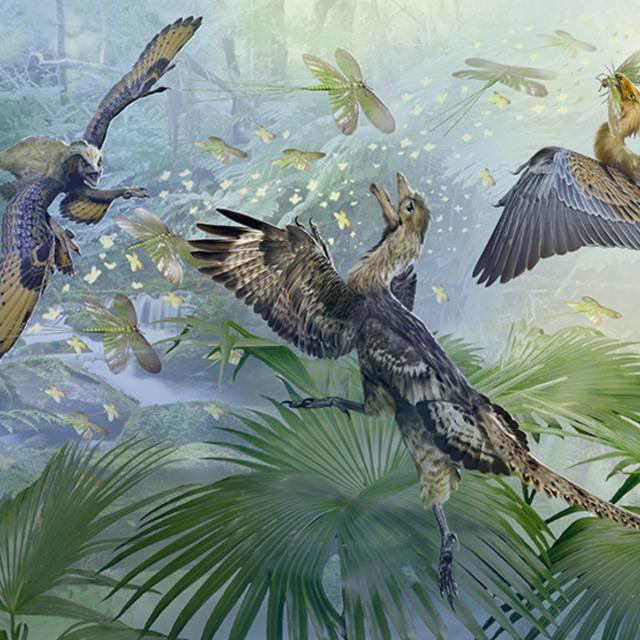
Paleontology: Theropod Dinosaurs and the Origin of Birds is a five-lesson course teaching a comprehensive overview of the origins of birds. This course examines the anatomy, diversity, and evolution of theropod dinosaurs in relation to the origin of birds. Students explore various hypotheses for the origin of flight.

Class Deals by MOOC List - Click here and see Coursera's Active Discounts, Deals, and Promo Codes.

Syllabus

WEEK 1
Bird Anatomy
In Lesson 1, we explore the anatomy and adaptations of birds, and meet the Victorian scientists who first suspected the link between the terrible lizards and modern birds. In order to fly, birds have undergone a series of anatomical specializations that distinguishes them from other vertebrates. However, many of the most striking and anatomically unusual traits of birds originated over 230 million years ago with the very first theropod dinosaurs. Just a quick note before you get started: 'Palaios' is the Greek word for 'ancient', so palaeontology or paleontology is the study of ancient life. Both spellings are correct, with palaeontology used in Britain, and paleontology more common in the US.

WEEK 2
Survey of Non-Avian Theropods
In the wake of the Permian mass extinction, the prehistoric world was ripe for the taking. All the world’s landmass was consolidated into the single supercontinent: Pangaea. With no seas standing in their way, new terrestrial animal lineages were able to exploit new habitats all across the globe. Archosaurs, meaning ‘ruling reptiles’, came to dominate Triassic ecosystems. However, dinosaurian archosaurs were not the top predators. Instead, crurotarsans sat undisputed at the top of the food chain. The first theropods were small, but agile carnivores, and although they started out as the Darwinian equivalent of the mail room clerks, by the next geological period (the Jurassic), they were large and in charge. In Lesson 2, we will introduce you to some of the earliest theropods, and explore the anatomical secrets to their survival and eventual success. We will also meet the largest land predators of all time.

WEEK 3
Coelurosaurs I
In the previous lesson, we explored how the various theropod lineages adapted to their role as apex predators. In this lesson, we will explore a new group of theropods, as much characterized by their speed and agility as their predatory prowess. The coelurosaurs were the most successful and diverse of all the theropods, and included herbivores, the smallest of all dinosaurs, and, of course, the mighty tyrannosaurs.

WEEK 4
Coelurosaurs II
Dinosaurs had long been thought of as overgrown reptiles; cold blooded, swamp bound, with meagre intelligence and little to no social complexity. The ‘Dinosaur Renaissance’ was a revolution in palaeontological thinking that entirely transformed that traditional image of dinosaurs. In Lesson 4, we will see how new research and discoveries over the past fifty years have shaped our modern image of dinosaurs into one of energetic, intelligent animals, that likely displayed many of the complex social behaviours witnessed in modern birds. You’ll also meet the deinonychosaurs, A.K.A. ‘the raptors’, and you will learn the leading theories for how one group of dinosaurs learned to fly.

WEEK 5
The Avian World
66 million years ago, an asteroid the larger than Mt. Everest collided with the earth and brought about the extinction of the dinosaurs…except birds! Now that you’re familiar with some of their larger Mesozoic ancestors and their bird-like features, it’s time to meet the avian lineage proper. With the evolution of flight, birds could exploit habitats and resources that were literally unreachable by other animals. The evolution of birds has been one of diversification. Flightlessness has evolved numerous times, as have specializations for insectivory, swimming, and predation. Although theropods may no longer dominate the land, they still rule the skies.
Go to Class
MOOC List is learner-supported. When you buy through links on our site, we may earn an affiliate commission.

Related Courses

The Science of Gastronomy (Coursera) Coursera
The Hong Kong University of Science and Technology - HKUST

The Science of Gastronomy (Coursera)

This course introduces a number of basic scientific principles underpinning the methodology of cooking, food preparation and the enjoyment of food. All topics covered have a strong basis in biology, chemistry, and physics application. Among others, they include the consumption of cooked food, the physiological and evolutionary implication of the senses, geographic and cultural influences on food, and the rationale behind food preparation. We will also discuss issues such as coupling of senses to improve sense stimulation; altering flavor by chemical means; and modification of the coloration to improve the appearance of dishes. Following the video demonstrations of the scientific principles of cooking, you will learn to recognize the key ingredients and their combinations for preparing good healthy food.

Sep 1st 2026
5-12 Weeks
Engineering Life: Synbio, Bioethics & Public Policy (Coursera) Coursera
Johns Hopkins University

Engineering Life: Synbio, Bioethics & Public Policy (Coursera)

Synbio is a diverse field with diverse applications, and the different contexts (e.g., gain-of-function research, biofuels) raise different ethical and governance challenges. The objective of this course is to increase learners’ awareness and understanding of ethical and policy/governance issues that arise in the design, conduct and application of synthetic biology. The course will begin with a short history of recombinant DNA technology and how governance of that science developed and evolved, and progress through a series of areas of application of synbio.

Sep 7th 2026
5-12 Weeks
Experimental Methods in Systems Biology (Coursera) Coursera
Icahn School of Medicine at Mount Sinai

Experimental Methods in Systems Biology (Coursera)

Learn about the technologies underlying experimentation used in systems biology, with particular focus on RNA sequencing, mass spec-based proteomics, flow/mass cytometry and live-cell imaging. A key driver of the systems biology field is the technology allowing us to delve deeper and wider into how cells respond to experimental perturbations. This in turns allows us to build more detailed quantitative models of cellular function, which can give important insight into applications ranging from biotechnology to human disease. This course gives a broad overview of a variety of current experimental techniques used in modern systems biology, with focus on obtaining the quantitative data needed for computational modeling purposes in downstream analyses.

Aug 24th 2026
5-12 Weeks
Emergence of Life (Coursera) Coursera
University of Illinois at Urbana-Champaign

Emergence of Life (Coursera)

How did life emerge on Earth? How have life and Earth co-evolved through geological time? Is life elsewhere in the universe? Take a look through the 4-billion-year history of life on Earth through the lens of the modern Tree of Life. This course will evaluate the entire history of life on Earth within the context of our cutting-edge understanding of the Tree of Life. This includes the pioneering work of Professor Carl Woese on the University of Illinois Urbana-Champaign campus which revolutionized our understanding with a new "Tree of Life."

Sep 7th 2026
5-12 Weeks
Charles Darwin: El origen del evolucionismo moderno (Coursera) Coursera
Universidad Nacional Autónoma de México

Charles Darwin: El origen del evolucionismo moderno (Coursera)

Este curso está dirigido a cualquier persona que desee conocer de manera general qué es y cómo se ha explicado la evolución de las especies. Será de gran interés para alumnos, profesores y profesionales del área de ciencias biológicas y de la salud que deseen conocer los antecedentes históricos, así como los fundamentos centrales de la teoría de Charles Darwin, que configuraron el pensamiento evolutivo moderno.

Sep 7th 2026
4 Weeks
Introduction to Forensic Science (Coursera) Coursera
Nanyang Technological University

Introduction to Forensic Science (Coursera)

We have all seen forensic scientists in TV shows, but how do they really work? What is the science behind their work? The course aims to explain the scientific principles and techniques behind the work of forensic scientists and will be illustrated with numerous case studies from Singapore and around the world.

Aug 24th 2026
5-12 Weeks
Sustainable Food Production Through Livestock Health Management (Coursera) Coursera
University of Illinois at Urbana-Champaign

Sustainable Food Production Through Livestock Health Management (Coursera)

Learn about the impact of infectious disease on sustainable animal-based food production by understanding the science of growth, immunity, and infection and by learning the problem-solving skills needed to advance animal health and food production through optimal management practices. In this course we will explore the effect of infectious disease on sustainable animal-based food production. The content and learning outcomes of this new course will be designed to be relevant across different food production sectors (i.e., beef, dairy, poultry, and pigs).

Sep 7th 2026
5-12 Weeks
Understanding Plants - Part I: What a Plant Knows (Coursera) Coursera
Tel Aviv University

Understanding Plants - Part I: What a Plant Knows (Coursera)

For centuries we have collectively marveled at plant diversity and form—from Charles Darwin’s early fascination with stems and flowers to Seymour Krelborn’s distorted doting in Little Shop of Horrors. This course intends to present an intriguing and scientifically valid look at how plants themselves experience the world—from the colors they see to the sensations they feel. Highlighting the latest research in genetics and more, we will delve into the inner lives of plants and draw parallels with the human senses to reveal that we have much more in common with sunflowers and oak trees than we may realize.

Aug 31st 2026
5-12 Weeks
Bioinformatic Methods I (Coursera) Coursera
University of Toronto

Bioinformatic Methods I (Coursera)

Large-scale biology projects such as the sequencing of the human genome and gene expression surveys using RNA-seq, microarrays and other technologies have created a wealth of data for biologists. However, the challenge facing scientists is analyzing and even accessing these data to extract useful information pertaining to the system being studied. This course focuses on employing existing bioinformatic resources – mainly web-based programs and databases – to access the wealth of data to answer questions relevant to the average biologist, and is highly hands-on.

Aug 24th 2026
5-12 Weeks
Chemical Biology (Coursera) Coursera
University of Geneva

Chemical Biology (Coursera)

Chemical biology is a burgeoning field that has rapidly risen to prominence. This surge of interest has been fuelled by chemical biology’s applicability to understanding critical processes in live cells or model organisms in real time. This success has arisen because chemical biology straddles a nexus between chemistry, biology, and physics. Thus, chemical biology can harness rapid chemistry to observe or perturb biological processes, that are in turn reported using physical assays, all in an otherwise unperturbed living entity. Although its boundaries are endless, the multidisciplinary nature of chemical biology can make the field seem daunting; we beg to differ! Here, we deconstruct chemical biology into its core components, and repackage the material.

Aug 31st 2026
5-12 Weeks