Our Place in the Cosmos (Coursera)

Our Place in the Cosmos (Coursera)

Come aboard! If you decide to take this course, you will expand your horizon of what is possible for you in the cosmos. In Course 1 (Our Place in the Cosmos) of this four course specialization, there are 39 learning objectives spread out over 4 weeks and 10 lessons.

Class Deals by MOOC List - Click here and see Coursera's Active Discounts, Deals, and Promo Codes.

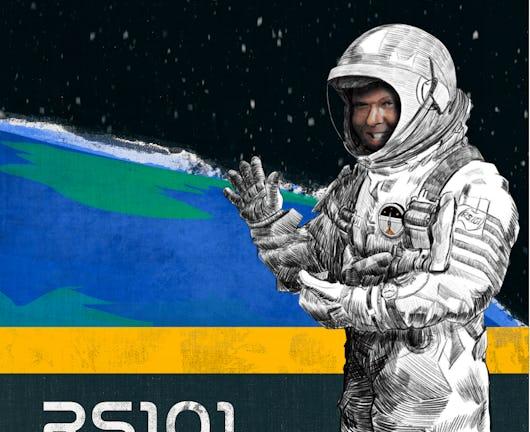
Week 1 - You will learn about the course and the specialization as a whole as well as the method used to guide you through the material. You will also get to meet the crew of the USS Pathway to Space. As your instructor and captain, I will create a unique and hopefully fun learning environment full of surprises and moments of connection with the material. We will also discuss how wonder started it all with our first guest, Dr. Valerio Ferme with Space and Wonder.
Week 2 - We have two topics and two guests this week. In A Tour of the Cosmos, with Dr. Erica Ellingson, we will guide you through all the grandeur of the cosmos from the size and scale to the timeline of its existence. In Astrophysics, with Dr. Kevin France, we will explore concept and merger of two great fields of study: Astronomy and Physics. The tools used by an astrophysicists are key to unlocking the cosmos. At the end of this week, you will have a better understanding of the cosmos and your place in it.
Week 3 - Space exploration can happen in two ways. By viewing there and going there. This week we will explore both methods. Our first lesson is with Dr. Paul Hayne and Dr. Carolyn Crow on Space Exploration-Going There. We will look at the stages of exploration and how the science changes at each point. Next, we will meet Dr. Kristy Tiampo as we discuss Space Exploration-Viewing There. We will dive deep into remote sensing work around Earth and how that technique of viewing can be applied throughout the cosmos.
Week 4 - This week, we will discuss some of the great science being conducted in the cosmos as well as our species search life elsewhere in the universe. We have three lessons this week. The first two are in two parts. Extending Science Beyond Earth. In Part 1, we meet Dr. Nick Schneider and discuss how the different wavelengths of light have allowed us to understand other planets like Mars but also Earth. In Part 2, we meet Dr. Dave Brain and discuss what we have learned about other planets in our solar system and compare those discoveries with our home planet. We will end with the Search for Life Elsewhere where our guest, Dr. Bruce Jakosky, and I discuss what is needed for life in the cosmos and where we might find it.
In these lessons, you will become a member of the crew of the USS Pathway to Space and together we will make the unknown, known. Your journey to discovering your pathway to space begins now.
Course 1 of 4 in the Pathway to Space Specialization.

What You Will Learn

  • You will learn about the cosmos and your place in it, the ways we explore space, and how people and politics play a role in what we learn.
  • Plus you will learn how space influences everything in our world all while finding your pathway to space.

Syllabus

WEEK 1
Specialization and Course Overview
Chris Koehler welcomes you aboard the USS Pathway to Space and introduces you to the format, the four courses, the five goals, 146 learning objectives, the crew, and the ship.

WEEK 2
Space and Wonder
Chris and Dr. Valerio Ferme explore the inextricable connection with space and wonder to our journey to make sense of our existence and place in the cosmos.

WEEK 3
A Tour of the Cosmos
Chris and Dr. Erica Ellingson (CUB) take a tour of the Solar System and universe from the perspectives of size, scale and time. [CUB = University of Colorado Boulder]

WEEK 4
Astrophysics
Chris and Dr. Kevin France (CUB/LASP) perform a basic overview of astrophysics and the tools used, such as the Hubble Space Telescope, to understand the cosmos and our place in it. [CUB = University of Colorado Boulder] [LASP = Laboratory for Atmospheric and Space Physics]

WEEK 5
Space Exploration: Going There
Chris, Dr. Paul Hayne (CUB/LASP), and Dr. Carolyn Crow (CUB) discuss discovering the cosmos through spacecraft missions that Go There, such as Apollo, New Horizons, and Juno. [CUB = University of Colorado Boulder] [LASP = Laboratory for Atmospheric and Space Physics]

WEEK 6
Space Exploration: Viewing There
Chris and Dr. Kristy Tiampo (CUB) discuss the study of Earth’s environment and other objects in the cosmos through remote sensing from space. [CUB = University of Colorado Boulder]

WEEK 7
Extending Science Beyond Earth - Part 1
Chris and Dr. Nick Schneider (CUB/LASP) discuss how remote sensing techniques used to study the Earth, along with spectroscopy, are applied to our solar system and beyond. [CUB = University of Colorado Boulder] [LASP = Laboratory for Atmospheric and Space Physics]

WEEK 8
Extending Science Beyond Earth - Part 2
Chris and Dr. Dave Brain (CUB/LASP) discuss understanding Earth’s climate and environment through the comparison and study of other planets in our solar system. [CUB = University of Colorado Boulder] [LASP = Laboratory for Atmospheric and Space Physics]

WEEK 9
The Search for Life Elsewhere
Chris and Dr. Bruce Jakosky (LASP) perform a geological discussion of whether there could be life on other planets or moons in our solar system, or on any of the planets recently discovered orbiting other stars. [LASP = Laboratory for Atmospheric and Space Physics]
Go to Class
MOOC List is learner-supported. When you buy through links on our site, we may earn an affiliate commission.

Related Courses

Archaeoastronomy (Coursera) Coursera
Politecnico di Milano

Archaeoastronomy (Coursera)

Archaeoastronomy is the “science of stars and stones”: it studies the relationships between the ancient monuments and the sky, in order to gain a better understanding of the ideas of the architects of the past and of their religious and symbolic world. The course provides the first complete, easy introduction to this fascinating discipline.

Jun 22nd 2026
5-12 Weeks
Control of Nonlinear Spacecraft Attitude Motion (Coursera) Coursera
University of Colorado Boulder

Control of Nonlinear Spacecraft Attitude Motion (Coursera)

This course trains you in the skills needed to program specific orientation and achieve precise aiming goals for spacecraft moving through three dimensional space. First, we cover stability definitions of nonlinear dynamical systems, covering the difference between local and global stability. We then analyze and apply Lyapunov's Direct Method to prove these stability properties, and develop a nonlinear 3-axis attitude pointing control law using Lyapunov theory. Finally, we look at alternate feedback control laws and closed loop dynamics.

Jun 22nd 2026
4 Weeks
Understanding Einstein: The Special Theory of Relativity (Coursera) Coursera
Stanford University

Understanding Einstein: The Special Theory of Relativity (Coursera)

In this course we will seek to “understand Einstein,” especially focusing on the special theory of relativity that Albert Einstein, as a twenty-six year old patent clerk, introduced in his “miracle year” of 1905. Our goal will be to go behind the myth-making and beyond the popularized presentations of relativity in order to gain a deeper understanding of both Einstein the person and the concepts, predictions, and strange paradoxes of his theory.

Jun 15th 2026
5-12 Weeks
Quantum Optics 1 : Single Photons (Coursera) Coursera
École Polytechnique

Quantum Optics 1 : Single Photons (Coursera)

This course gives you access to basic tools and concepts to understand research articles and books on modern quantum optics. You will learn about quantization of light, formalism to describe quantum states of light without any classical analogue, and observables allowing one to demonstrate typical quantum properties of these states. These tools will be applied to the emblematic case of a one-photon wave packet, which behaves both as a particle and a wave.

Jun 29th 2026
5-12 Weeks
Vers l'infiniment grand (Coursera) Coursera
École Polytechnique

Vers l'infiniment grand (Coursera)

Partez à la découverte de l'infiniment grand, en compagnie de physiciens et de physiciennes qui vont vous faire découvrir l'Univers aux distances les plus grandes connues à ce jour et les outils scientifiques utilisés pour l'étudier. Vous comprendrez ce que les scientifiques ont pu apprendre sur l'histoire et la structure de l'Univers, ses composantes, et comment ils ont pu accumuler ces observations sur les étoiles, les galaxies, les amas de galaxies, et l'Univers dans son ensemble.

Jun 29th 2026
4 Weeks
D'un infini à l'autre (Coursera) Coursera
École Polytechnique

D'un infini à l'autre (Coursera)

Partez à la découverte de l'infiniment petit et de l'infiniment grand, en compagnie de physiciens et de physiciennes qui vont vous faire découvrir les liens entre la structure de la matière aux distances les plus petites et l'organisation de l'Univers aux distances les plus grandes ce jour, et entre les outils scientifiques utilisés pour les étudier. Vous découvrirez que de nombreux messagers venus de notre Univers (le photon, les neutrinos, ou encore les rayons cosmiques) sont aussi des objets d'intérêt pour les physiciens qui étudient la matière aux échelles les plus petites.

Jun 29th 2026
4 Weeks
Big History - From the Big Bang until Today (Coursera) Coursera
University of Amsterdam

Big History - From the Big Bang until Today (Coursera)

Welcome to this Big History course! In this course, renowned scientists and scholars from the University of Amsterdam and beyond will take you on a journey from the Big Bang until today while addressing key questions in their fields. After completing this journey you will have developed a better understanding of how you and everything around you became the way they are today.

Jun 8th 2026
4 Weeks
The Sun and the Total Eclipse of August 2017 (Coursera) Coursera
University of Colorado Boulder

The Sun and the Total Eclipse of August 2017 (Coursera)

A total eclipse is one of the most spectacular sights you can ever see! It looks like the end of the world may be at hand. There is a black hole in the sky where the sun should be. Pink flames of solar prominences and long silver streamers of the sun's corona stretch across the sky. It gets cold, and animals do strange things. People scream and shout and cheer, and remember the experience their whole life. But total eclipses are important scientifically as well.

Jun 8th 2026
5-12 Weeks
The Business, Politics, Policy, & Players of Space Programs (Coursera) Coursera
University of Colorado Boulder

The Business, Politics, Policy, & Players of Space Programs (Coursera)

Welcome Course 3 - The Business, Politics, Policy, & Players of Space Programs. If you are here, you have successfully completed both Course 1 and 2 of this specialization. Course 3 has nine lessons spread out over 4 weeks with 31 Learning Objectives. In this course, we will discover who and what funds the exploration that we have enjoyed learning about in Course 1 and 2. We will also focus on a few specific applications of some of the concepts we have learned about so far with two companies, the Global Positioning System, and the an academic program that could be implemented at your institution of higher learning.

Jun 22nd 2026
4 Weeks
From the Big Bang to Dark Energy (Coursera) Coursera
The University of Tokyo

From the Big Bang to Dark Energy (Coursera)

We have learned a lot recently about how the Universe evolved in 13.7 billion years since the Big Bang. More than 80% of matter in the Universe is mysterious Dark Matter, which made stars and galaxies to form. The newly discovered Higgs-boson became frozen into the Universe a trillionth of a second after the Big Bang and brought order to the Universe.

Jun 15th 2026
4 Weeks