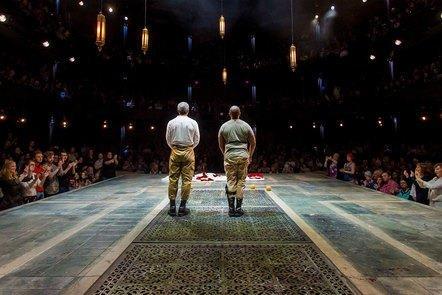
Othello: In Performance (FutureLearn)

Othello: In Performance (FutureLearn)

Explore how Othello has been performed and interpreted, from its original staging to the modern day, with this free online course.

Class Deals by MOOC List - Click here and see FutureLearn's Active Discounts, Deals, and Promo Codes.

While Shakespeare’s Othello is studied and read all over the world, it was written to be staged and can only be fully understood as a play in performance.

Discover how Othello has been performed through time
On this free online course, designed with A-level learners in mind, you will discover how the performances and interpretations of Othello have evolved from its first performance in 1604 to the present day. You will find out what influenced performance choices then and now, and how specific themes within the text have been addressed at different moments in history.
After an introductory week looking at Othello as a whole, we will explore different themes and ideas each week:

  • The significance of race
  • The role of women
  • The form of tragedy

Ultimately, you will analyse the Royal Shakespeare Company’s most recent production of Othello, informed by your learning over the four weeks and exploring three specific scenes.

Learn from Othello actors, academics and directors
You will learn with leading experts, based in Shakespeare’s birthplace, Stratford upon Avon, from the Royal Shakespeare Company (RSC), the University of Birmingham’s Shakespeare Institute and the Shakespeare Birthplace Trust.

  • Jacqui O’Hanlon, RSC Director of Education, will offer an overview of Othello, with insights from: Professor Michael Dobson of the Shakespeare Institute; RSC Artistic Director Gregory Doran and Director Iqbal Khan; and members of the 2015 RSC Acting Company, including Hugh Quarshie, Lucian Msamati and Joanna Vanderham. As part of this, we will explore what Othello is ultimately about, looking at people, places and perspectives.
  • Dr Nick Walton from the Shakespeare Birthplace Trust will discuss the issue of race in Othello, exploring critical responses to this idea, both in original performance and through its performance history before focussing on Act 1 Scene 1.
  • Dr Abigail Rokison-Woodall from the Shakespeare Institute will look at the role of women in the play, uncovering the treatment of those roles in performance from 1604 to the present day, with an emphasis on Act 4 Scene 3, also known as the “Willow Scene”.
  • Dr Anjna Chouhan from the Shakespeare Birthplace Trust will explore Othello as a tragedy, looking in detail at the tragic journeys of the play’s characters and discussing the conclusion of the drama in Act 5 Scene 2.

Along the way, you’ll be able to debate the questions that the play raises - with both course educators and learners from around the world - and draw your own conclusions.

Go to Class
MOOC List is learner-supported. When you buy through links on our site, we may earn an affiliate commission.

Related Courses

Inspiring Peak Performance on Technical Teams (Coursera) Coursera
Advancing Women in Tech

Inspiring Peak Performance on Technical Teams (Coursera)

In the previous course, Leadership Principles for Software Engineers, you learned about how to hire your team and set its goals. Now, learn how to lead each individual team member, increasing their personal best performance, and your team's overall performance, day after day. NANCY WANG, Director of Engineering and General Manager of AWS Data Protection Services and Founder, Advancing Women in Tech (AWIT), shares with you the engineering management skills cultivated at AMAZON (the #2-ranked company in the Fortune 500), with supplemental practices from GOOGLE and MICROSOFT. Develop the skills and mental models that the world's best engineering managers apply to turn their new hires into world-class engineers.

Nov 23rd 2026
3 Weeks
Richard Schechner's Introduction to Performance Studies (Coursera) Coursera
New York University

Richard Schechner's Introduction to Performance Studies (Coursera)

Performance Studies: An Introduction explores the wide world of performance--from theatre, dance, and music to ritual, play, political campaigns, social media, and the performances of everyday life. Performance studies also ranges across cultures--Asia, Africa, the Caribbean, Europe, the Americas. And it spans historical periods from the art of the paleolithic caves to YouTube and the avantgarde. This course is devised by Richard Schechner, one of the pioneers of performance studies, in dialogue with more than a dozen expert scholars and artists.

Nov 23rd 2026
13-24 Weeks
Shakespeare's Language: Revealing Meanings and Exploring Myths (FutureLearn) FutureLearn
Lancaster University

Shakespeare's Language: Revealing Meanings and Exploring Myths (FutureLearn)

Demystify renowned Shakespeare myths and get introduced to corpus-based methods for analysing his use of language in context. Debunk and discover common myths surrounding the language of William Shakespeare. William Shakespeare is a global phenomenon, yet there is actually relatively little work specifically devoted to his language, and even less deploying the latest techniques from linguistics.

Jul 12th 2021
4 Weeks
The Science of Endurance Training and Performance (FutureLearn) FutureLearn
University of Kent

The Science of Endurance Training and Performance (FutureLearn)

Learn about the science behind endurance sports training and performance, including effective preparation and rehabilitation. Endurance sports such as cycling, marathons and triathlons are increasingly popular. Events attract everyone from elite athletes striving for performance improvements, to sedentary individuals looking to improve their health and well-being.

No sessions available
5-12 Weeks
Poetry: How to Read a Poem (FutureLearn) FutureLearn
University of York

Poetry: How to Read a Poem (FutureLearn)

Discover what poetry can tell us about human emotion and learn key ideas and techniques for understanding and interpreting verse. Dive into the wonderful world of poetry and learn how to analyse a poem. Humans have communicated their thoughts, ideas, and feelings through poetry throughout history. At its best, it tells us new truths about the human experience. However, it’s often presented as hard to understand without expert knowledge. On this course, you’ll build your confidence in reading and enjoying poetry.

Self Paced
4 Weeks
Shakespeare: Context and Stagecraft (FutureLearn) FutureLearn
King's College London

Shakespeare: Context and Stagecraft (FutureLearn)

Explore Shakespeare’s stagecraft through three of his most well-known plays: Romeo and Juliet, The Merchant of Venice and Macbeth. Study fascinating theatrical and social contexts that shaped Shakespeare’s plays. On this course, you’ll explore the language, themes, and contexts of three of Shakespeare’s most widely studied and frequently performed plays.

Self Paced
2 Weeks
Shakespeare: Print and Performance (FutureLearn) FutureLearn
King's College London

Shakespeare: Print and Performance (FutureLearn)

As part of Shakespeare400, learn about Shakespeare in print and performance around the world, from early modern times to today. Why do we continue to read and perform Shakespeare’s works around the world today? How were his plays performed and printed 400 years ago, and how has our conception of Shakespeare changed over the centuries?

Self Paced
4 Weeks
Literature and Mental Health: Reading for Wellbeing (FutureLearn) FutureLearn
The University of Warwick

Literature and Mental Health: Reading for Wellbeing (FutureLearn)

Find out how poems, plays and novels can help us understand and cope with deep emotional strain in this free online course. The great 18th century writer Dr Samuel Johnson, who suffered from severe bouts of depression, said “the only end of writing is to enable the reader better to enjoy life or better to endure it.” This free online course will explore how enjoying literature can help us to endure life.

No sessions available
5-12 Weeks