Performance Studies: An Introduction explores the wide world of performance--from theatre, dance, and music to ritual, play, political campaigns, social media, and the performances of everyday life. Performance studies also ranges across cultures--Asia, Africa, the Caribbean, Europe, the Americas. And it spans historical periods from the art of the paleolithic caves to YouTube and the avantgarde. This course is devised by Richard Schechner, one of the pioneers of performance studies, in dialogue with more than a dozen expert scholars and artists.
Class Deals by MOOC List - Click here and see Coursera's Active Discounts, Deals, and Promo Codes.
Performance Studies: An Introduction puts students in dialogue with the most important ideas, approaches, theories, and questions of this dynamic, new academic field.
By the end of this course, you should be able to:
- Articulate and analyze the major concepts of performance studies
- Identify and analyze performances within the “broad spectrum of performance”--from everyday life and social media to performance art and global spectacles such as the Olympics
- Comprehend key terms of performance studies, including is/as performance, restored behavior, ritual, play, make-belief/make-believe, performance in everyday life, the performative, and intercultural performance
- Produce collaborative work that demonstrates teamwork in applying ideas learned in the course
- Compare, analyze, and interpret performances of their own and other cultures
- Articulate how the major concepts of the course relate to their own experiences and worldviews
- Analyze and criticize in a constructive way the work of classmates
The lessons present Schechner’s concept of performance studies along with online assignments. In the assignments, students apply what they are learning by composing short responses to materials, writing in their NYU Classes Forums, and by reviewing other students’ forum posts each week.
Students choose either to work in groups of 3 to 5 on a term-long project maintaining a project portfolio in NYU Classes or to write a research paper. During the term, each group will lead an in-class 25-minute discussion of their project-in-progress. During the last face-to-face class, each group will present their project.
The weekly content is:
- What is Performance?
- What is Performance Studies?
- Performance Processes
- From Not Performing to Performing
- Ritual
- Play
- Performing in the Paleolithic
- Ramlila of Ramnagar
- The Performing Brain
- Performativity
- Constructing Social Roles
- Social Media
- Intercultural, Transcultural, Global
- Group Projects & Wrap Up
- Course Requirements
Each student is required to complete the week’s online lesson prior to the class session, attend and participate in the class sessions, complete the weekly assignments, participate and present the group project or submit a final paper.
Required Readings
See weekly online lessons.
Required Viewings (Videos)
See weekly online lessons.
Written work
Each student will either participate in a group project or write a research paper due at the end of the term, submitted electronically. Your professor will confer online and/or face-to-face during office hours to help students develop their writing and their projects. If you do a group project your professor may ask you to do some writing in relationship to your project.
Syllabus
WEEK 1
Introducing the Course
“Performance Studies: An Introduction” explores the wide world of performance--from theatre, dance, and music to ritual, play, political campaigns, social media, and the performances of everyday life. Performance studies also ranges across cultures--Asia, Africa, the Caribbean, Europe, the Americas. And it spans historical periods from the art of the paleolithic caves to YouTube and the avantgarde. This course is devised by Richard Schechner, one of the pioneers of performance studies, in dialogue with more than a dozen expert scholars and artists. “Performance Studies: An Introduction” puts you--students--in dialogue with the most important ideas, approaches, theories, and questions of this dynamic, new academic field.
WEEK 2
What Is Performance? What Is Performance Studies?
What is performance? What is Performance Studies? Performance is a broad spectrum of actions ranging from play, games, popular entertainments, and rituals to the performing arts, professional roles, political personae, media, and the constructions of race, gender, and identity in everyday life. Performance studies is the academic discipline whose topic is this broad spectrum of actions. To perform is to act in a play, to dance, to make music; to play your life roles as friend, child, parent, student, and so on; to pretend or make believe; to engage in sports and games; to enact sacred and secular rituals; to argue a case in court or present a PowerPoint in class ... and many more activities, too.
Understanding and theorizing the broad spectrum of performance is what performance studies (PS) does. PS is a relatively new academic discipline. The first PS department began at New York University in 1980. The second PS department was started at Northwestern University in 1985. PS expanded rapidly and by now, deep into the second decade of the 21st century, there are PS departments on every continent except Antarctica.Topics we will cover the following topics:What is performance?Kinds of performance Functions of performanceIs/as performanceRestored behaviorMake belief and make believePerformances in/of everyday lifeWhat is performance studies?
WEEK 3
Performance Processes
Performances of all kinds are generated, enacted, and evaluated. Exactly how are performances generated? How are they enacted? How are they evaluated? In this lesson, we will concentrate on the processes of making, doing, and evaluating theatre, dance, and music. Why this focus on the "performing arts"? Because the performing arts provide a clear model of performance processes. This model can be applied to the performances of everyday life, rituals, play, and so on. Also I use the performing arts because in their many varieties globally and historically they permeate social, political, intellectual, scientific, and religious life. Shakespeare's adage "all the world's a stage" is demonstrably true (As You Like It II, 2: 138). Throughout this course, we will move back and forth from the aesthetic domain to the other domains of performance
WEEK 4
From Not-Performing to Performing
Performing is a broad spectrum term, meaning everything from stage acting and ballet dancing to arguing a case in court and displaying different emotions by smiling, frowning, or glaring in anger. In fact, people can't help but perform: displaying and communicating feelings and ideas by means of "codified" behavior, behavior that is shaped in order either to clarify meaning or to be more beautiful – or both. This week we will start in the theatre, move to the courtroom, and end studying the expressive range of the human face.
WEEK 5
Ritual
Ritual, like play, underlies all performances and performance-making processes. Ritual has biological roots in non-human animals and manifold cultural manifestations in human societies. Truly, we perform rituals both secular and sacred from before birth to after death.
WEEK 6
Play
People play from birth to death. Play, like ritual, has roots in animal behavior. Cats batting toy mice, dogs fetching balls, chimps wrestling one another, dolphins frolicking in the waves. People-play is very complex, ranging from roughhouse and sports to make believe, pretending, masking, mind-games, and con games (dark play). In this week's lesson, we examine the broad range of play -- make believe, mimicry, carnival, sports, dark play, flow, metacommunication, and more.
WEEK 7
Performing in the Paleolithic
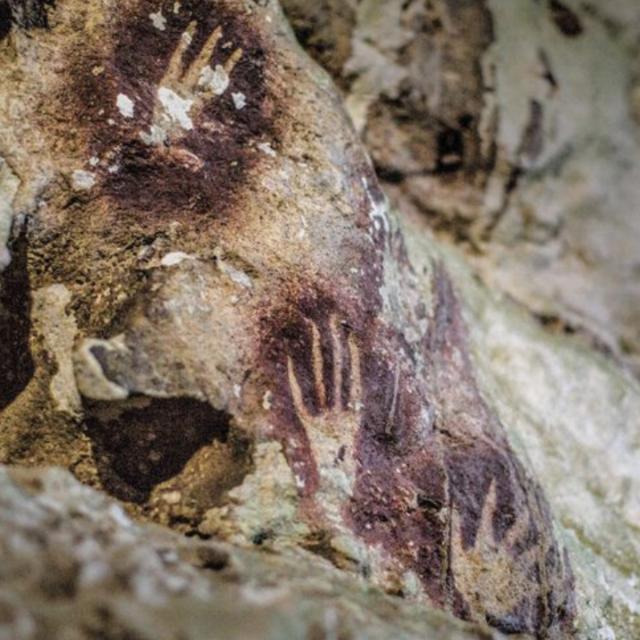
In numerous caves around the world, humans many thousands of years ago made "cave art." The earliest art — marks, stencils, images, sculptings — dates to 35-40,000 years BP (before present, with “present” being 2000). Some goes back further, to 70,000 BP and perhaps even earlier.
There is a concentration of this art in southwestern France, northeastern Spain, and southwestern Germany. In 2014, hand stencils and the figure of a pig in the Maros cave in Sulawesi, Indonesia, were dated to 39-40,000 years BP. More recent cave art exists in the Americas, Australia, Africa, and Asia. Doubtlessly, there will be future discoveries in various parts of the world. This week, we will explore how the paleolithic art of Europe was made and what it may have been used for. Could caves be the sites of very ancient human performances?
WEEK 8
Ramlila of Ramnagar, India
The Ramlila of Ramnagar is a 31-day outdoor performance attended by thousands. The Ramlila tells the story of Rama, the seventh avatar (incarnation) of the Hindu god Vishnu. Ramnagar is a town of 49,000 across the sacred Ganga (Ganges) River from Varanasi, a city of 1.1 million (both numbers from the 2011 census). In this week's lesson, we will apply some concepts from earlier lessons. The Ramlila is an excellent example of ritual and play, make-believe and make-belief, maya-lila, social drama, and communitas. Many Ramlilas are performed in India and in the Indian diaspora. Here, unless I specify otherwise, "Ramlila" refers to the Ramlila of Ramnagar.
Glossary and Pronunciation Because this week's lesson contains terms, places, and names that may be unfamiliar to you, I have made a glossary. Just click on a word in bold and you will be taken to its definition. Try it with Rama. In the north Indian dialect of Hindi where Ramlila is performed, the final "a" of many Sanskirt names is not pronounced. The god Rama is "Ram." His brothers Lakshmana, Bharata, and Shatrughna are "Lakshman," "Bharat," and "Shatrughan." The rakshasa (demon) Ravana is "Ravan," and so on.
WEEK 9
Performativity
Performativity is a vast subject stretching from the performances of everyday life to kinds of writing that "does something" such as wills or contracts. Performativity is a way of thinking about human actions in terms of how these actions are staged – sometimes consciously, sometimes unwittingly. A wide range of cultural products from advertising to political speeches, the arts to popular entertainments, newspapers to social media, can be analyzed as "performatives." For the next two lessons, we will explore performativity not only as a theory but as it operates in daily life, the media, and the arts.
WEEK 10
Constructing Social Roles
This week, we will continue to explore performativity – in terms of social roles. What roles do people play in their daily lives? How does being part of a family, a clutch of friends, a class, or any other of the many groups people belong to change who a person “really is”? Does each individual have a core self or do people change in response to circumstances? How does the process of growth, development, and decline affect who a person is? The complex relationships between society and biology, the individual and the group, are always in flux. Maintaining any particular place within a social group takes “emotional labor” – also called "immaterial labor" – a kind of “deep acting.” People are not pretending or being insincere as they move through various social roles. Performance studies offers ways to question, examine, and understand these roles.
WEEK 11
Social Media
How important is social media? Donald Trump, who Tweets incessantly, credits his election and the success (if you call it that) of his agenda to social media. Social media is the public face of digitization. Digitization is the ability to quantify data, turn data into information, manipulate the information, derive knowledges from it, and disseminate those knowledges. Digitization is a two-way street. Data becomes knowledge and knowledge becomes data. This process is revolutionizing human societies. The internet is an example of digitization – and social media is part of the internet. In fact, social media is exactly what the phrase indicates: the means (media) for people to "socialize," – to be in touch with each other on various scales ranging from one-to-one, one-to-few, few-to-few, one-to-many, and many-to-many. Theoretically a single person can communicate with the whole world.
The flexibility of social media means that it can be used not only for personal contact but to convene a public in the digital commons. This new democracy, if one can use that word in this instance, is not the agora of ancient Athens where all the adult men met to decide matters of common interest. But it is not not the agora. It is a version of this ancient idea. By means of YouTube, Twitter, Facebook, email, and such, people interact as individuals and small groups; and as large associations and even "all" of humankind, at least in theory. On social media, a person is always performing, constructing an online "persona" – the ancient Greek and Latin word for a theatrical mask/character. Etymologically, a "person" is a mask, a performance. If a person's daily behavior is a performance – and in this course you have explored how this is so – then a person's online persona is doubly performative. Online performances are not inauthentic. But on social media they can be constructed and managed carefully and consciously. In last week's lesson we learned that gender and race are constructed. Similarly, people construct versions of themselves on and for social media. In the final section of this week's lesson, "Media's Influence on the Arts," I go beyond social media and the performing arts. I consider media in the larger sense, including both digital and nondigital media, in relation to all the arts. My principal example comes from theatre, but I want you to extrapolate from this example and apply what you learn to all the arts.
WEEK 12
Intercultural, Transcultural, Global
The world is always getting smaller. It's been that way for millennia. Each time a new means of communication is invented, the world shrinks. The world with spoken language is smaller than the world without it; the world with written language is smaller than the world without it. And on through printing, telecommunications, digitization, the WWW, the internet .... Doubtlessly, in the future the world will get even smaller. More crowded not only with people but with ideas, ideologies, arts, and technologies. Therefore, in one sense, globalization is nothing new. It is the continuation – and acceleration – by new means of the long-operating process of linking humans to each other across time and space. Sometimes these links result in increased cooperation and understanding. Sometimes these links result in conflicts, displacements, wars, and genocides. In other words, there is nothing inherently good or bad about the process of world-shrinking aka globalization.
Of course, there is also the possibility also that at some point globalization will result in smoothing out cultural differences as information technology and the increasing mobility of people – sometimes voluntarily, sometimes under pressure – accelerates the emergence of a global uniculture. Already such a uniculture exists as both an umbrella and a base, systems that overarch individual cultures and underlie them at the same time. While "purity" used to be a prime value, today hybridity holds sway. At the same time, there is plenty of evidence showing the continuing vibrancy of distinct cultures and belief systems; globalization has not eliminated differences in religion, languages, ideologies, and cultural practices. These differences, and other factors including the inequities fostered by globalization, create a backlash against globalization -- the rise of Donald Trump in the USA, the increasing strength of Marine Le Pen in France, the Brexit vote taking the UK out of the European Union, and nationalist/xenophobic movements elsewhere. Terrorism can be read as anti-globalization. Today's world is both global and local: glocal. Many of the myriad interactions of the glocal are performative.
WEEK 13
Looking Back, Looking Forward
Looking Back, Looking Forward:
We are nearing the end of our journey exploring the broad spectrum of performance studies. Performance studies is a discipline and a methodology. We have worked with both the theories and practices of many scholars and artists, from a variety of disciplines and genres, considering these in relation to a variety of secular and sacred performances across cultures, styles, epochs, and genres. You are learning performance studies by practicing it. Performance studies is always going somewhere, but never arriving at a stop-point. Or, to put it differently: performance studies is embodied and archival research moving into new places with new ideas creating as well as finding its topics and objects of study. Performance studies is imagined at the intersection of cultures, academic disciplines, artistic practices, and social media. Performance studies will keep growing and changing as more programs and departments are created and more scholars and artists use performance studies as a method of inquiry and creativity. In this course, you've worked both with me online and with a teacher in class. The in-class teacher and I have been in contact about the work you've been doing. We recognize that this course, both online and in class, is a living organism. We've tried to make the relationship between learning and teaching organic and performative. Explaining, defining, probing, exploring, researching, writing, and critically examining the topics of this multi-layered course are integral to the teaching-learning process. In a phrase, you are teaching us just as we are teaching you. During the past weeks, you have practiced the process of performance studies. This week you will show and share some of the results of that practice. You will present your final projects or your final papers. Shortly after, you will turn in your final papers on [date]. I hope that your presentations and papers won't be the end of the matter. I hope that what you've accomplished during this course will inform the way you live the rest of your lives.