New Business Models - Working Together on Value Creation (iversity)

New Business Models - Working Together on Value Creation (iversity)

Learn how to build your own sustainable New Business Model, based on your own ideas. Step by step, you will build and test the model, leading to a mature result than can be put to practice instantly after the course.

Have you ever dreamed about starting your own business? Are you dedicated to sustainability but don't know how to put this passion into practice? Do you see challenges in your community which you want to change? If the answer to one or all of these questions is yes, then this is the course for you!
In this course, you will systematically explore and build your own New Business Model around your own idea. In a systematic manner, we will present you with five building blocks that will help you develop a viable and valuable model. By using the knowhow and experience of your peers in this course, you gain insight into what others are doing and get feedback on your own results. Step by step, you will build and test the model, leading to a mature result than can be put to practice instantly after the course. Enrol and invest in new adventures that will help you to create a lasting impact for yourself and the community around you.

By the end of the course, you will know:

  • the role of business models in a changing economy, against the background of trends and developments.
  • understand how the economy and society is changing and how to use this as input for your value proposition.
  • how to make making an initial design for your NBM.
  • who and what you will need for your NBM and how to design your own NBM.
  • how to improve your value proposition, based on three principles of value creation.
  • how to develop a community of people who actively participate in your NBM.
  • how to distinguish and assess the values your NBM is creating.

Course Structure

Chapter 1: Introduction
1.0 Introduction: Part of the first video, welcome to the week, learning objectives and assignments.
1.1 What is sustainability: Understand the notion of sustainability from a organisational and business wise perspective.
1.2 The great transition: Identify the transition from a linear to a circular economy and what this implies.
1.3 Business Models & why do we need new business models?: What is a business model and why a changing economy needs a new generation of business models.
1.4 Living in a changing economy: Identify seven trends and developments of a changing economy
1.5 Let’s talk about your NBM: What are you going to do? At the end of this course you will have your own new business model. Note to self: Isn’t this the right time to start your own community for your NBM?

Chapter 2: WEconomy
2.1 WEconomy: Understand how the economy and society is changing and how to use this as input for your value proposition.
2.2 Bio-based, functional and circular economy: Describe how we can shift from a commodity-based economy to one based on natural materials.Understand how the economy is changing from a linear to a circular model and what this implies when it comes to design. Explain the notion of selling functions instead of products and how this impacts ownership / legal structures.
2.3 Sharing and Collaborative economy: Understand what “asset management” is and how it offers tremendous possibilities for the sustainable economy. Understand how a changing economy requires new concepts of collaboration. 2.4 Self-production (3D) economy: Envision the rise of self-production through 3D print technology.
2.5 Internet of Things + Let’s talk about your NBM: Understand how people and things and things are exponentially connected and what this implies for transition. Write down your value proposition for the first time, upload and ask for feedback.

Chapter 3: New Business Model Design
3.1 Pitching your NBM team: Identify and describe the people with whom you want to develop the initial value proposition.
3.2 Organising your NBM?: Describe what kind of organisational concept you have in mind.
3.3 Resources needed for your NBM? Make an inventory of the things you need to structure your value proposition.
3.4 Case-study: Study several real world examples and analyse how they have shaped their value proposition.
3.5 Let’s talk about your NBM: This week we concentrated on the who, how and what. Write this down for your NBM, upload it and ask for feedback.

Chapter 4: Principles & Value proposition
4.1 What is value creation? Understand the nature of value creation from a co-creation perspective.
4.2 Comparing conventional and new business models: Recognise the difference in value creation between conventional and new business models.
4.3 Principles: Understand how business models are based on principles and what the principles are at play in new business models.
4.4 Reassessing the value proposition: Analyse your initial value proposition in the light of principles of value creation.
4.5 Let’s talk about your NBM: Write down your new value proposition, upload it and ask for feedback.

Chapter 5: Community building
5.1 What is a community?: Identify the key elements that make up a community.
5.2 Communities come in different shapes and sizes: Describe the different character of communities.
5.3 Building a community means building a value network: Create a value network based on diversity, scope and the nature of membership.
5.4 How to build your own community? Structure a community based on role division, principles and membership.
5.5 Let’s talk about your NBM: Start looking for a limited number of people who will help you elaborate the model, either on the internet or in your psychical environment. Ask them for feedback on your value proposition and upload the feedback.

Chapter 6 Assessing value creation
6.1 What is the value created? Understand the nature of values and which role they play in business models.
6.2 How do we assess values: Understanding the difference monetisation and valuation.
6.3 Assessing the value created by your NBM: Understand how valuation and monetisation are embedded in your NBM
6.4 Missed chances: Assess your business model from a non-monetary perspective.
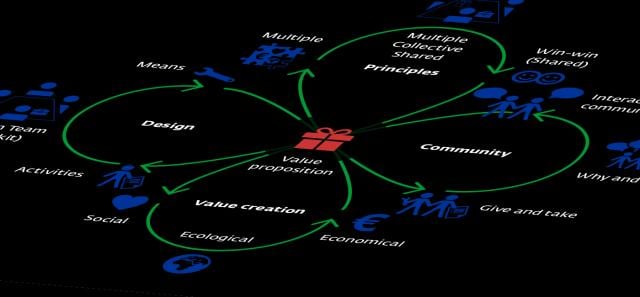
6.5 Let’s talk about your NBM: At the end of this week you will have a complete clover canvas and you will hand this in as a text (100 words).
6.6 Make a video of your NBM: Make a video of your NBM and upload it.


Go to Class
MOOC List is learner-supported. When you buy through links on our site, we may earn an affiliate commission.

Related Courses

Management of Urban Infrastructures – part 1 (Coursera) Coursera
École Polytechnique Fédérale de Lausanne

Management of Urban Infrastructures – part 1 (Coursera)

Sustainability, Resilience and Efficiency are fundamental considerations for city managers in managing urban infrastructures. Today, more than 3.9 billion people, making up more than 54% of the global population, live in cities. Urbanization is expected to continue in the coming years, raising the urban population to 6.0 billion by 2045. This dramatic increase in urban populations will inevitably increase the demand for energy, mobility (transportation), water, and other urban services in every city around the world. Without functional governance and management structures that ensure efficient, resilient and sustainable performance in cities, the current urbanization growth might become a catastrophic risk threatening the quality of life of the humanity.

Jun 22nd 2026
5-12 Weeks
Applying Data Analytics in Marketing (Coursera) Coursera
University of Illinois at Urbana-Champaign

Applying Data Analytics in Marketing (Coursera)

This course introduces students to the science of business analytics while casting a keen eye toward the artful use of numbers found in the digital space. The goal is to provide businesses and managers with the foundation needed to apply data analytics to real-world challenges they confront daily in their professional lives.

Jun 27th 2026
4 Weeks
Subsistence Marketplaces (Coursera) Coursera
University of Illinois at Urbana-Champaign

Subsistence Marketplaces (Coursera)

The foundation for this course lies with unique synergies between pioneering research, teaching, and social initiatives through the Subsistence Marketplaces Initiative. Unique to this approach is a bottom-up understanding of the intersection of poverty and the marketplace. The goals of this course are to help you develop an understanding of marketplace activity in the radically different context of subsistence where much of humanity resides and survives, and for you to design solutions that can be implemented by individuals, businesses, and social enterprises through economically, ecologically, and socially sustainable products for subsistence marketplaces.

Jun 22nd 2026
5-12 Weeks
Financial Markets (Coursera) Coursera
Yale University

Financial Markets (Coursera)

An overview of the ideas, methods, and institutions that permit human society to manage risks and foster enterprise. Emphasis on financially-savvy leadership skills. Description of practices today and analysis of prospects for the future. Introduction to risk management and behavioral finance principles to understand the real-world functioning of securities, insurance, and banking industries. The ultimate goal of this course is using such industries effectively and towards a better society.

Jun 22nd 2026
5-12 Weeks
What is Social? (Coursera) Coursera
Northwestern University

What is Social? (Coursera)

The “What Is Social?" MOOC is for business owners, executives, and marketing professionals who want to significantly improve their abilities to grow their social strategy using effective, proven methodologies. This hands on, "how to" program won’t just tell you how to grow your professional persona using social – you will actually do it! This course is the first in the six-course specialization, Social Media Marketing: How to Profit in a Digital World.

Jun 22nd 2026
4 Weeks
Managing the Organization (Coursera) Coursera
University of Illinois at Urbana-Champaign

Managing the Organization (Coursera)

This course is intended to help you become a better manager by helping you to more fully understand and deal with some of the complexities and challenges associated with managerial life in organizations. In this course, you will learn theories, principles, and frameworks that will help you to more effectively manage and lead the organizations that you belong to. We will view organizations from different perspectives that we will use as lenses to help us highlight common managerial challenges and point us toward solutions to those challenges. Some of these common challenges that we will explore in this course include using power effectively, implementing organizational change, understanding and managing organizational culture, decision-making including decision-making pitfalls and ethical traps, and leadership. As you learn and apply the principles from this course, you will be better prepared to navigate some of the complex challenges that you face as a manager.

Jun 24th 2026
4 Weeks
Fundamentals of Management (Coursera) Coursera
University of California, Irvine

Fundamentals of Management (Coursera)

Are you about to enter the workforce? Are you an emerging professional? Are you new to your role in the organization? All prospective new employees benefit from understanding management principles, roles and responsibilities, regardless of position. Now you can acquire an in-depth understanding of the basic concepts and theories of management while exploring the manager's operational role in all types of organizations. Gain insight into the manager's responsibility in planning, organizing, leading, staffing and controlling within the workplace. It’s never too soon to plan your professional path by learning how the best managers manage for success!

Jun 22nd 2026
4 Weeks
Creating a Social Business (Coursera) Coursera
Yunus Social Business Fund Bengaluru

Creating a Social Business (Coursera)

This course is primarily aimed at learners interested in knowing about and running a social business. An ideal learner could be a student, social entrepreneur, social intrapreneur, or a corporate professional interested in social business. In the Module 1 of the course students will learn how different social business leaders - such as Professor Muhammad Yunus, Rajni Bakshi, Corinne Bazina, Lamiya Morshed, Suresh Krishna, and Daniel Nowack - are reimagining capitalism. The subsequent modules of this course crystallize varied learnings of practitioners and theorists at YSB to a set of tools and readings, which a learner may use as building blocks of a social business.

Jun 24th 2026
5-12 Weeks