Moral and Political Philosophy (saylor.org)

Offered by Saylor.org,
Moral and Political Philosophy (saylor.org)

This course will introduce you to the basic concepts and methods of moral and political philosophy. Its primary focus is on the development of moral reasoning skills and the application of those skills to contemporary social and political issues.

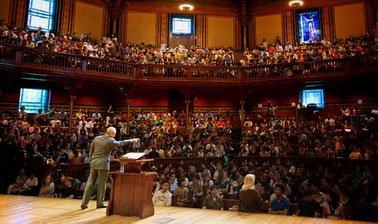
This course will introduce you to the basic concepts and methods of moral and political philosophy. Its primary focus is on the development of moral reasoning skills and the application of those skills to contemporary social and political issues. Although the course is organized around the central concept of justice, it uses this notion as a point of departure for discussing a wide range of philosophical topics and perspectives. Topics range from the value of human life, the moral standing of the free market, and the notion of fundamental human rights, to equality of opportunity, the legality of same-sex marriage, and the conditions for a moral community. In order to investigate these topics, this course makes extensive use of Professor Michael Sandel’s video lecture course on justice, delivered at Harvard University in 2009. In addition to these lectures, you will study a number of important moral and political philosophers, including Plato, Aristotle, John Locke, Thomas Hobbes, Jeremy Bentham, John Stuart Mill, Immanuel Kant, Jean-Paul Sartre, Friedrich Nietzsche, and John Rawls. Supplementary readings will include texts from contemporary philosophers, such as Robert Nozick, John Finnis, Alasdair MacIntyre, and others, as well as news articles and primary source texts regarding important legal decisions. By the end of the course, you will have gained a detailed understanding of the philosophical issues involved in many contemporary debates in the public sphere, as well as a refined sense of your own moral and political positions and intuitions.

Upon successful completion of this course, the student will be able to:

  • Identify and describe the major areas of moral and political theory, explain how those areas differ from and relate to one another, and place the views and arguments of major philosophical figures within those areas.
  • Use ethical, moral, and political terminology correctly and consistently.
  • Apply critical thinking and reasoning skills to ethical issues in a variety of professional contexts.
  • Identify and describe several major theories of justice and morality, including utilitarianism, libertarianism, social contract theory, deontology, and the ethics/politics of virtue.
  • Analyze how moral and political dilemmas are handled differently by each set of theoretical principles.
  • Analyze the consequences of various moral principles, and interpret how these principles relate to concepts of justice.
  • Discuss the relationship between morality and politics.
  • Identify and describe the origins of western democratic politics and constitutional government.
  • Analyze a range of difficult and controversial moral and political issues, including murder, the income tax, corporate cost-benefit analysis, lying, affirmative action, and same-sex marriage.

Go to Class
MOOC List is learner-supported. When you buy through links on our site, we may earn an affiliate commission.

Related Courses

Philosophy of Science (Coursera) Coursera
University of Pennsylvania

Philosophy of Science (Coursera)

For the last four centuries, scientists have aimed to provide us with an understanding of the world around us. By all appearances, science has made substantial progress during this time. But is this progress real or illusory? And if it is real, how has this progress been made? This four-week course will consider these important questions.

May 18th 2026
4 Weeks
Intellectual Humility: Theory (Coursera) Coursera
University of Edinburgh

Intellectual Humility: Theory (Coursera)

Faced with difficult questions people often tend to dismiss and marginalize dissent. Political and moral disagreements can be incredibly polarizing, and sometimes even dangerous. And whether it’s Christian fundamentalism, Islamic extremism, or militant atheism, religious dialogue remains tinted by arrogance, dogma, and ignorance. The world needs more people who are sensitive to reasons both for and against their beliefs, and are willing to consider the possibility that their political, religious and moral beliefs might be mistaken. The world needs more intellectual humility.

Jun 8th 2026
3 Weeks
The Philosophy of Death (saylor.org) Saylor Academy
Saylor.org

The Philosophy of Death (saylor.org)

This class provides an in-depth introduction to the philosophical problems surrounding death. It takes its starting point in the fact that everyone, eventually, will die. This is one of the few facts that human beings can be absolutely sure about.

Legacy Course
Self-Paced
Existentialism (saylor.org) Saylor Academy
Saylor.org

Existentialism (saylor.org)

Existentialism is a philosophical and literary movement that first was popularized in France soon after World War II by figures such as Jean-Paul Sartre and Albert Camus. The roots of this movement can be traced back to the religious writings of Blaise Pascal in the seventeenth century and those of Søren Kierkegaard in the nineteenth century.

Self Paced
Self-Paced
Setting Expectations & Assessing Performance Issues (Coursera) Coursera
University of California, Davis

Setting Expectations & Assessing Performance Issues (Coursera)

If you don’t know where you are going, any road will take you there. One of the most important roles of a manager is to ensure everyone knows the destination. The most effective managers set expectations and assess their employees’ performance against those expectations, and take a coaching approach to helping them get to the destination. That’s exactly what you’ll learn to do in this course! You will explore how to collaboratively develop expectations with those you lead. When you encounter expectations that are not being met, you’ll learn how to use "Coaching Algebra" to determine the underlying issues that are impeding performance, and how to respond as a manger-coach.

Jun 1st 2026
4 Weeks
Principles of Secure Coding (Coursera) Coursera
University of California, Davis

Principles of Secure Coding (Coursera)

This course introduces you to the principles of secure programming. It begins by discussing the philosophy and principles of secure programming, and then presenting robust programming and the relationship between it and secure programming. We'll go through a detailed example of writing robust code and we'll see many common programming problems and show their connection to writing robust, secure programs in general.

Jun 1st 2026
4 Weeks
Thought Experiments: An introduction to philosophy (Coursera) Coursera
Erasmus University Rotterdam

Thought Experiments: An introduction to philosophy (Coursera)

Doing philosophy is like seeing a movie and wondering what will happen next, or what you would do in the same situation, or what’s real and what’s merely make-believe. You’re probably not aware of it, but since you already know how to see movies and use your imagination, you’re well on your way to becoming a good philosopher. The only thing you still need and want to develop though, is the ability to use your imagination in the philosophical way, and that’s exactly what you’ll learn in this MOOC.

Jun 1st 2026
5-12 Weeks
Ancient Philosophy: Aristotle and His Successors (Coursera) Coursera
University of Pennsylvania

Ancient Philosophy: Aristotle and His Successors (Coursera)

What is philosophy? How does it differ from science, religion, and other modes of human discourse? This course traces the origins of philosophy in the Western tradition in the thinkers of Ancient Greece. We begin with the Presocratic natural philosophers who were active in Ionia in the 6th century BCE and are also credited with being the first scientists. Thales, Anaximander, and Anaximines made bold proposals about the ultimate constituents of reality, while Heraclitus insisted that there is an underlying order to the changing world.

Jun 1st 2026
5-12 Weeks
Know Thyself - The Value and Limits of Self-Knowledge: The Examined Life (Coursera) Coursera
University of Edinburgh

Know Thyself - The Value and Limits of Self-Knowledge: The Examined Life (Coursera)

According to legend, inscribed on walls of the temple on the sacred site of Delphi in Ancient Greece were two premier injunctions: NOTHING IN EXCESS, and KNOW THYSELF. This course will be an examination of the latter injunction in an effort to discover what self-knowledge is, why it might be valuable, and what, if any, limitations it might face.

Jun 1st 2026
4 Weeks
Alfabetização Midiática, Informacional e Diálogo Intercultural - UNESCO e UNICAMP (Coursera) Coursera
Universidade Estadual de Campinas - UNICAMP

Alfabetização Midiática, Informacional e Diálogo Intercultural - UNESCO e UNICAMP (Coursera)

Este curso quer pensar junto com você sobre um fenômeno recente no Brasil, que é a presença de uma grande quantidade de informação via mundo digital. Vamos mostrar diferentes caminhos do que podemos fazer com essa quantidade incrível de midias e como participar da construção de conteúdo digital de maneira sóbria e segura.

Jun 8th 2026
5-12 Weeks
Philosophy, Science and Religion: Philosophy and Religion (Coursera) Coursera
University of Edinburgh

Philosophy, Science and Religion: Philosophy and Religion (Coursera)

Philosophy, Science and Religion mark three of the most fundamental modes of thinking about the world and our place in it. Are these modes incompatible? Put another way: is the intellectually responsible thing to do to ‘pick sides’ and identify with one of these approaches at the exclusion of others? Or, are they complementary or mutually supportive? As is typical of questions of such magnitude, the devil is in the details. For example, it is important to work out what is really distinctive about each of these ways of inquiring about the world. In order to gain some clarity here, we’ll be investigating what some of the current leading thinkers in philosophy, science and religion are actually doing.

May 25th 2026
5-12 Weeks
The Modern and the Postmodern (Part 2) (Coursera) Coursera
Wesleyan University

The Modern and the Postmodern (Part 2) (Coursera)

This course examines how the idea of "the modern" develops at the end of the 18th century in European philosophy and literature, and how being modern (or progressive, or hip) became one of the crucial criteria for understanding and evaluating cultural change. Are we still in modernity, or have we moved beyond the modern to the postmodern?

May 18th 2026
5-12 Weeks