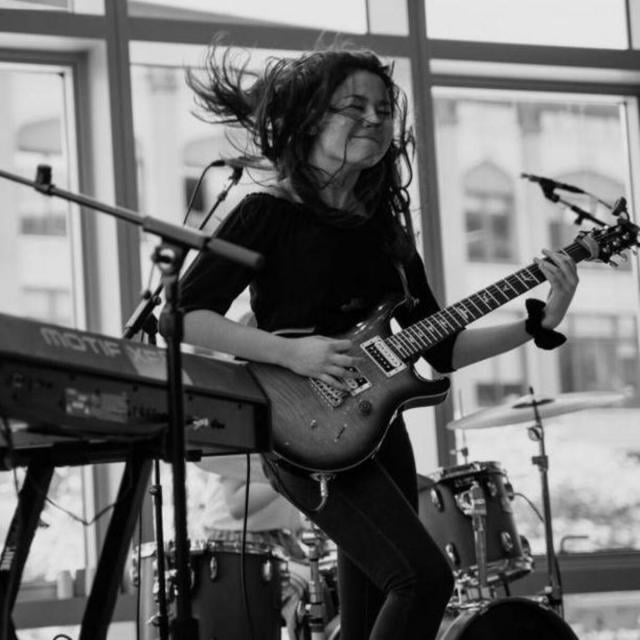
Guitar Performance Techniques (Coursera)

Guitar Performance Techniques (Coursera)

Your favorite guitarist didn't become your favorite guitarist without the support of other musicians. The most important skill for a guitarist to learn is the exact same skill that was so important in kindergarten: playing well with others. Guitar Performance Techniques gives guitarists the essential and practical skills to play well with others in any ensemble situation.

Class Deals by MOOC List - Click here and see Coursera's Active Discounts, Deals, and Promo Codes.

This course begins with daily warm-up techniques that help you prepare for rehearsals, jam sessions, and stage performances. From there, you'll explore chords, time accuracy, tone production, ear training, and the many aspects of jamming with other musicians. Upon successful completion of this course, you will be able to confidently interact with other musicians in a group setting and bring your A-game to any jam session you join.

What You Will Learn

  • Develop warm-up techniques to prepare for ensemble playing
  • Identify and play common chordal accompaniment
  • Demonstrate ensemble playing techniques while performing

Learners should complete "Guitar for Beginners" and "Guitar Scales and Chord Progressions" before enrolling in this course.

Course 4 of 4 in the How to Play Guitar Specialization.

Syllabus

WEEK 1
Welcome to Guitar Performance Techniques!
Welcome to the course! Here we will cover all the details about the course and what you'll need to know to get the most out of your experience.
Warming Up
In this lesson, we begin by learning how to warm up for a rehearsal or performance. Warming up effectively is essential to play your best, and you'll find that it will enhance all of your skills in an ensemble setting. It will help you to play more relaxed, get a better tone, improve your time, intonation, articulation, and allow you to focus on listening.

WEEK 2
Developing Your Ears
This lesson focuses on the skills needed to develop “good ears.” Musicians who develop “good ears” are able to adapt to any musical situation, even when they do not know the song, key, or form. We will go over exercises to improve our ears and we will practice learning melodies and identifying chords by ear.

WEEK 3
Tone Production Essentials: Developing Your Touch on the Guitar
This lesson will focus on key elements to develop your unique and personal sound on the guitar. We will discuss how the pick can be used to adjust four essential elements of your guitar sound: timbre, dynamics, note duration, and intonation. These four essential elements, when practiced with focus, will take you on the path to having a great touch and unique approach to sound and tone.

WEEK 4
Performance Preparation
In this lesson, we'll prepare for a performance. Being prepared for a rehearsal or gig can help to create a relaxed atmosphere and better overall performance experience. We will discuss developing a performance checklist as well the importance of knowing your gear. Finally, we'll highlight the importance of listening and blending on stage.
Go to Class
MOOC List is learner-supported. When you buy through links on our site, we may earn an affiliate commission.

Related Courses

The Piano Sonata: Russian and 20th-21st Century Composers (Coursera) Coursera
University of Michigan

The Piano Sonata: Russian and 20th-21st Century Composers (Coursera)

In this course, you’ll review sonata form and learn how the piano sonata was revitalized in the 20th century, with a particular attention to composers from Russia, where the sonata was an especially popular and successful genre. You’ll study some of the most influential piano sonatas of the 20th century, in both Neo-Classical and avant-garde styles. This course will also expose you to a variety of lesser-known and more recent compositions, showing how the piano sonata genre continues to expand and to thrive.

Jun 22nd 2026
4 Weeks
Story and Narrative Development for Video Games (Coursera) Coursera
California Institute of the Arts

Story and Narrative Development for Video Games (Coursera)

In this course, you will examine how storytelling acts as a vital mechanism for driving video gameplay forward. Looking at several historical and contemporary games, you will be asked to evaluate and interpret different story styles with the goal of identifying themes and procedures for your own game ideas. We'll examine traditional narrative story processes, such as three-act structure, and how they fit into game story flows and the strategic elements of gameplay. Ultimately, you will learn how to define character, setting, and structure to create a compelling game concept.

Jun 22nd 2026
4 Weeks
Songwriting: Writing the Music (Coursera) Coursera
Berklee College of Music

Songwriting: Writing the Music (Coursera)

If your notebook is full of unused lyrics and you’re struggling to find inspiration for the music, this course is for you. Whether you are an experienced songwriter looking for new ideas or a beginning songwriter learning to read music, this course will lead you to a rich source of songwriting possibilities. Led by award winning songwriter and Berklee College of Music professor Scarlet Keys, you’ll learn to construct strong, expressive melodies that your audience will remember as well as experiment with new chords to break out of any harmonic rut.

Jun 22nd 2026
4 Weeks
The Place of Music in 21st Century Education (Coursera) Coursera
The University of Sydney

The Place of Music in 21st Century Education (Coursera)

What do children need from education now, and in the future? How is technology best used in teaching and learning? How can innovative approaches to education be reconciled with established, traditional ones? What does student-centred learning really mean? This five module course is not just for classroom or ensemble music educators. It’s suitable for anyone interested in creativity-infused education, in contemporary education issues, and in the integration and use of digital technology.

Jun 22nd 2026
5-12 Weeks
The Piano Sonata: Origins to Mozart (Coursera) Coursera
University of Michigan

The Piano Sonata: Origins to Mozart (Coursera)

In this course, you’ll be introduced to sonata form; how it works, where it came from, and how sonatas are put together as multi-movement compositions. We will analyze the early history of the piano sonata and discover the important early masters of this style (Scarlatti, CPE Bach, Haydn, and Mozart). You’ll then investigate the relationship between the keyboard instruments of the time and the musical style, and be able to differentiate between Baroque, Galant, and Classical styles.

Jun 22nd 2026
4 Weeks
Aplicaciones musicales con Arduino (Coursera) Coursera
Universidad Nacional Autónoma de México

Aplicaciones musicales con Arduino (Coursera)

En este curso nos adentraremos en el terreno del hardware. Concretamente, aprenderemos a utilizar la placa de desarrollo de hardware de código abierto, llamada Arduino, enfocándonos en las aplicaciones que esta ofrece para la experimentación musical. De manera más específica, aprenderemos en este curso a construir nuestros propios generadores de sonido, y a partir de ello haremos instalaciones sonoras que nos permitirán expandir nuestra creatividad hacia el terreno de las cosas materiales, y ya no solo de los datos informáticos.

Jun 22nd 2026
4 Weeks
William Shakespeare's Twelfth Night: Comedy, Conflict, and Community (Coursera) Coursera
University of Colorado Boulder

William Shakespeare's Twelfth Night: Comedy, Conflict, and Community (Coursera)

This course introduces and explores William Shakespeare’s classic comedy, Twelfth Night. Interviews with actors who appeared in the Colorado Shakespeare Festival’s 2019 production of Twelfth Night, as well as lectures by scholars and theater professionals who work and teach at the University of Colorado Boulder, offer students insight into Shakespeare’s artistic vision and its applications.

Jun 22nd 2026
5-12 Weeks
How Music Can Change Your Life (Coursera) Coursera
University of Melbourne

How Music Can Change Your Life (Coursera)

Did you ever wonder how music works? This course provides free video, audio and journal resources that explain six basic principles about how music can influence individual and community health and wellbeing. From biology and neuroscience, to psychotherapy and politics, the ways we engage with music can make all the difference. Music has always played an integral role in the lives of individuals and communities all around the globe.

Jun 22nd 2026
5-12 Weeks
ART of the MOOC: Activismo y Movimientos Sociales (Coursera) Coursera
Duke University,Creative Time

ART of the MOOC: Activismo y Movimientos Sociales (Coursera)

Este curso es para activistas, artistas y pensadores que deseen entender mejor el cambio social y participar en él. El contenido del curso enfoca en la coincidencia prolífica y emocionante entre el arte socialmente comprometido y prácticas culturales generadas por recientes movimientos sociales en todo el mundo. Más que evaluar la eficacia política de actividades como el luto, la escucha, la organización, el baile, o la fiesta, las conferencias examinan tales actividades culturales al lado y dentro de la práctica artística contemporánea.

Jun 22nd 2026
5-12 Weeks
ART of the MOOC: Activism and Social Movements (Coursera) Coursera
Duke University,Creative Time

ART of the MOOC: Activism and Social Movements (Coursera)

This course is for activists, artists, and thinkers who wish to better understand and participate in social change. We will focus on the prolific and exciting overlap between socially engaged art and cultural practices generated by recent social movements around the world. Rather than assess the political efficacy of activities like mourning, listening, organizing, dancing, or partying, the lectures examine such cultural activities next to, and within, contemporary art practice.

Jun 22nd 2026
5-12 Weeks
The Importance and Power of Music in our Society (Coursera) Coursera
Leiden University,University of the Arts The Hague

The Importance and Power of Music in our Society (Coursera)

Music plays an important role in our daily lives and is woven into the fabric of society. We listen to music while alone or in company, in a dance club or at home, through simple headphones or via high-end speakers, as background or as foreground, after we get up or before we go to bed. Music accompanies us when we are traveling, doing sports, shopping, working or relaxing. This omnipresence of music raises several questions: how does music affect our lives? What is the relation between the society we live in and the role, function, and position of music within that society? How is music influenced by and does music influence social, political, economic, technological, and multiple other developments?

Jun 23rd 2026
4 Weeks