Exploring Beethoven’s Piano Sonatas Part 2 (Coursera)

Exploring Beethoven’s Piano Sonatas Part 2 (Coursera)

Welcome to Part 2 of Exploring Beethoven's Piano Sonatas! I'm delighted to launch another set of new lectures of this course as Part 2. As before, this class is meant for people of all levels of experience with Beethoven's music (including no experience at all!). Remember that you are able to watch the lectures as many times as you like, at whatever pace is comfortable for you.

Class Deals by MOOC List - Click here and see Coursera's Active Discounts, Deals, and Promo Codes.

As I’ve done with the first set of Beethoven lectures, I look forward to meeting with students—online and in person, in various cities. The dates and locations will be posted in the Announcements and Events section, as part of the course content. So please remember to check back there for details.
In these four new lectures, we will explore the following sonatas:
• Sonata Op. 2, No. 3
• Sonata Op. 13 (“Pathetique”)
• Sonata Op. 53 (“Waldstein”)
• Sonata Op. 90

Syllabus

WEEK 1
Welcome to Class!
We’re happy that you’ve joined us for Part 2 of Exploring Beethoven's Piano Sonatas course! This course is considered Part 2, with a brand new and separate set of lectures. In Part 2, we will cover Beethoven's Piano Sonatas Op. 2, No. 3, Op. 13 ("Pathetique"), Op. 53 ("Waldstein") and Op. 90 . Please remember that it doesn't matter if you have taken the first part of the previous Exploring Beethoven's Piano Sonatas course. You can jump in here with Part 2 and start learning right away. And if you'd like, you always have the option of going back to take Part 1 of the original course at any time. The items you see here will enable you to get the most out of Part 2 of the course. Please note that there are previous offerings and resources as part of Part 1, and we encourage you to reference those additional items as well.

WEEK 2
Op. 2, No. 3
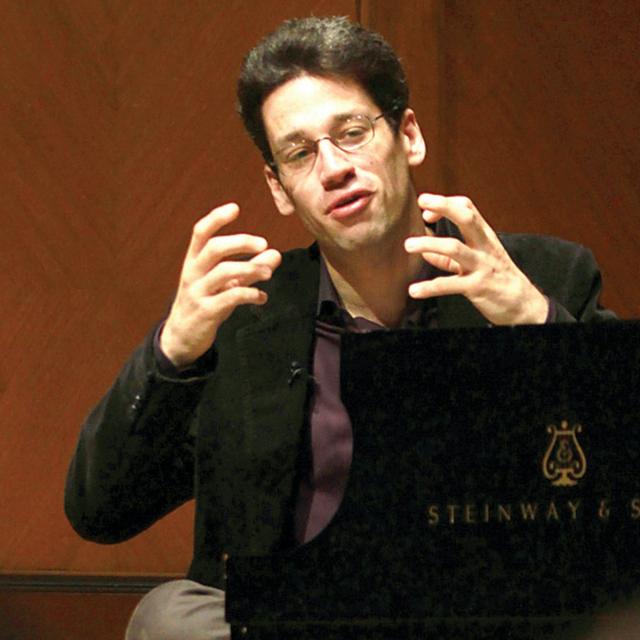
The course kicks off with Beethoven's Op. 2 No. 3, an exuberant work full of youth and ambition. The work was a huge statement for 26-year-old Beethoven, and in this lecture Mr. Biss examines how Beethoven starts to innovate the sonata as a musical form, even in his very first opus for the solo piano. In doing so, we'll also lay some groundwork for the next few sonatas to be covered in the course.

WEEK 3
Op. 13, "Pathetique"
The course continues with Beethoven's Op. 13 Sonata, nicknamed the "Pathétique." Known for its high drama and pathos, the "Pathétique" is a gem from Beethoven's early period and is one of Beethoven's most popular piano sonatas. In this lecture, Mr. Biss uncovers how Beethoven achieves these intense characters within the context of a classical sonata.

WEEK 4
Op. 53, "Waldstein"
The Op. 53 Sonata, nicknamed the "Waldstein," is a monumental achievement and a cornerstone of the piano repertoire. In this lecture, Mr. Biss explains how Beethoven breaks apart conventions in harmony and form to write one of the most adventurous and thrilling compositions of his middle period.

WEEK 5
Op. 90
The final sonata in this course is Beethoven's Op. 90. As Beethoven had not written a piano sonata for five years prior to the composition of Op. 90, Mr. Biss examines this work as a beginning of a late, mature style and a harbinger of great things to come. We will also uncover how Beethoven, ever the innovator, manages to elevate the sonata form into a new, unfathomable realm.

WEEK 6
Listening to the Sonatas
To supplement your learning during the course, enjoy free access to several of the Jonathan's Beethoven Sonatas recordings.

WEEK 7
Feedback Please!
We hope you enjoyed the course. Please take a few minutes to share your thoughts with us.

Go to Class
MOOC List is learner-supported. When you buy through links on our site, we may earn an affiliate commission.

Related Courses

The Arctic as a System (Coursera) Coursera
University of Colorado Boulder

The Arctic as a System (Coursera)

In this course you will first learn about the Arctic as a geographic region, the peoples the Arctic, and the long history of Arctic settlement and exploration. Attention then turns to key features of the Arctic environment – its climate and weather, features of the ocean, sea ice, lands and the Greenland Ice Sheet, and some of the rapid changes being observed.

Jun 8th 2026
5-12 Weeks
Understanding China, 1700-2000: A Data Analytic Approach, Part 1 (Coursera) Coursera
The Hong Kong University of Science and Technology - HKUST

Understanding China, 1700-2000: A Data Analytic Approach, Part 1 (Coursera)

The purpose of this course is to summarize new directions in Chinese history and social science produced by the creation and analysis of big historical datasets based on newly opened Chinese archival holdings, and to organize this knowledge in a framework that encourages learning about China in comparative perspective. Our course demonstrates how a new scholarship of discovery is redefining what is singular about modern China and modern Chinese history.

Jun 8th 2026
5-12 Weeks
Musicianship: Tensions, Harmonic Function, and Modal Interchange (Coursera) Coursera
Berklee College of Music

Musicianship: Tensions, Harmonic Function, and Modal Interchange (Coursera)

After a tremendous response from learners on Coursera, Berklee Online has created a Developing Your Musicianship specialization, and this course is the third course in the series. If you have a general understanding of music theory or if you have completed Developing Your Musicianship I and II, this course will continue to help you understand musical concepts, enabling you to create and perform contemporary music. Taught by Berklee College of Music professor George W. Russell, Jr., the course includes four lessons that delve into an intermediate level of harmony and ear training.

Jun 8th 2026
4 Weeks
The Music of the Beatles (Coursera) Coursera
University of Rochester

The Music of the Beatles (Coursera)

The Music of the Beatles will track the musical development of the band, starting from the earliest days in Liverpool and Hamburg, moving through the excitement of Beatlemania, the rush of psychedelia, and the maturity of Abbey Road. While the focus will be on the music, we will also consider how recording techniques, the music business, the music of other artists, and the culture of the 1960s affected John, Paul, George, and Ringo as they created the Beatles repertory.

Jun 8th 2026
5-12 Weeks
Richard Schechner's Introduction to Performance Studies (Coursera) Coursera
New York University

Richard Schechner's Introduction to Performance Studies (Coursera)

Performance Studies: An Introduction explores the wide world of performance--from theatre, dance, and music to ritual, play, political campaigns, social media, and the performances of everyday life. Performance studies also ranges across cultures--Asia, Africa, the Caribbean, Europe, the Americas. And it spans historical periods from the art of the paleolithic caves to YouTube and the avantgarde. This course is devised by Richard Schechner, one of the pioneers of performance studies, in dialogue with more than a dozen expert scholars and artists.

Jun 8th 2026
13-24 Weeks
Plagues, Witches, and War: The Worlds of Historical Fiction (Coursera) Coursera
University of Virginia

Plagues, Witches, and War: The Worlds of Historical Fiction (Coursera)

A unique and exciting introduction to the genre and craft of historical fiction, for curious students, aspiring authors--anyone with a passion for the past. Read classics of the genre, encounter bestselling writers of historical fiction, and discover your own historical archive while interacting with a global community of interested readers.

Jun 8th 2026
5-12 Weeks
Today’s Music Industry (Coursera) Coursera
West Virginia University

Today’s Music Industry (Coursera)

This course provides an engaging and methodical insight into the past and present cultural and commercial music industry developments, directions, and trends. It will equip the students with the knowledge and skills necessary to appreciate, understand and more productively participate in today’s music industry field.

Jun 8th 2026
5-12 Weeks
Exploring Beethoven's Piano Sonatas (Coursera) Coursera
Curtis Institute of Music

Exploring Beethoven's Piano Sonatas (Coursera)

Our relationship to Beethoven is a deep and paradoxical one. For many musicians, he represents a kind of holy grail: His music has an intensity, rigor, and profundity which keep us in its thrall, and it is perhaps unequalled in the interpretive, technical, and even spiritual challenges it poses to performers. At the same time, Beethoven’s music is casually familiar to millions of people who do not attend concerts or consider themselves musically inclined. Two hundred years after his death, he is everywhere in the culture, yet still represents its summit. This course takes an inside-out look at the 32 piano sonatas from the point of view of a performer.

Jun 8th 2026
5-12 Weeks
The Music of American English Pronunciation (Coursera) Coursera
University of California, Irvine

The Music of American English Pronunciation (Coursera)

In this third course of The Pronunciation of American English specialization, you will learn and practice the "music" of American English, the features of pronunciation such as stress, rhythm, and intonation that will help improve your listening comprehension as well as your ability to communicate more clearly. Each week you will receive practical advice from successful English learners and practice an effective technique called shadowing to improve your pronunciation of the musical features of English.

Jun 8th 2026
4 Weeks
Teaching the Violin and Viola: Creating a Healthy Foundation (Coursera) Coursera
Northwestern University

Teaching the Violin and Viola: Creating a Healthy Foundation (Coursera)

Join us as we explore the fundamental principles and early stages of teaching violin and viola through a series of engaging video lectures and lesson demonstrations, including: 1) Master classes with some of the world’s top string pedagogues, 2) Individual lesson demos of teaching violin/viola set up, left and right hand technique and pieces from the early violin/viola repertoire, 3) Group lesson demos of teaching music theory, ear training and fun activities that encourage good playing habits, and 4) A “field trip” to the violin shop, where we will outfit a new beginning student with a proper instrument and bow.

Jun 8th 2026
5-12 Weeks