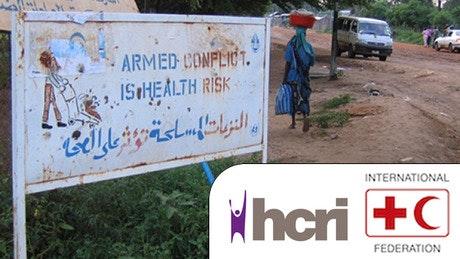
Global Health and Humanitarianism (Coursera)

Global Health and Humanitarianism (Coursera)

Welcome to the Global Health and Humanitarianism MOOC. We are delighted to have you with us, and hope that the next six weeks will provide an interesting and thoughtful experience for you. We hope the course will give you an overview of global health and humanitarianism in theory and in practice.

Class Deals by MOOC List - Click here and see Coursera's Active Discounts, Deals, and Promo Codes.

These fields overlap, and are connected, in many significant ways. However, we have used three key themes to explore our subjects: each key theme will be discussed over two week blocks by specialist course lecturers, and supported by unique video perspectives by three keynote speakers who are leading specialists in the field.

  • Weeks 1 & 2: An Introduction to Global Health Dr Amy Hughes MBE;
  • Weeks 3 & 4: Humanitarian Responses and Dilemmas Dr Tim Jacoby;
  • Weeks 5 & 6: The Right to Humanitarian Assistance and the Responsibility to Protect Dr Kirsten Howarth.

To get the best out of the course we encourage you to try and set aside a few hours each week. This will give you time to work through videos, written materials and linked resources, and to get involved with discussion with other learners. We have provided a variety of different readings, resources and suggested activity based on the course content. Some will be essential to your understanding of the MOOC themes, and to assessment (if you have chosen to take part in assessment activity). Others will be for those of you who want to discover more about a particular subject or perspective, or to make your own study of global health or humanitarianism in action. Check through the weekly resources and content to find out which best suit your needs.
During the course we will look at a range of different opinions and debates, linked to key themes and addressing ethics and moral issues. We hope you will be inspired and encouraged to explore and share your own perspectives, and those of others, throughout the course. Different viewpoints are essential to understanding global health and humanitarian practice.
We hope you enjoy the next six weeks finding out about Global Health and Humanitarianism, and look forward to hearing from you on the discussion boards.

Syllabus

WEEK 1
What is Global Health?
These first two weeks will introduce you to the concept of global health through a range of perspectives from three keynote speakers, draw out some of their key thoughts, explore these with examples, and determine whether we can clearly conclude upon a definition of Global Health. We will be using various educational platforms to navigate the question 'What is Global Health?' - some short video narrations from me, expert thoughts from our three keynote speakers and some external documentary videos and articles.

WEEK 2
Global Health definitions, case studies and evolution
We will first re-visit part of last week's keynote video and discuss their thoughts on what global health is, and bring particular focus to the origin and evolution of the term, the main organisations and agencies involved in global health and the influence of private and commercial organisations on global health.

WEEK 3
Humanitarian Response
This week we will consider what gives rise to a humanitarian emergency. We will look at different types of hazard, and how these combine with vulnerability to give rise to a disaster. We will then go on to think about how responses to such phenomena are organised: Who undertakes these? What phases do they go through?

WEEK 4
Humanitarian Dilemmas
Last week we looked at the nature of 'disasters' and examined a possible set of humanitarian responses to disaster. We concluded by considering the problem of mitigation, leading us to complex ethical questions that make the main focus of the course this week. In particular we will look at the way humanitarian agencies bear witness to the actions of others, and the problem, or requirement, of holding people accountable for these actions.

WEEK 5
The Right to Humanitarian Assistance
In the previous weeks of this course, you learned about the origins, key agencies and different approaches of humanitarianism. As the world becomes more interconnected as a result of globalisation, increased migration and technology, disasters (both natural and man-made) are no longer of local but global concern. The right to assistance for those affected by armed conflict and natural disasters is at the forefront of humanitarian action.

WEEK 6
Responsibility to Protect (R2P)
Moving on from last week, where we examined the right to humanitarian assistance and the obstacles and challenges surrounding its practice, this week we explore another controversial issue within humanitarianism: the responsibility to protect, or more commonly known as R2P.

Go to Class
MOOC List is learner-supported. When you buy through links on our site, we may earn an affiliate commission.

Related Courses

Literacy Teaching and Learning: Aims, Approaches and Pedagogies (Coursera) Coursera
University of Illinois at Urbana-Champaign

Literacy Teaching and Learning: Aims, Approaches and Pedagogies (Coursera)

This course opens with an exploration of the social context and aims of literacy teaching and learning. It goes on to describe a range of historical and contemporary approaches to literacy pedagogy, including didactic, authentic, functional, and critical approaches. The course takes has a 'Multiliteracies' perspective, which aims to expand the definition of literacy to encompass today's multimodal communications, and the diversity of literacies across different social and culltural contexts.

Oct 5th 2026
4 Weeks
Air Pollution – a Global Threat to our Health (Coursera) Coursera
University of Copenhagen

Air Pollution – a Global Threat to our Health (Coursera)

We all have to breathe to live. But the air we breathe is polluted both outdoors and indoors. Each year, this pollution costs 7 million lives across the globe – and a lot of suffering. 1 in 8 deaths is due to air pollution. This course will provide you with an introduction to the most recent research in the field of health effects of air pollution as well as a broader understanding of sources and spread of air pollution and what we should do about it.

Oct 5th 2026
3 Weeks
Data and Health Indicators in Public Health Practice (Coursera) Coursera
Johns Hopkins University

Data and Health Indicators in Public Health Practice (Coursera)

Epidemiology is often described as the cornerstone science in public health. Epidemiology in public health practice uses study design and analyses to identify causes in an outbreak situation, guides interventions to improve population health, and evaluates programs and policies. In this course, we'll define the role of the professional epidemiologist as it relates to public health services, functions, and competencies. With that foundation in mind, we'll introduce you to the problem solving methodology and demonstrate how it can be used in a wide variety of settings to identify problems, propose solutions, and evaluate interventions.

Oct 5th 2026
4 Weeks
Acute and Chronic Rhinosinusitis: A Comprehensive Review (Coursera) Coursera
Icahn School of Medicine at Mount Sinai

Acute and Chronic Rhinosinusitis: A Comprehensive Review (Coursera)

This course is designed to inform primary care physicians and general otolaryngologists about the differences between acute and chronic rhinosinusitis and how to distinguish and treat them. It is also applicable to individuals who wish to broaden their knowledge and vernacular about this disease process, especially those who may suffer from this condition.

Oct 5th 2026
5-12 Weeks
Discover Best Practice Farming for a Sustainable 2050 (Coursera) Coursera
University of Western Australia

Discover Best Practice Farming for a Sustainable 2050 (Coursera)

The Discover Best Practice Farming for a Sustainable 2050 Course is based on a clear vision: imagine best practice farming for 2050, start to implement these strategies now, all the while making sure it will still be profitable. At UWA we're doing just that with the Future Farm 2050 Project, set on a mixed-enterprise farm in Western Australia and we want you to learn how it can be done in your part of the world.

Oct 5th 2026
5-12 Weeks
Children's Human Rights - An Interdisciplinary Introduction (Coursera) Coursera
University of Geneva

Children's Human Rights - An Interdisciplinary Introduction (Coursera)

Drawing on the contributions of several academic disciplines including law, psychology, sociology, history, educational and health sciences, economy and anthropology, an interdisciplinary approach guides the student into a selection of critical issues concerning children’s rights. Participants will gain insight relative to the development of this specific human rights category, as well as to the evolution of the challenges faced by children over time and society’s efforts to respond.

Oct 5th 2026
5-12 Weeks
Systems Thinking In Public Health (Coursera) Coursera
Johns Hopkins University

Systems Thinking In Public Health (Coursera)

This course provides an introduction to systems thinking and systems models in public health. Problems in public health and health policy tend to be complex with many actors, institutions and risk factors involved. If an outcome depends on many interacting and adaptive parts and actors the outcome cannot be analyzed or predicted with traditional statistical methods. Systems thinking is a core skill in public health and helps health policymakers build programs and policies that are aware of and prepared for unintended consequences.

Oct 5th 2026
4 Weeks
Psychological First Aid (Coursera) Coursera
Johns Hopkins University

Psychological First Aid (Coursera)

Learn to provide psychological first aid to people in an emergency by employing the RAPID model: Reflective listening, Assessment of needs, Prioritization, Intervention, and Disposition. Utilizing the RAPID model (Reflective listening, Assessment of needs, Prioritization, Intervention, and Disposition), this specialized course provides perspectives on injuries and trauma that are beyond those physical in nature. The RAPID model is readily applicable to public health settings, the workplace, the military, faith-based organizations, mass disaster venues, and even the demands of more commonplace critical events, e.g., dealing with the psychological aftermath of accidents, robberies, suicide, homicide, or community violence.

Oct 5th 2026
5-12 Weeks
Whole genome sequencing of bacterial genomes - tools and applications (Coursera) Coursera
Technical University of Denmark - DTU

Whole genome sequencing of bacterial genomes - tools and applications (Coursera)

This course will cover the topic of Whole genome sequencing (WGS) of bacterial genomes which is becoming more and more relevant for the medical sector. WGS technology and applications are high on international political agenda, as the classical methods are being replaced by WGS technology and therefore bioinformatic tools are extremely important for allowing the people working in this sector to be able to analyze the data and obtain results that can be interpreted and used for different purposes.

Oct 5th 2026
5-12 Weeks