Generative Design for Performance and Weight Reduction (Coursera)

Offered by Autodesk,
Generative Design for Performance and Weight Reduction (Coursera)

There are many considerations and factors that play a part in designing a new product. Cost is usually a big one, but sometimes there are other factors that are the main contributors to a product's direction. With vehicles, specifically motorcycles, we see advanced engineering practices performed on seemingly minor parts. In some instances, making a part as light as possible can have a big effect on performance.

Class Deals by MOOC List - Click here and see Coursera's Active Discounts, Deals, and Promo Codes.

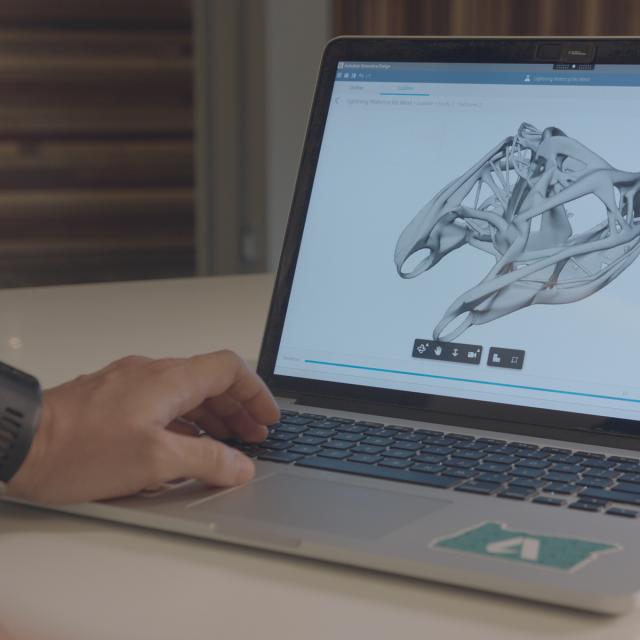
In other cases, the strength or stiffness of a part, such as a motor mount, is more critical than its mass. Generative design allows us the ability to solve for both problems at the same time and make informed design decisions without the sacrifice. In this course, we’ll explore how generative design can be applied to motorcycle parts to help reduce mass while also increasing performance.
Want to take your learning to the next level? Complete the Autodesk Generative Design for Manufacturing Specialization, and you’ll unlock an additional Autodesk Credential as further recognition of your success! The Autodesk Credential comes with a digital badge and certificate, which you can add to your resume and share on social media platforms like LinkedIn, Facebook, and Twitter. Sharing your Autodesk Credential can signal to hiring managers that you’ve got the right skills for the job and you’re up on the latest industry trends like generative design.
Course 2 of 4 in the Autodesk Generative Design for Manufacturing Specialization.
What You Will Learn

  • Examine a multi-component assembly.
  • Create Generative Design Studies.
  • Examine and Select Generative Outcome Iterations.
  • Summarize how to Post Process a Generative Outcome.

Syllabus

WEEK 1
Identifying and Modeling Obstacle and Preserve Regions
In Week 1, we’ll cover the review of a complex assembly and the identification and modeling of any preserve and obstacle regions needed for the definition of a generative design study.

WEEK 2
Setting up a Generative Design Study
In Week 2, we’ll talk about setting up an unrestricted generative design study for multiple materials to explore the swingarm of a motorcycle.

WEEK 3
Review and Select an Outcome
In Week 3, we’ll focus on the tools used to explore and select a generative outcome. Selecting the right iteration of an outcome for production is a critical step in the process.

WEEK 4
Post Process a File for Production
In Week 4, we’ll cover all the little details needed to get a design ready for production. Preserve regions are usually made up of simple geometry that need further modeling attention. Obstacles are usually cut from a generative outcome as a boundary fill operation in the timeline, but it isn’t always needed and doesn’t always produce ideal results. Taking care of the little details in the design will save time from having to manually modify parts after they have been prototyped.
Go to Class
MOOC List is learner-supported. When you buy through links on our site, we may earn an affiliate commission.

Related Courses

3D CAD Fundamental (Coursera) Coursera
National Taiwan University

3D CAD Fundamental (Coursera)

There have many three-dimensional shape of the object in your brain that are wanted to share, but do not know how to express? How to "sketch" the three-dimensional image in your mind? 3D modeling technology can help us construct the most intuitive and understandable three-dimensional model. The use of floor plan interpret the three-dimensional object process-the most direct and effective expression of our ideas.

Jun 15th 2026
5-12 Weeks
Ideal Gases (Coursera) Coursera
University of Colorado Boulder

Ideal Gases (Coursera)

Course 3 of Statistical Thermodynamics, Ideal Gases, explores the behavior of systems when intermolecular forces are not important. This done by evaluating the appropriate partition functions for translational, rotational, vibrational and/or electronic motion. We start with pure ideal gases including monatomic, diatomic and polyatomic species.

Jun 22nd 2026
3 Weeks
The Finite Element Method for Problems in Physics (Coursera) Coursera
University of Michigan

The Finite Element Method for Problems in Physics (Coursera)

This course is an introduction to the finite element method as applicable to a range of problems in physics and engineering sciences. The treatment is mathematical, but only for the purpose of clarifying the formulation. The emphasis is on coding up the formulations in a modern, open-source environment that can be expanded to other applications, subsequently.

Jun 15th 2026
13-24 Weeks
Generative Design for Additive Manufacturing (Coursera) Coursera
Autodesk

Generative Design for Additive Manufacturing (Coursera)

This course introduces you to one of the more common applications of generative design: Additive Manufacturing or 3D printing as it’s also known. In this course, we explore the basics of geometry creation and the mindset shift needed to build a generative design—a deeper understanding of generative design, its parameters, and how to work with the results specifically aimed at making a 3D printed metal part.

Jan 6th 2025
4 Weeks
Intelligent Machining (Coursera) Coursera
University at Buffalo,The State University of New York

Intelligent Machining (Coursera)

Manufacturers are increasingly utilizing machine tools that are self-aware – they perceive their own states and the state of the surrounding environment – and are able to make decisions related to machine activity processes. This is called intelligent machining, and through this course students will receive a primer on its background, tools and related terminology.

Jun 15th 2026
4 Weeks
Modern Robotics, Course 6: Capstone Project, Mobile Manipulation (Coursera) Coursera
Northwestern University

Modern Robotics, Course 6: Capstone Project, Mobile Manipulation (Coursera)

The capstone project of the Modern Robotics specialization is on mobile manipulation: simultaneously controlling the motion of a wheeled mobile base and its robot arm to achieve a manipulation task. This project integrates several topics from the specialization, including trajectory planning, odometry for mobile robots, and feedback control. Beginning from the Modern Robotics software library provided to you (written in Python, Mathematica, and MATLAB), and software you have written for previous courses, you will develop software to plan and control the motion of a mobile manipulator to perform a pick and place task.

Jun 22nd 2026
4 Weeks
Introduction to Thermodynamics: Transferring Energy from Here to There (Coursera) Coursera
University of Michigan

Introduction to Thermodynamics: Transferring Energy from Here to There (Coursera)

This course provides an introduction to the most powerful engineering principles you will ever learn - Thermodynamics: the science of transferring energy from one place or form to another place or form. We will introduce the tools you need to analyze energy systems from solar panels, to engines, to insulated coffee mugs. More specifically, we will cover the topics of mass and energy conservation principles; first law analysis of control mass and control volume systems; properties and behavior of pure substances; and applications to thermodynamic systems operating at steady state conditions.

Jun 1st 2026
5-12 Weeks
Fundamentals of Fluid Power (Coursera) Coursera
University of Minnesota

Fundamentals of Fluid Power (Coursera)

In this course, you will be introduced to the fundamental principles and analytical modeling of fluid power components, circuits, and systems. You will learn the benefits and limitations of fluid power compared with other power transmission technologies; the operation, use, and symbols of common hydraulic components; how to formulate and analyze models of hydraulic components and circuits; and how to design and predict the performance of fluid power circuits.

May 11th 2026
5-12 Weeks
Rigid Body Dynamics (Coursera) Coursera
Korea Advanced Institute of Science and Technology - KAIST

Rigid Body Dynamics (Coursera)

This course teaches dynamics, one of the basic mechanics subjects of Mechanical Engineering. Students would be able to organize their knowledge about force and motion, work-energy, impulse-momentum in view of Newton's 2nd law and its integration over time and displacement. The Engineering Dynamics consists of two parts: particle dynamics and rigid body dynamics. This is the second part of the dynamics: rigid body dynamics.

Jun 22nd 2026
13-24 Weeks