The Finite Element Method for Problems in Physics (Coursera)

The Finite Element Method for Problems in Physics (Coursera)

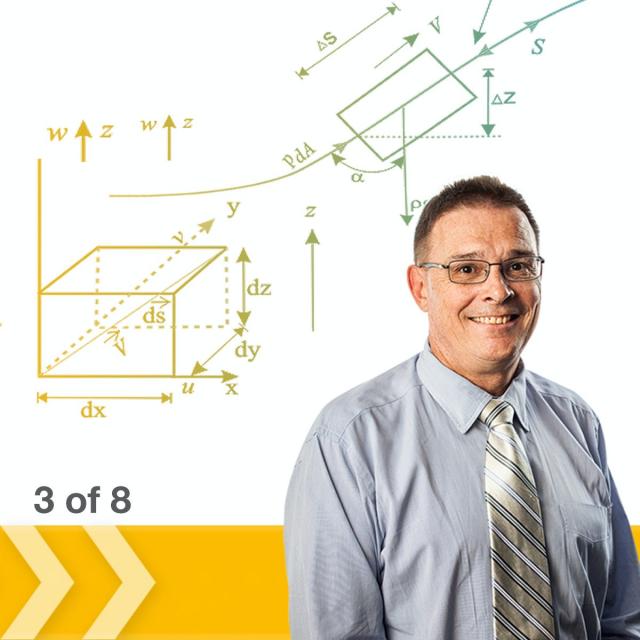
This course is an introduction to the finite element method as applicable to a range of problems in physics and engineering sciences. The treatment is mathematical, but only for the purpose of clarifying the formulation. The emphasis is on coding up the formulations in a modern, open-source environment that can be expanded to other applications, subsequently.

Class Deals by MOOC List - Click here and see Coursera's Active Discounts, Deals, and Promo Codes.

The course includes about 45 hours of lectures covering the material I normally teach in an introductory graduate class at University of Michigan. The treatment is mathematical, which is natural for a topic whose roots lie deep in functional analysis and variational calculus. It is not formal, however, because the main goal of these lectures is to turn the viewer into a competent developer of finite element code. We do spend time in rudimentary functional analysis, and variational calculus, but this is only to highlight the mathematical basis for the methods, which in turn explains why they work so well. Much of the success of the Finite Element Method as a computational framework lies in the rigor of its mathematical foundation, and this needs to be appreciated, even if only in the elementary manner presented here. A background in PDEs and, more importantly, linear algebra, is assumed, although the viewer will find that we develop all the relevant ideas that are needed.
The development itself focuses on the classical forms of partial differential equations (PDEs): elliptic, parabolic and hyperbolic. At each stage, however, we make numerous connections to the physical phenomena represented by the PDEs. For clarity we begin with elliptic PDEs in one dimension (linearized elasticity, steady state heat conduction and mass diffusion). We then move on to three dimensional elliptic PDEs in scalar unknowns (heat conduction and mass diffusion), before ending the treatment of elliptic PDEs with three dimensional problems in vector unknowns (linearized elasticity). Parabolic PDEs in three dimensions come next (unsteady heat conduction and mass diffusion), and the lectures end with hyperbolic PDEs in three dimensions (linear elastodynamics). Interspersed among the lectures are responses to questions that arose from a small group of graduate students and post-doctoral scholars who followed the lectures live. At suitable points in the lectures, we interrupt the mathematical development to lay out the code framework, which is entirely open source, and C++ based.
Suggested Readings:

Syllabus

WEEK 1
This unit is an introduction to a simple one-dimensional problem that can be solved by the finite element method.

WEEK 2
In this unit you will be introduced to the approximate, or finite-dimensional, weak form for the one-dimensional problem.

WEEK 3
In this unit, you will write the finite-dimensional weak form in a matrix-vector form. You also will be introduced to coding in the deal.ii framework.

WEEK 4
This unit develops further details on boundary conditions, higher-order basis functions, and numerical quadrature. You also will learn about the templates for the first coding assignment.

WEEK 5
This unit outlines the mathematical analysis of the finite element method.

WEEK 6
This unit develops an alternate derivation of the weak form, which is applicable to certain physical problems.

WEEK 7
In this unit, we develop the finite element method for three-dimensional scalar problems, such as the heat conduction or mass diffusion problems.

WEEK 8
In this unit, you will complete some details of the three-dimensional formulation that depend on the choice of basis functions, as well as be introduced to the second coding assignment.

WEEK 9
In this unit, we take a detour to study the two-dimensional formulation for scalar problems, such as the steady state heat or diffusion equations.

WEEK 10
This unit introduces the problem of three-dimensional, linearized elasticity at steady state, and also develops the finite element method for this problem. Aspects of the code templates are also examined.

WEEK 11
In this unit, we study the unsteady heat conduction, or mass diffusion, problem, as well as its finite element formulation.

WEEK 12
In this unit we study the problem of elastodynamics, and its finite element formulation.

WEEK 13
This is a wrap-up, with suggestions for future study.

Go to Class
MOOC List is learner-supported. When you buy through links on our site, we may earn an affiliate commission.

Related Courses

What is a Proof? (Coursera) Coursera
University of California, San Diego,Higher School of Economics - HSE University

What is a Proof? (Coursera)

Mathematical thinking is crucial in all areas of computer science: algorithms, bioinformatics, computer graphics, data science, machine learning, etc. In this course, we will learn the most important tools used in discrete mathematics: induction, recursion, logic, invariants, examples, optimality. We will use these tools to answer typical programming questions like: How can we be certain a solution exists? Am I sure my program computes the optimal answer? Do each of these objects meet the given requirements?

Jun 1st 2026
5-12 Weeks
Digitalisation in Space Research (Coursera) Coursera
Technische Universität München - TUM

Digitalisation in Space Research (Coursera)

This course provides an overview of the most important digital applications in the field of aerospace research. The course instructors discuss how digitalisation is impacting and changing both satellite-based and manned spaceflight research. One unit is specifically devoted to exploring the use of artificial intelligence in the evaluation of satellite data.

Jun 1st 2026
3 Weeks
Modern Robotics, Course 1: Foundations of Robot Motion (Coursera) Coursera
Northwestern University

Modern Robotics, Course 1: Foundations of Robot Motion (Coursera)

Do you want to know how robots work? Are you interested in robotics as a career? Are you willing to invest the effort to learn fundamental mathematical modeling techniques that are used in all subfields of robotics? If so, then the "Modern Robotics: Mechanics, Planning, and Control" specialization may be for you. This specialization, consisting of six short courses, is serious preparation for serious students who hope to work in the field of robotics or to undertake advanced study. It is not a sampler.

Jun 1st 2026
4 Weeks
Analyse numérique pour ingénieurs (Coursera) Coursera
École Polytechnique Fédérale de Lausanne

Analyse numérique pour ingénieurs (Coursera)

Ce cours contient les 7 premiers chapitres d'un cours donné aux étudiants bachelor de l'EPFL. Il est basé sur le livre "Introduction à l'analyse numérique", J. Rappaz M. Picasso, Ed. PPUR. Des outils de base sont décrits dans les 5 premiers chapitres. Les deux derniers chapitres abordent la question de la résolution numérique d'équations différentielles.

Jun 1st 2026
5-12 Weeks
Introduction to Ordinary Differential Equations (Coursera) Coursera
Korea Advanced Institute of Science and Technology - KAIST

Introduction to Ordinary Differential Equations (Coursera)

In this introductory course on Ordinary Differential Equations, we first provide basic terminologies on the theory of differential equations and then proceed to methods of solving various types of ordinary differential equations. We handle first order differential equations and then second order linear differential equations. We also discuss some related concrete mathematical modeling problems, which can be handled by the methods introduced in this course.

Jun 1st 2026
5-12 Weeks
Oral Communication for Engineering Leaders (Coursera) Coursera
Rice University

Oral Communication for Engineering Leaders (Coursera)

Taught by Rice University communication faculty from the Rice Center for Engineering Leadership (RCEL). This course covers core topics in oral communication: Communication strategy, content, data visualization, and delivery. You’ll learn key principles in: Creating a communication strategy; Developing a clear message and organizing persuasive content; Creating strong visual support; Presenting data effectively; Presenting professionally and confidently; Handling formal presentations, giving pitches, speaking extemporaneously, managing online presentations, and lowering public speaking anxiety.

Jun 1st 2026
5-12 Weeks
Advanced Linear Models for Data Science 1: Least Squares (Coursera) Coursera
Johns Hopkins University

Advanced Linear Models for Data Science 1: Least Squares (Coursera)

Welcome to the Advanced Linear Models for Data Science Class 1: Least Squares. This class is an introduction to least squares from a linear algebraic and mathematical perspective. Before beginning the class make sure that you have the following: a basic understanding of linear algebra and multivariate calculus; a basic understanding of statistics and regression models; at least a little familiarity with proof based mathematics; basic knowledge of the R programming language.

Jun 1st 2026
5-12 Weeks
Quantitative Formal Modeling and Worst-Case Performance Analysis (Coursera) Coursera
EIT Digital

Quantitative Formal Modeling and Worst-Case Performance Analysis (Coursera)

Welcome to Quantitative Formal Modeling and Worst-Case Performance Analysis. In this course, you will learn about modeling and solving performance problems in a fashion popular in theoretical computer science, and generally train your abstract thinking skills. After finishing this course, you have learned to think about the behavior of systems in terms of token production and consumption, and you are able to formalize this thinking mathematically in terms of prefix orders and counting functions. You have learned about Petri-nets, about timing, and about scheduling of token consumption/production systems, and for the special class of Petri-nets known as single-rate dataflow graphs, you will know how to perform a worst-case analysis of basic performance metrics, like throughput, latency and buffering.

Jun 1st 2026
4 Weeks