Generative Design for Additive Manufacturing (Coursera)

Offered by Autodesk,
Generative Design for Additive Manufacturing (Coursera)

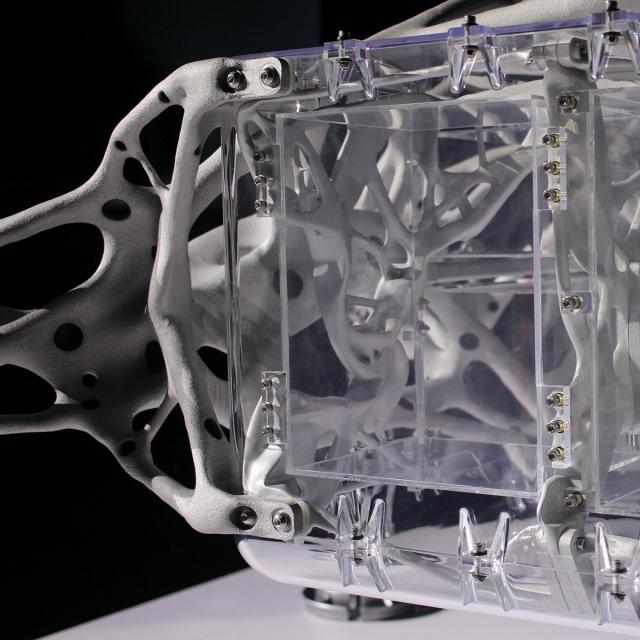
This course introduces you to one of the more common applications of generative design: Additive Manufacturing or 3D printing as it’s also known. In this course, we explore the basics of geometry creation and the mindset shift needed to build a generative design—a deeper understanding of generative design, its parameters, and how to work with the results specifically aimed at making a 3D printed metal part.

Class Deals by MOOC List - Click here and see Coursera's Active Discounts, Deals, and Promo Codes.

We develop insightful understanding of the generative workflow by exploring Autodesk® Fusion 360™ tools and combining them with the creative process of taking an idea to a 3D model. We'll learn how to focus on where a design is and isn’t and apply the generative design thinking process to define a study as we take a deeper dive into Fusion 360.
Want to take your learning to the next level? Complete the Autodesk Generative Design for Manufacturing Specialization, and you’ll unlock an additional Autodesk Credential as further recognition of your success! The Autodesk Credential comes with a digital badge and certificate, which you can add to your resume and share on social media platforms like LinkedIn, Facebook, and Twitter. Sharing your Autodesk Credential can signal to hiring managers that you’ve got the right skills for the job and you’re up on the latest industry trends like generative design.

What You Will Learn

  • Explain the CAD design process as applied to generative design.
  • Summarize the mindset for generative design.
  • Demonstrate knowledge and skills in more advanced Fusion 360 CAD workflows.

Course 1 of 4 in the Autodesk Generative Design for Manufacturing Specialization.

Syllabus

WEEK 1
What is Generative Design?
In Week 1, we’ll overview generative design and cover the fundamentals of creating preserve and obstacle geometry for setting up a generative design study. With generative design, it’s important to understand the mindset needed to set up a generative design study and control the areas where it can and can’t explore. Through obstacles to avoid and preserves to keep, we’ll appropriately create the basis of a generative shelf bracket.

WEEK 2
Defining a Generative Setup
In Week 2, we'll expand into a generative design study utilizing the preserve and obstacle regions created in the prior week. We'll explore the various options and settings which will drive our generative outcomes and completely set up and solve a generative design study.

WEEK 3
Working with Generative Design Outcomes
In Week 3, we’ll explore the process of viewing outcomes, selecting an appropriate iteration, and creating a design that can be further manipulated in Fusion 360.

WEEK 4
Post Process a Generative Design for Additive Manufacturing
In Week 4, we’ll explore how to work with a generative design outcome in Fusion 360. Generative design outcomes can produce different results based on the complexity of the part. In these lessons, we’ll explore form tools and how to work with form geometry to finalize our shelf bracket for additive manufacturing.


Go to Class
MOOC List is learner-supported. When you buy through links on our site, we may earn an affiliate commission.

Related Courses

Quantum Mechanics (Coursera) Coursera
University of Colorado Boulder

Quantum Mechanics (Coursera)

Course 2 of Statistical Thermodynamics presents an introduction to quantum mechanics at a level appropriate for those with mechanical or aerospace engineering backgrounds. Using a postulatory approach that describes the steps to follow, the Schrodinger wave equation is derived and simple solutions obtained that illustrate atomic and molecular structural behavior. More realistic behavior is also explored along with modern quantum chemistry numerical solution methods for solving the wave equation.

Jul 20th 2026
3 Weeks
Introduction to Thermodynamics: Transferring Energy from Here to There (Coursera) Coursera
University of Michigan

Introduction to Thermodynamics: Transferring Energy from Here to There (Coursera)

This course provides an introduction to the most powerful engineering principles you will ever learn - Thermodynamics: the science of transferring energy from one place or form to another place or form. We will introduce the tools you need to analyze energy systems from solar panels, to engines, to insulated coffee mugs. More specifically, we will cover the topics of mass and energy conservation principles; first law analysis of control mass and control volume systems; properties and behavior of pure substances; and applications to thermodynamic systems operating at steady state conditions.

Jul 27th 2026
5-12 Weeks
Material Processing (Coursera) Coursera
Georgia Institute of Technology

Material Processing (Coursera)

Have you ever wondered why ceramics are hard and brittle while metals tend to be ductile? Why some materials conduct heat or electricity while others are insulators? Why adding just a small amount of carbon to iron results in an alloy that is so much stronger than the base metal? In this course, you will learn how a material’s properties are determined by the microstructure of the material, which is in turn determined by composition and the processing that the material has undergone.

Jul 20th 2026
2 Weeks
VLSI CAD Part II: Layout (Coursera) Coursera
University of Illinois at Urbana-Champaign

VLSI CAD Part II: Layout (Coursera)

A modern VLSI chip is a remarkably complex beast: billions of transistors, millions of logic gates deployed for computation and control, big blocks of memory, embedded blocks of pre-designed functions designed by third parties (called “intellectual property” or IP blocks). How do people manage to design these complicated chips? Answer: a sequence of computer aided design (CAD) tools takes an abstract description of the chip, and refines it step-wise to a final design.

Jul 27th 2026
5-12 Weeks
Fundamentals of waves and vibrations (Coursera) Coursera
École Polytechnique

Fundamentals of waves and vibrations (Coursera)

Waves are everywhere. On water of course, but also in the air as you hear a plane, and under your feet during an earthquake certainly. Vibrations, too, are everywhere In your bike as you go over a bump, in you guitar as you play, and of course in your smartphone. You can guess that there is something in common behind all this. This is exactly the purpose of this course !

Aug 3rd 2026
5-12 Weeks
Engineering Systems in Motion: Dynamics of Particles and Bodies in 2D Motion (Coursera) Coursera
Georgia Institute of Technology

Engineering Systems in Motion: Dynamics of Particles and Bodies in 2D Motion (Coursera)

This course is an introduction to the study of bodies in motion as applied to engineering systems and structures. We will study the dynamics of particle motion and bodies in rigid planar (2D) motion. This will consist of both the kinematics and kinetics of motion. Kinematics deals with the geometrical aspects of motion describing position, velocity, and acceleration, all as a function of time. Kinetics is the study of forces acting on these bodies and how it affects their motion.

Aug 10th 2026
5-12 Weeks
Industrial Applications of AI (Coursera) Coursera
L&T EduTech

Industrial Applications of AI (Coursera)

The course Embarks on a transformative learning journey exploring the power of Artificial Intelligence across diverse fields such as electrical, mechanical, civil, and general applications. This course elevates the learner’s insight on AI towards the real-world practices by bridging the gap between theory and practical applications. It also provides hands-on experience of applying AI algorithms into potential applications.

Jul 27th 2026
5-12 Weeks
Machine Design Part I (Coursera) Coursera
Georgia Institute of Technology

Machine Design Part I (Coursera)

“Machine Design Part I” is the first course in an in-depth three course series of “Machine Design.” The “Machine Design” Coursera series covers fundamental mechanical design topics, such as static and fatigue failure theories, the analysis of shafts, fasteners, and gears, and the design of mechanical systems such as gearboxes. Throughout this series of courses we will examine a number of exciting design case studies, including the material selection of a total hip implant, the design and testing of the wing on the 777 aircraft, and the impact of dynamic loads on the design of an bolted pressure vessel. In this first course, you will learn robust analysis techniques to predict and validate design performance and life.

Jul 20th 2026
5-12 Weeks
Introduction to Solid Edge (Coursera) Coursera
Siemens

Introduction to Solid Edge (Coursera)

The Introduction to Siemens Solid Edge software will enable you to learn basic design concepts in both 2D and 3D environments using Computer-Aided Design (CAD) software. The concepts include 2D sketches, basic shapes, 3D models, and simple assemblies. You’ll gain experience using commands such as extrude, revolve, rounds, blend, and thinwall to more efficiently design solid models. Additionally, you’ll learn about drafting concepts such as detailing, drawing view, section cuts, and design intent.

Aug 3rd 2026
5-12 Weeks