Advanced Manufacturing Enterprise (Coursera)

Advanced Manufacturing Enterprise (Coursera)

Enterprises that seek to become proficient in advanced manufacturing must incorporate manufacturing management tools and integrate data throughout the supply chain to be successful. This course will make students aware of what a digitally connected enterprise is, as they learn about the operational complexity of enterprises, business process optimization and the concept of an integrated product-process-value chain.

Class Deals by MOOC List - Click here and see Coursera's Active Discounts, Deals, and Promo Codes.

Students will become acquainted with the available tools, technologies and techniques for aggregation and integration of data throughout the manufacturing supply chain and entire product life-cycle. They will receive foundational knowledge to assist in efforts to facilitate design, planning, and production scheduling of goods and services by applying product life cycle data.
Main concepts of this course will be delivered through lectures, readings, discussions and various videos.
This is the sixth course in the Digital Manufacturing & Design Technology specialization that explores the many facets of manufacturing’s “Fourth Revolution,” and features a culminating project involving creation of a roadmap to achieve a self-established DMD-related professional goal. To learn more about the Digital Manufacturing and Design Technology specialization:

Course 6 of 10 in the Digital Manufacturing & Design Technology Specialization.

Syllabus

WEEK 1
The Concept of a Connected and Collaborative Enterprise
The purpose of this module is to educate students on why a holistic approach is necessary for analyzing the impact of advanced manufacturing on the success of an enterprise.

WEEK 2
How to Build a Digitally Connected Enterprise
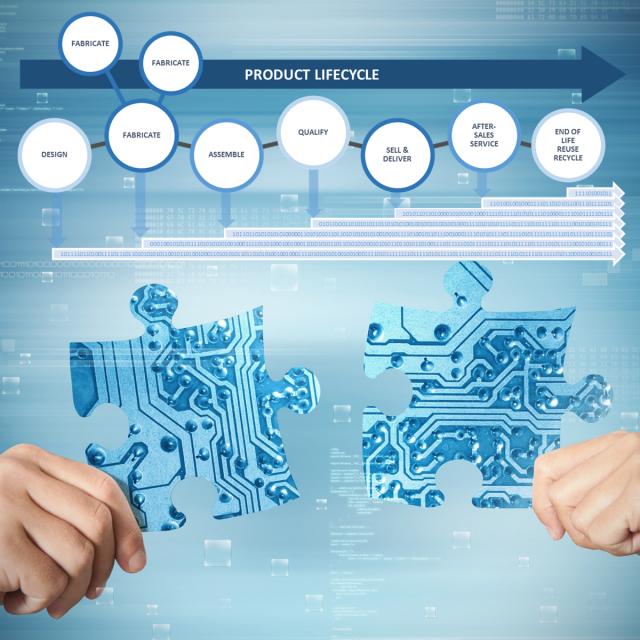
The purpose of this module is to provide an overview of product lifecycle and describe the challenges and opportunities that organizations face in adoption of advanced manufacturing technologies. We will discuss the desire for collection of product lifecycle data as well as outline the required features for a highly connected enterprise. In addition, we will provide several examples of information-sharing infrastructures and will elaborate the concept of Product Lifecycle Management (PLM) system. Finally, we will discuss several examples of effective data collection technologies.

WEEK 3
Introduction to a Set of Supply Chain Management Tools & Integrated Capabilities
In this module, we will introduce the current enterprise management tools (such as ERP, MRP, and MES) that are often employed to integrate capabilities of various entities through the supply chain. We will provide a broad overview of these tools, and will review the capabilities of each of them.

WEEK 4
Ensure a Robust Infrastructure
In this module, we discuss the importance of measuring the performance of supply chains. We will also discuss decision analysis methods and techniques that facilitate decision making through the entire product lifecycle.

Go to Class
MOOC List is learner-supported. When you buy through links on our site, we may earn an affiliate commission.

Related Courses

Material Behavior (Coursera) Coursera
Georgia Institute of Technology

Material Behavior (Coursera)

Have you ever wondered why ceramics are hard and brittle while metals tend to be ductile? Why some materials conduct heat or electricity while others are insulators? Why adding just a small amount of carbon to iron results in an alloy that is so much stronger than the base metal? In this course, you will learn how a material’s properties are determined by the microstructure of the material, which is in turn determined by composition and the processing that the material has undergone.

Sep 7th 2026
5-12 Weeks
Gestão da Cadeia de Suprimentos (Coursera) Coursera
FIA Business School

Gestão da Cadeia de Suprimentos (Coursera)

Nossas boas-vindas ao Curso Gestão da Cadeia de Suprimentos. Neste curso, você aprenderá sobre os principais conceitos necessários para entender o que é a cadeia de suprimentos, como ela pode gerar maior valor para a empresa, quais são as novas tecnologias que permitem uma maior eficácia na sua gestão e como podemos personalizar a oferta para os segmentos de cliente da empresa.

Sep 14th 2026
4 Weeks
Fundamentals of Fluid Power (Coursera) Coursera
University of Minnesota

Fundamentals of Fluid Power (Coursera)

In this course, you will be introduced to the fundamental principles and analytical modeling of fluid power components, circuits, and systems. You will learn the benefits and limitations of fluid power compared with other power transmission technologies; the operation, use, and symbols of common hydraulic components; how to formulate and analyze models of hydraulic components and circuits; and how to design and predict the performance of fluid power circuits.

Aug 31st 2026
5-12 Weeks
Rigid Body Dynamics (Coursera) Coursera
Korea Advanced Institute of Science and Technology - KAIST

Rigid Body Dynamics (Coursera)

This course teaches dynamics, one of the basic mechanics subjects of Mechanical Engineering. Students would be able to organize their knowledge about force and motion, work-energy, impulse-momentum in view of Newton's 2nd law and its integration over time and displacement. The Engineering Dynamics consists of two parts: particle dynamics and rigid body dynamics. This is the second part of the dynamics: rigid body dynamics.

Sep 14th 2026
13-24 Weeks
Advanced Engineering Systems in Motion: Dynamics of Three Dimensional (3D) Motion (Coursera) Coursera
Georgia Institute of Technology

Advanced Engineering Systems in Motion: Dynamics of Three Dimensional (3D) Motion (Coursera)

This course is an advanced study of bodies in motion as applied to engineering systems and structures. We will study the dynamics of rigid bodies in 3D motion. This will consist of both the kinematics and kinetics of motion. Kinematics deals with the geometrical aspects of motion describing position, velocity, and acceleration, all as a function of time. Kinetics is the study of forces acting on these bodies and how it affects their motion.

Sep 7th 2026
5-12 Weeks
Digital Manufacturing & Design (Coursera) Coursera
University at Buffalo,The State University of New York

Digital Manufacturing & Design (Coursera)

This course will expose you to the transformation taking place, throughout the world, in the way that products are being designed and manufactured. The transformation is happening through digital manufacturing and design (DM&D) – a shift from paper-based processes to digital processes in the manufacturing industry. By the end of this course, you’ll understand what DMD is and how it is impacting careers, practices and processes in companies both large and small.

Aug 31st 2026
2 Weeks
Fundamentals of Fluid-Solid Interactions (Coursera) Coursera
École Polytechnique

Fundamentals of Fluid-Solid Interactions (Coursera)

What is fluid-solid interactions ? It is what happens when the motions of a fluid and of a solid are somehow coupled. This happens all the time, around you when leaves flutter in the wind, inside you when your heart beats, above you when wings of a plane vibrate, under the sea... The idea behind this MOOC is to give you the basic tools to be able to predict and eventually mitigate things called flutter, galloping, sloshing, vortex-induced vibrations, added mass, to cite a few. We are going to consider any possible domains of applications such as civil engineering, aerospace engineering, nuclear engineering , ocean engineering, biomechanics and even food processing !

Sep 7th 2026
5-12 Weeks
Materials Science: 10 Things Every Engineer Should Know (Coursera) Coursera
University of California, Davis

Materials Science: 10 Things Every Engineer Should Know (Coursera)

We explore “10 things” that range from the menu of materials available to engineers in their profession to the many mechanical and electrical properties of materials important to their use in various engineering fields. We also discuss the principles behind the manufacturing of those materials. By the end of the course, you will be able to: recognize the important aspects of the materials used in modern engineering applications; explain the underlying principle of materials science: “structure leads to properties,”; identify the role of thermally activated processes in many of these important “things” – as illustrated by the Arrhenius relationship; relate each of these topics to issues that have arisen (or potentially could arise) in your life and work.

Aug 31st 2026
5-12 Weeks
Machine Design Part I (Coursera) Coursera
Georgia Institute of Technology

Machine Design Part I (Coursera)

“Machine Design Part I” is the first course in an in-depth three course series of “Machine Design.” The “Machine Design” Coursera series covers fundamental mechanical design topics, such as static and fatigue failure theories, the analysis of shafts, fasteners, and gears, and the design of mechanical systems such as gearboxes. Throughout this series of courses we will examine a number of exciting design case studies, including the material selection of a total hip implant, the design and testing of the wing on the 777 aircraft, and the impact of dynamic loads on the design of an bolted pressure vessel. In this first course, you will learn robust analysis techniques to predict and validate design performance and life.

Sep 14th 2026
5-12 Weeks
Introduction to Basic Vibrations (Coursera) Coursera
Korea Advanced Institute of Science and Technology - KAIST

Introduction to Basic Vibrations (Coursera)

Introduction to Basic Vibrations starts with the fundamental principle of vibrations with a single and double degree of freedom systems. These fundamental vibration systems provide a solid platform not only to understand general vibrations but also to apply or use them into simple mechanical problems.

Sep 7th 2026
5-12 Weeks