Cyber-Physical Systems: Modeling and Simulation (Coursera)

Cyber-Physical Systems: Modeling and Simulation (Coursera)

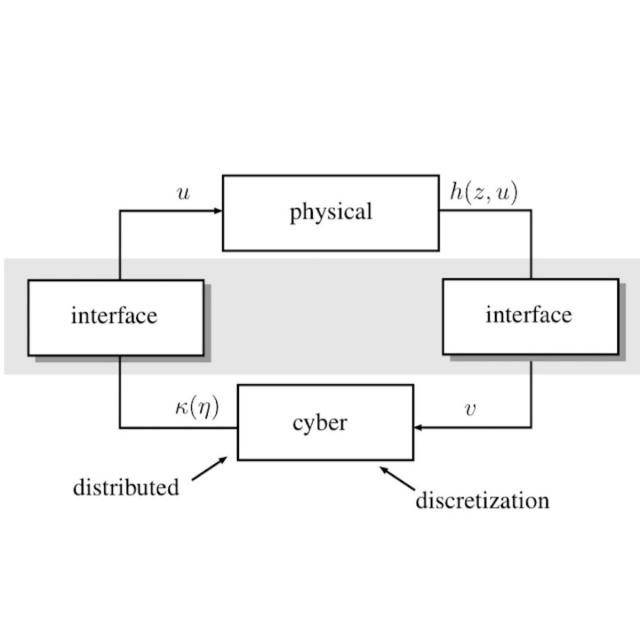
Cyber-physical systems (CPS for short) combine digital and analog devices, interfaces, networks, computer systems, and the like, with the natural and man-made physical world. The inherent interconnected and heterogeneous combination of behaviors in these systems makes their analysis and design a challenging task.

Class Deals by MOOC List - Click here and see Coursera's Active Discounts, Deals, and Promo Codes.

CPS: Modeling and Simulation provides you with an introduction to modeling and simulation of cyber-physical systems. The main focus is on models of physical process, finite state machines, computation, converters between physical and cyber variables, and digital networks. The instructor of this course is Ricardo Sanfelice, Associate Professor in the Department of Computer Engineering at the University of California Santa Cruz.

Syllabus

WEEK 1: Basic Modeling Concepts: Discrete-time and Continuous-Time Systems
WEEK 2: Modeling Cyber Components: Finite State Machines, Computations, Algorithms, and a First CPS Model
WEEK 3: Modeling Interfaces for Cyber-Physical Systems: Conversion, Networks, and Complete CPS Models
WEEK 4: Trajectories in CPS and Simulations: Time Domains, Executions, and Complete CPS Models

Go to Class
MOOC List is learner-supported. When you buy through links on our site, we may earn an affiliate commission.

Related Courses

Intelligent Machining (Coursera) Coursera
University at Buffalo,The State University of New York

Intelligent Machining (Coursera)

Manufacturers are increasingly utilizing machine tools that are self-aware – they perceive their own states and the state of the surrounding environment – and are able to make decisions related to machine activity processes. This is called intelligent machining, and through this course students will receive a primer on its background, tools and related terminology.

Jun 1st 2026
4 Weeks
Algorithms, Part I (Coursera) Coursera
Princeton University

Algorithms, Part I (Coursera)

This course covers the essential information that every serious programmer needs to know about algorithms and data structures, with emphasis on applications and scientific performance analysis of Java implementations. Part I covers elementary data structures, sorting, and searching algorithms. Part II focuses on graph- and string-processing algorithms.

Jun 1st 2026
5-12 Weeks
Development of Real-Time Systems (Coursera) Coursera
EIT Digital

Development of Real-Time Systems (Coursera)

This course is intended for the Master's student and computer engineer who likes practical programming and problem solving! After completing this course, you will have the knowledge to plan and set-up a real-time system both on paper and in practice. The course centers around the problem of achieving timing correctness in embedded systems, which means to guarantee that the system reacts within the real-time requirements.

Jun 1st 2026
5-12 Weeks
Scaling operations: Linking strategy and execution (Coursera) Coursera
Northwestern University

Scaling operations: Linking strategy and execution (Coursera)

Over the past several decades, operations strategy has played an increasingly important role in business’ success. In this course, we will equip you with concepts and tools to build operations in a way that not only supports your competitive strategy, but also allows you to create new opportunities in the market place.

Jun 1st 2026
5-12 Weeks
Data Structures and Performance (Coursera) Coursera
University of California, San Diego

Data Structures and Performance (Coursera)

How do Java programs deal with vast quantities of data? Many of the data structures and algorithms that work with introductory toy examples break when applications process real, large data sets. Efficiency is critical, but how do we achieve it, and how do we even measure it? This is an intermediate Java course. We recommend this course to learners who have previous experience in software development or a background in computer science, and in particular, we recommend that you have taken the first course in this specialization (which also requires some previous experience with Java).

Jun 1st 2026
5-12 Weeks
Shortest Paths Revisited, NP-Complete Problems and What To Do About Them (Coursera) Coursera
Stanford University

Shortest Paths Revisited, NP-Complete Problems and What To Do About Them (Coursera)

The primary topics in this part of the specialization are: shortest paths (Bellman-Ford, Floyd-Warshall, Johnson), NP-completeness and what it means for the algorithm designer, and strategies for coping with computationally intractable problems (analysis of heuristics, local search).

Jun 1st 2026
4 Weeks
Cloud Computing Concepts: Part 2 (Coursera) Coursera
University of Illinois at Urbana-Champaign

Cloud Computing Concepts: Part 2 (Coursera)

Cloud computing systems today, whether open-source or used inside companies, are built using a common set of core techniques, algorithms, and design philosophies—all centered around distributed systems. Learn about such fundamental distributed computing "concepts" for cloud computing. Some of these concepts include: Clouds, MapReduce, key-value stores, Classical precursors, Widely-used algorithms, Classical algorithms, Scalability, Trending areas, And more!

Jun 1st 2026
5-12 Weeks
Object Oriented Programming in Java (Coursera) Coursera
University of California, San Diego

Object Oriented Programming in Java (Coursera)

Welcome to our course on Object Oriented Programming in Java using data visualization. People come to this course with many different goals -- and we are really excited to work with all of you! Some of you want to be professional software developers, others want to improve your programming skills to implement that cool personal project that you’ve been thinking about, while others of you might not yet know why you’re here and are trying to figure out what this course is all about.

Jun 1st 2026
5-12 Weeks
Text Mining and Analytics (Coursera) Coursera
University of Illinois at Urbana-Champaign

Text Mining and Analytics (Coursera)

This course will cover the major techniques for mining and analyzing text data to discover interesting patterns, extract useful knowledge, and support decision making, with an emphasis on statistical approaches that can be generally applied to arbitrary text data in any natural language with no or minimum human effort.

Jun 1st 2026
5-12 Weeks
VLSI CAD Part I: Logic (Coursera) Coursera
University of Illinois at Urbana-Champaign

VLSI CAD Part I: Logic (Coursera)

A modern VLSI chip has a zillion parts -- logic, control, memory, interconnect, etc. How do we design these complex chips? Answer: CAD software tools. Learn how to build thesA modern VLSI chip is a remarkably complex beast: billions of transistors, millions of logic gates deployed for computation and control, big blocks of memory, embedded blocks of pre-designed functions designed by third parties (called “intellectual property” or IP blocks). How do people manage to design these complicated chips? Answer: a sequence of computer aided design (CAD) tools takes an abstract description of the chip, and refines it step-wise to a final design.

Jun 1st 2026
5-12 Weeks
Advanced Manufacturing Enterprise (Coursera) Coursera
University at Buffalo,The State University of New York

Advanced Manufacturing Enterprise (Coursera)

Enterprises that seek to become proficient in advanced manufacturing must incorporate manufacturing management tools and integrate data throughout the supply chain to be successful. This course will make students aware of what a digitally connected enterprise is, as they learn about the operational complexity of enterprises, business process optimization and the concept of an integrated product-process-value chain.

Jun 1st 2026
4 Weeks
Nearest Neighbor Collaborative Filtering (Coursera) Coursera
University of Minnesota

Nearest Neighbor Collaborative Filtering (Coursera)

In this course, you will learn the fundamental techniques for making personalized recommendations through nearest-neighbor techniques. First you will learn user-user collaborative filtering, an algorithm that identifies other people with similar tastes to a target user and combines their ratings to make recommendations for that user.

Jun 1st 2026
4 Weeks