Foundations of AR (Coursera)

Offered by Meta,
Foundations of AR (Coursera)

In this course, you will learn the basics of augmented reality (AR). You will focus on where AR fits in the XR spectrum, how AR is used, what AR can do today—and in the future—and the various technologies used for building such experiences. You will also learn about computer vision in AR, the software development lifecycle, and careers in AR development.

Class Deals by MOOC List - Click here and see Coursera's Active Discounts, Deals, and Promo Codes.

By the end of the course, you will be able to:

  • Explain how AR fits into the XR spectrum.
  • Distinguish between AR in social media (Meta Spark), AR on a browser (web AR), and AR in a mobile app (Unity AR).
  • Describe AR’s defining characteristics, affordances, and capabilities.
  • Explain how computer vision relates to AR development.
  • Give an overview of the AR software development lifecycle and production.
  • Describe how AR is used in the marketing, education, gaming and entertainment industries.

To be successful in this course, experience with object oriented programming and basic web development is needed. JavaScript is a plus but not required.

Course 1 of 7 in the Meta AR Developer Professional Certificate.

Syllabus

WEEK 1
Introduction to AR
What is AR? What value does it bring to people? Why are developers drawn to it? In this module, you'll answer these questions, as well as learn about the XR spectrum, tools used to develop AR, computer vision, and hear about career paths for AR developers.

WEEK 2
AR technologies and capabilities
In this module, you will learn about the different types of AR and how businesses and developers choose the right one. You'll also learn about different pieces of hardware and their capabilities. In addition, you'll learn about the devices and development technologies that AR developers use.

WEEK 3
Computer vision
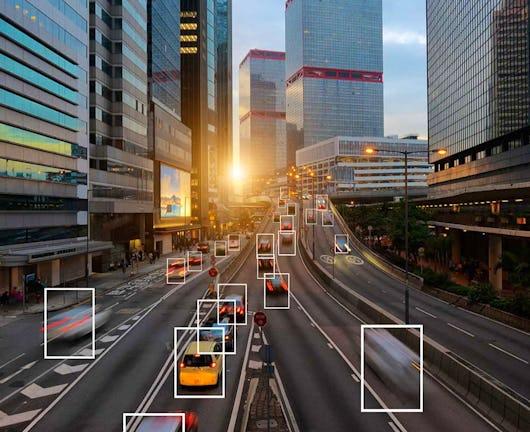
Learn what computer vision is and how it applies to AR development, as well as ways to use it in a project.

WEEK 4
AR software development lifecycle
Learn how the software development cycle factors into how AR developers do their work. You'll also hear about careers in AR development, whether alone or as part of a team. You'll end this course with an exploration of design and accessibility considerations.


Go to Class
MOOC List is learner-supported. When you buy through links on our site, we may earn an affiliate commission.

Related Courses

User Experience & Interaction Design for AR/VR/MR/XR (Coursera) Coursera
University of Michigan

User Experience & Interaction Design for AR/VR/MR/XR (Coursera)

This second course in the XR for Everybody specialization looks at how to design new user experiences for XR technologies. The course provides learners with a design thinking mindset and equips them with a fundamental toolbox for creating XR applications using rapid prototyping. It starts with a broad overview of the complete XR design process, discussing different paths to becoming an XR creator, what is generally involved in making XR experiences, and how to best get started.

Jun 8th 2026
4 Weeks
Visual Perception for Self-Driving Cars (Coursera) Coursera
University of Toronto

Visual Perception for Self-Driving Cars (Coursera)

Welcome to Visual Perception for Self-Driving Cars, the third course in University of Toronto’s Self-Driving Cars Specialization. This course will introduce you to the main perception tasks in autonomous driving, static and dynamic object detection, and will survey common computer vision methods for robotic perception. By the end of this course, you will be able to work with the pinhole camera model, perform intrinsic and extrinsic camera calibration, detect, describe and match image features and design your own convolutional neural networks.

Jun 15th 2026
5-12 Weeks
Advanced Computer Vision with TensorFlow (Coursera) Coursera
DeepLearning.AI

Advanced Computer Vision with TensorFlow (Coursera)

In this course, you will: a) Explore image classification, image segmentation, object localization, and object detection. Apply transfer learning to object localization and detection; b) Apply object detection models such as regional-CNN and ResNet-50, customize existing models, and build your own models to detect, localize, and label your own rubber duck images; c) Implement image segmentation using variations of the fully convolutional network (FCN) including U-Net and d) Mask-RCNN to identify and detect numbers, pets, zombies, and more; d) Identify which parts of an image are being used by your model to make its predictions using class activation maps and saliency maps and apply these ML interpretation methods to inspect and improve the design of a famous network, AlexNet.

Jun 8th 2026
4 Weeks
Introduction to Computer Vision with Watson and OpenCV (Coursera) Coursera
IBM

Introduction to Computer Vision with Watson and OpenCV (Coursera)

Computer Vision is one of the most exciting fields in Machine Learning and AI. It has applications in many industries such as self-driving cars, robotics, augmented reality, face detection in law enforcement agencies. In this beginner-friendly course you will understand about computer vision, and will learn about its various applications across many industries.

Jun 15th 2026
4 Weeks
3D Reconstruction - Multiple Viewpoints (Coursera) Coursera
Columbia University

3D Reconstruction - Multiple Viewpoints (Coursera)

This course focuses on the recovery of the 3D structure of a scene from images taken from different viewpoints. We start by first building a comprehensive geometric model of a camera and then develop a method for finding (calibrating) the internal and external parameters of the camera model. Then, we show how two such calibrated cameras, whose relative positions and orientations are known, can be used to recover the 3D structure of the scene. This is what we refer to as simple binocular stereo.

Jun 15th 2026
5-12 Weeks
Internet of Things: Multimedia Technologies (Coursera) Coursera
University of California, San Diego

Internet of Things: Multimedia Technologies (Coursera)

Content is an eminent example of the features that contributed to the success of wireless Internet. Mobile platforms such as the Snapdragon™ processor have special hardware and software capabilities to make acquisition, processing and rendering of multimedia content efficient and cost-effective.

May 25th 2026
3 Weeks
AI and Disaster Management (Coursera) Coursera
DeepLearning.AI

AI and Disaster Management (Coursera)

In Course 3, AI and Disaster Management, you will begin by learning how natural disasters create both short and long-term impacts on the economy, environment, and community. You will learn how the disaster management cycle can be used to reduce the impacts of a disaster and guidelines for how you can engage in disaster-related projects.

Jun 15th 2026
3 Weeks
Computer Vision with Embedded Machine Learning (Coursera) Coursera
Edge Impulse

Computer Vision with Embedded Machine Learning (Coursera)

Computer vision (CV) is a fascinating field of study that attempts to automate the process of assigning meaning to digital images or videos. In other words, we are helping computers see and understand the world around us! A number of machine learning (ML) algorithms and techniques can be used to accomplish CV tasks, and as ML becomes faster and more efficient, we can deploy these techniques to embedded systems.

Jun 8th 2026
3 Weeks