Evolutionary Biology (saylor.org)

Offered by Saylor.org,
Evolutionary Biology (saylor.org)

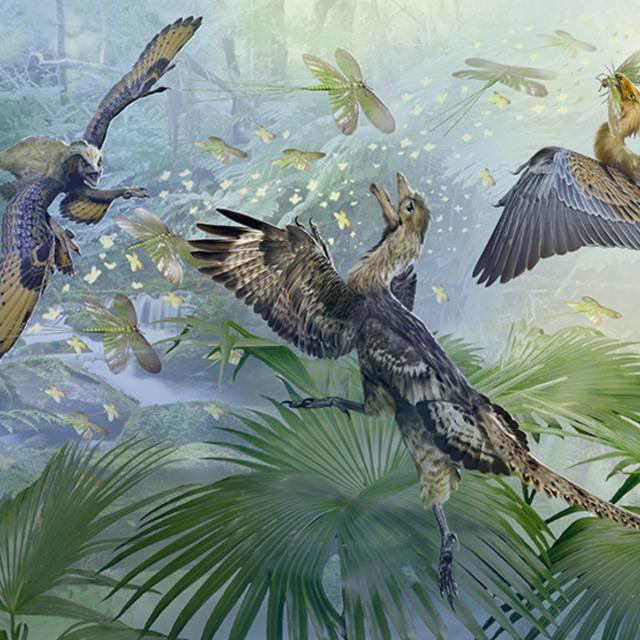
One of the best ways to understand the present is to understand the past. Evolutionary Biology is the study of the changes in life forms over time—changes that have occurred over millions of years as well as those that have occurred over just a few decades.

One of the best ways to understand the present is to understand the past. Evolutionary Biology is the study of the changes in life forms over time—changes that have occurred over millions of years as well as those that have occurred over just a few decades. In this course, we will look at the various mechanisms of evolution, how these mechanisms work, and how change is measured. The concepts you learn in this course will serve as a foundation for studying fossil records and current classification schemes in biology.

We will begin the course by reviewing the evolutionary concepts of selection and speciation. We will then learn to measure evolutionary change through comparisons with the Hardy-Weinberg Equilibrium, to understand the process of change through Game Theory, and to interpret and classify changes by creating phylogenies. The course will wrap up with a look at the history of life according to the fossil record and a discussion of the broad range of life forms as they are currently classified.

At the end of this course, you will have a better understanding for the evolution of biological life. Also, this course will prepare you for future study and research in macroevolution, microevolution, genetics, anthropology, zoology, botany, behavioral biology, and computational biology.

Upon completion of this course, students will be able to:

Define evolution and describe different types of selection.
Provide examples of microevolutionary forces and describe how they impact the genetics of populations.
Describe the Hardy-Weinberg principle and solve problems related to Hardy-Weinberg equilibrium.
Provide examples of games used in evolutionary game theory.
Connect biological phenomena to game theory.
Develop simple phylogenies from molecular or morphological data.
Identify important evolutionary events that have occurred throughout geologic time.
Characterize and provide examples of major plant and animal phyla.

Go to Class
MOOC List is learner-supported. When you buy through links on our site, we may earn an affiliate commission.

Related Courses

Advanced Neurobiology I (Coursera) Coursera
Peking University

Advanced Neurobiology I (Coursera)

Hello everyone! Welcome to advanced neurobiology! Neuroscience is a wonderful branch of science on how our brain perceives the external world, how our brain thinks, how our brain responds to the outside of the world, and how during disease or aging the neuronal connections deteriorate. We’re trying to understand the molecular, cellular nature and the circuitry arrangement of how nervous system works.

Jun 29th 2026
5-12 Weeks
Introduction to Forensic Science (Coursera) Coursera
Nanyang Technological University

Introduction to Forensic Science (Coursera)

We have all seen forensic scientists in TV shows, but how do they really work? What is the science behind their work? The course aims to explain the scientific principles and techniques behind the work of forensic scientists and will be illustrated with numerous case studies from Singapore and around the world.

Jun 29th 2026
5-12 Weeks
Marine Biology (saylor.org) Saylor Academy
Saylor.org

Marine Biology (saylor.org)

Marine Biology is the study of ocean life. As you might expect, life in salt water is vastly different from life in a terrestrial or freshwater environment due to factors like salinity, water circulation, and atmospheric pressure. How, for example, can organisms living in salt water avoid dehydration? How do organisms living in the depths of the ocean handle the immense pressure? How do the environmental factors in marine communities affect biodiversity? How do some animals manage to alternate between the demands of terrestrial life and the demands of marine life? In this course, you will learn the answers to these questions and more. This course will touch on a number of different subfields of biological study (including biochemistry, physiology, zoology, botany, and ecology) within the context of the ocean environment.

Legacy Course
Self-Paced
The Science of the Solar System (Coursera) Coursera
Caltech

The Science of the Solar System (Coursera)

Learn about the science behind the current exploration of the solar system in this free class. Use principles from physics, chemistry, biology, and geology to understand the latest from Mars, comprehend the outer solar system, ponder planets outside our solar system, and search for habitability in our neighborhood and beyond. This course is generally taught at an advanced level assuming a prior knowledge of undergraduate math and physics, but the majority of the concepts and lectures can be understood without these prerequisites.

Jun 22nd 2026
5-12 Weeks
Data Visualization for Genome Biology (Coursera) Coursera
University of Toronto

Data Visualization for Genome Biology (Coursera)

The past decade has seen a vast increase in the amount of data available to biologists, driven by the dramatic decrease in cost and concomitant rise in throughput of various next-generation sequencing technologies, such that a project unimaginable 10 years ago was recently proposed, the Earth BioGenomes Project, which aims to sequence the genomes of all eukaryotic species on the planet within the next 10 years. So while data are no longer limiting, accessing and interpreting those data has become a bottleneck. One important aspect of interpreting data is data visualization. This course introduces theoretical topics in data visualization through mini-lectures, and applied aspects in the form of hands-on labs.

Jun 29th 2026
5-12 Weeks
Bioinformatic Methods II (Coursera) Coursera
University of Toronto

Bioinformatic Methods II (Coursera)

Large-scale biology projects such as the sequencing of the human genome and gene expression surveys using RNA-seq, microarrays and other technologies have created a wealth of data for biologists. However, the challenge facing scientists is analyzing and even accessing these data to extract useful information pertaining to the system being studied. This course focuses on employing existing bioinformatic resources – mainly web-based programs and databases – to access the wealth of data to answer questions relevant to the average biologist, and is highly hands-on.

Jun 29th 2026
5-12 Weeks
Synapses, Neurons and Brains (Coursera) Coursera
Hebrew University of Jerusalem

Synapses, Neurons and Brains (Coursera)

These are very unique times for brain research. The aperitif for the course will thus highlight the present “brain-excitements” worldwide. You will then become intimately acquainted with the operational principles of neuronal “life-ware” (synapses, neurons and the networks that they form) and consequently, on how neurons behave as computational microchips and how they plastically and constantly change - a process that underlies learning and memory.

Jun 29th 2026
5-12 Weeks
Antimicrobial resistance - theory and methods (Coursera) Coursera
Technical University of Denmark - DTU

Antimicrobial resistance - theory and methods (Coursera)

The course will cover the topics related to antimicrobial resistance with basic definitions and overview on antimicrobials their use and the emergence and spread of resistance. The course will guide you through the concepts and the importance of resistance spread and dissemination and how that happens. It will show you how bacteria become resistant and which mechanisms they might use for this. And as part of the course you will also receive some training in methods for antimicrobial susceptibility testing (AST) and detection of specific resistance in the microbiological laboratories with the basic methods available and with focus on the obtention of good quality results which can be interpreted and used for different purposes.

Jun 29th 2026
5-12 Weeks