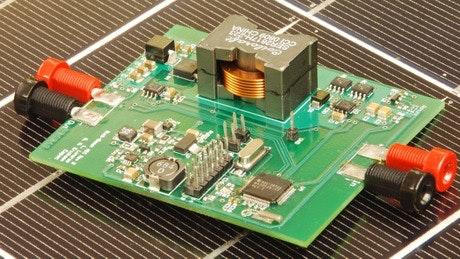
Converter Circuits (Coursera)

Converter Circuits (Coursera)

This course introduces more advanced concepts of switched-mode converter circuits. Realization of the power semiconductors in inverters or in converters having bidirectional power flow is explained. Power diodes, power MOSFETs, and IGBTs are explained, along with the origins of their switching times. Equivalent circuit models are refined to include the effects of switching loss. The discontinuous conduction mode is described and analyzed. A number of well-known converter circuit topologies are explored, including those with transformer isolation.

Class Deals by MOOC List - Click here and see Coursera's Active Discounts, Deals, and Promo Codes.

The homework assignments include a boost converter and an H-bridge inverter used in a grid-interfaced solar inverter system, as well as transformer-isolated forward and flyback converters.
After completing this course, you will:

  • Understand how to implement the power semiconductor devices in a switching converter
  • Understand the origins of the discontinuous conduction mode and be able to solve converters operating in DCM
  • Understand the basic dc-dc converter and dc-ac inverter circuits
  • Understand how to implement transformer isolation in a dc-dc converter, including the popular forward and flyback converter topologies.

Completion of the first course Introduction to Power Electronics is the assumed prerequisite for this course.
What You Will Learn

  • Understand how to implement the power semiconductor devices in a switching converter
  • Understand the origins of the discontinuous conduction mode and be able to solve converters operating in DCM
  • Understand the basic dc-dc converter and dc-ac inverter circuits
  • Understand how to implement transformer isolation in a dc-dc converter, including the popular forward and flyback converter topologies

Course 2 of 4 in the Power Electronics Specialization.

Syllabus

WEEK 1
Ch 4.1: Switch Realization
How to implement the switches using transistors and diodes, including applications having bidirectional power flow or ac outputs.

WEEK 2
Ch 4.2: Power Semiconductor Switches
Basics of power semiconductor switches, including the origins of switching times and switching loss. How to incorporate switching loss into equivalent circuit models. MOSFETs, IGBTs, and gate driver considerations.

WEEK 3
Ch 5: Discontinuous Conduction Mode
The discontinuous conduction mode (DCM) arising from unidirectional switch realization. Analysis of mode boundaries and output voltage.

WEEK 4
Ch 6: Converter Circuits
Some well-known converter circuits and their origins. How to incorporate transformer isolation into a dc-dc converter. Analysis and equivalent circuit modeling of transformer-isolated converters.

Go to Class
MOOC List is learner-supported. When you buy through links on our site, we may earn an affiliate commission.

Related Courses

Magnetics for Power Electronic Converters (Coursera) Coursera
CIRES, University of Colorado at Boulder

Magnetics for Power Electronic Converters (Coursera)

This course covers the analysis and design of magnetic components, including inductors and transformers, used in power electronic converters. The course starts with an introduction to physical principles behind inductors and transformers, including the concepts of inductance, core material saturation, airgap and energy storage in inductors, reluctance and magnetic circuit modeling, transformer equivalent circuits, magnetizing and leakage inductance.

Jun 22nd 2026
4 Weeks
Physics 102 - Electric Potential and DC Circuits (Coursera) Coursera
Rice University

Physics 102 - Electric Potential and DC Circuits (Coursera)

This course serves as an introduction to the physics of electricity and magnetism. Upon completion, learners will have an understanding of how the forces between electric charges are described by fields, and how these fields are related to electrical circuits. They will gain experience in solving physics problems with tools such as graphical analysis, algebra, vector analysis, and calculus.

Jun 22nd 2026
3 Weeks
Circuits and Electronics 3: Applications (edX) EdX
MIT,MITx

Circuits and Electronics 3: Applications (edX)

Learn about cool applications, op-amps and filters in the design of microchips used in smartphones, computers, and the internet. Want to learn how your radio works? Wondering how to implement filters using resistors, inductors, and capacitors? Wondering what are some other applications of RLC and CMOS circuits? This free circuit course, taught by edX CEO and MIT Professor Anant Agarwal and MIT colleagues, is for you.

Self Paced
Self-Paced
AC and Switching Circuits (edX) EdX
National University of Singapore,NUS

AC and Switching Circuits (edX)

In this course, you will learn all about circuits with alternating current (AC). The course shows how to design and analyse AC circuits, and concepts like phasors and power factor are explained. We also cover transformers, fuses, relays, and the use of transistors as switches. The course is the second in our series on electronics and a working knowledge of DC circuits is assumed.

Self Paced
Self-Paced
Microwave engineering and antennas (Coursera) Coursera
Eindhoven University of Technology

Microwave engineering and antennas (Coursera)

This unique Master-level course provides you with in-depth know-how of microwave engineering and antennas. The course combines both passive and active microwave circuits as well as antenna systems. Future applications, like millimeter-wave 5G/beyond-5G wireless communications or automotive radar, require experts that can co-design highly integrated antenna systems that include both antennas and microwave electronics. We will provide you with the required theoretical foundation as well as hands-on experience using state-of-the-art design tools. The web lectures are supported by many on-line quizzes in which you can practice the background theory.

Jun 8th 2026
5-12 Weeks
Cómo entrenar a tus electrones 3: Aplicaciones interesantes (Coursera) Coursera
Pontificia Universidad Católica de Chile

Cómo entrenar a tus electrones 3: Aplicaciones interesantes (Coursera)

La electrónica ha respaldado el desarrollo científico y tecnológico de la humanidad, ostentando un rol clave en los últimos 50 años. Nos admiramos de la capacidad del ser humano de diseñar circuitos integrados que contienen millones de transistores y que nos permiten procesar con gran precisión las señales más débiles provenientes de las antenas de telefonía celular, de las neuronas del cerebro, de una cámara digital, o de la carga depositada por partículas subatómicas que colisionan en el Gran Colisionador de Hadrones en Suiza.

Jun 15th 2026
3 Weeks
Principles of Modeling, Simulations, and Control for Electric Energy Systems (edX) EdX
MIT,MITx

Principles of Modeling, Simulations, and Control for Electric Energy Systems (edX)

Apply a dynamic systems-level approach and engage emerging research on efficient, sustainable, and physically and economically feasible electric power systems of the future. As global energy demand grows, to mitigate climate change we must drive a swift transition to clean energy resources and enhanced electric power grid infrastructure. In this course, you will explore systemic principles of future electric power system management, such as the role of smart grids, data-enabled machine learning, power electronics-control, and data-driven decision-making.

No session available
5-12 Weeks