EdX

AC and Switching Circuits (edX)

AC and Switching Circuits (edX)

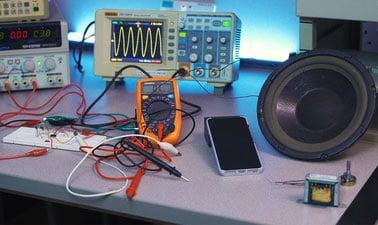
In this course, you will learn all about circuits with alternating current (AC). The course shows how to design and analyse AC circuits, and concepts like phasors and power factor are explained. We also cover transformers, fuses, relays, and the use of transistors as switches. The course is the second in our series on electronics and a working knowledge of DC circuits is assumed.

Class Deals by MOOC List - Click here and see EdX's Active Discounts, Deals, and Promo Codes.

Alternating current (AC) is the type of electricity commonly used throughout the world to connect power plants, homes, and businesses. This course will give you an understanding of why AC is used and will allow you to design and analyse circuits which use AC electricity.
You will learn how to calculate voltages, currents and power in circuits with AC sources, how to calculate RMS voltage and current, how to handle both sinusoidal and non-sinusoidal sources, how to use relays and transistors as switches, how to design circuits with transformers, how to model realistic, non-ideal transformers, how to design and build simple DC power supplies and rectifiers, and we will explore concepts of maximum power transfer with AC circuits. In terms of sequencing, this course would be suitable for students who already have a working knowledge of basic DC circuits (such as our other MOOC Circuits for Beginners).

What you'll learn
At the end of this MOOC, learners will be able to discuss:

  • how to calculate voltages, currents and power in circuits with AC sources
  • how to calculate RMS voltage and current
  • how to handle both sinusoidal and non-sinusoidal sources
  • how to use relays and transistors as switches
  • how to design circuits with transformers
  • how to model realistic, non-ideal transformers
  • how to design and build simple DC power supplies and rectifiers
  • concepts of maximum power transfer with AC circuits

Syllabus

Week 1:- Introduction to AC Circuits
Week 2: Phasors
Week 3: Non-Sinusoidal AC Circuits
Week 4: Transformer Circuits
Week 5: AC-DC Conversion
Week 6: Switching Circuits
Go to Class
MOOC List is learner-supported. When you buy through links on our site, we may earn an affiliate commission.

Related Courses

Introducción al Internet de las Cosas (IoT) (edX) EdX
Universitat Politècnica de València,UPValenciaX

Introducción al Internet de las Cosas (IoT) (edX)

Este es un curso en línea preliminar en el que tratamos los conceptos básicos de electronica y programación utilizando placas Arduino y ESP. El internet de las cosas (Internet of things o IoT) es el presente y el futuro de la tecnología. Tanto si tienes algo de experiencia con la electrónica y deseas desarrollar proyectos como si no tienes ninguna, este curso online te dara los conocimientos iniciales necesarios para comenzar a crear dispositivos increibles capaces de medir y controlar señales físicas.

Self Paced
Self-Paced
Electrónica Digital Bit a Bit: Aprendiendo fundamentos (Coursera) Coursera
Pontificia Universidad Católica de Chile

Electrónica Digital Bit a Bit: Aprendiendo fundamentos (Coursera)

Es desafiante y hasta atemorizante entender un circuito digital cuando observamos la cantidad de transistores que puede contener, y aún más difícil diseñarlo eficientemente para su implementación en un circuito integrado o una FPGA. Sin embargo, saber diseñar circuitos digitales simples nos abre las puertas para diseñar sistemas digitales más complejos a partir de estos.

Jun 22nd 2026
5-12 Weeks
Introducción al Internet de las Cosas (edX) EdX
Galileo University,GalileoX

Introducción al Internet de las Cosas (edX)

Prácticamente cualquier objeto puede conectarse al Internet. Desde lavadoras hasta componentes sofisticados de aviones y aún cultivos inteligentes. La habilidad de conectar cosas y capturar información útil está transformando a las organizaciones en cada sector de la industria y está abriendo nuevas especializaciones de carrera. Descubre esto y más en este curso de introducción al internet de las cosas.

Self Paced
Self-Paced
Aplicaciones musicales con Arduino (Coursera) Coursera
Universidad Nacional Autónoma de México

Aplicaciones musicales con Arduino (Coursera)

En este curso nos adentraremos en el terreno del hardware. Concretamente, aprenderemos a utilizar la placa de desarrollo de hardware de código abierto, llamada Arduino, enfocándonos en las aplicaciones que esta ofrece para la experimentación musical. De manera más específica, aprenderemos en este curso a construir nuestros propios generadores de sonido, y a partir de ello haremos instalaciones sonoras que nos permitirán expandir nuestra creatividad hacia el terreno de las cosas materiales, y ya no solo de los datos informáticos.

Jun 22nd 2026
4 Weeks
Circuitos Eléctricos en Corriente Alterna (edX) EdX
Galileo University,GalileoX

Circuitos Eléctricos en Corriente Alterna (edX)

Curso introductorio de análisis de circuitos resistivos en AC. Aprende la base fundamental de Instalaciones Eléctricas. Este curso trata la teoría básica de circuitos eléctricos en corriente alterna. Un sólido conocimiento de esta teoría es clave para diseñar instalaciones eléctricas y sistemas de potencia.

Self Paced
Self-Paced
Distribución de la energía eléctrica (edX) EdX
Tecnológico de Monterrey,TecdeMonterreyX

Distribución de la energía eléctrica (edX)

Aprende las formas en que la energía eléctrica se distribuye al usuario final por medio de la infraestructura eléctrica existente. Conoces los procesos que se requieren para llevar la energía eléctrica desde el lugar donde se genera (plantas eléctricas) hasta el lugar donde la necesitas?, ¿sabes cómo funciona una red de distribución? En este curso en línea obtendrás las respuestas, ya que conocerás las formas en las que la energía eléctrica se distribuye al usuario final por medio de la infraestructura existente.

Self Paced
Self-Paced
Electromagnetic Compatibility Essentials (edX) EdX
Graz University of Technology,TUGrazX

Electromagnetic Compatibility Essentials (edX)

Advance your career by learning the basics of EMC. Explore all the different aspects and challenges every electronics engineer must be aware of. This course is designed to gain essential know-how in today’s world of very high frequencies. For instance, smartphone CPUs already work with clock frequencies above 3 GHz. But did you know that such fast switching disturbs other devices nearby? Such disturbances are either simply annoying or can become a real problem. As a consequence, international regulations exist which demand for emission and immunity tests before selling an electronic device.

Self Paced
Self-Paced
Semiconductors for Beginners (edX) EdX
National University of Singapore,NUS

Semiconductors for Beginners (edX)

The primary goal of the course is to enable the student to understand what semiconductors are, and why they are important to the electronics industry. Students will first learn and understand why some materials are insulators and others are conductors, and will learn how these properties can be modified. The course also explores other situations where the conductivity of an insulator can be drastically changed, such as the situation inside a bolt of lightning or inside a semiconductor.

Self Paced
Self-Paced
Semiconductor Fundamentals (edX) EdX
Purdue University,PurdueX

Semiconductor Fundamentals (edX)

From smartphones to satellites, semiconductors are everywhere. Tying together physics, chemistry, and electrical engineering, this easy-to-follow introduction provides the background needed to understand devices such as transistors and solar cells. This course provides the essential foundations required to understand the operation of semiconductor devices such as transistors, diodes, solar cells, light-emitting devices, and more.

Jan 9th 2023
5-12 Weeks
Electrónica Digital Bit a Bit: Diseñando circuitos complejos (Coursera) Coursera
Pontificia Universidad Católica de Chile

Electrónica Digital Bit a Bit: Diseñando circuitos complejos (Coursera)

Los circuitos digitales más complejos como memorias y procesadores, que contienen millones de transistores gracias a su reducido tamaño, pueden ser divididos en circuitos más simples ya conocidos para facilitar su diseño e implementación. Lo mismo podemos realizar utilizando Verilog para diseñar circuitos digitales complejos que realizan muchas funciones o cuentan con un gran número de entradas y salidas.

Jun 22nd 2026
5-12 Weeks