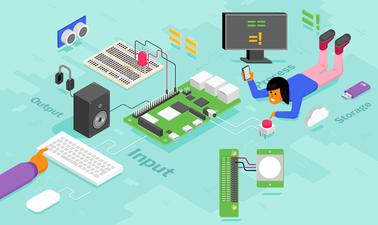
Explore the exciting world of physical computing and create electronic circuits that you can control with code. On this course from the Raspberry Pi Foundation, you will be introduced to the world of physical computing. You will use input devices to capture data, process that data with the Python programming language, and then use output devices to get information back out from your computer.
Class Deals by MOOC List - Click here and see EdX's Active Discounts, Deals, and Promo Codes.
Along the way, you will learn how to use the principles of sequence, selection, and iteration in your physical computing programs. You will also learn some foundational electronics to help you create the circuits that you will use.
In the final week, you will create a physical computing project of your own.
What you'll learn
Over the following three weeks, you will:
- Develop understanding of how the Raspberry Pi can be used as a tool for physical computing.
- Apply knowledge of programming concepts to control digital inputs and outputs.
- Identify practical applications of inputs and outputs to make a project.
- Reflect on your learning and create ideas for your classroom practice.
- Identify ways of engaging learners in physical computing in your learning context.
Syllabus
You will cover:
- Input and output devices
- Python programming
- Use of variables, functions, and classes
- Applying design processes
- Project-based learning