EdX

Chinese Culture: Interaction (edX)

Chinese Culture: Interaction (edX)

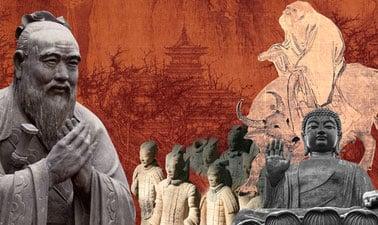
This compact course introduces 5 interesting aspects of Chinese cultural exchange and interaction with other countries in history. They are (a) China and the West, (b) China and Central Asia (c) China and Vietnam, (d) Colonialism, Anti-Colonialism and Pan-Asianism, and (e) Chinese Food and Cuisine. This dynamic course forms part of the HKPolyUx series on Chinese culture.

Class Deals by MOOC List - Click here and see EdX's Active Discounts, Deals, and Promo Codes.

Owing to its rapid development in recent years, China has been in the spotlight of the international arena. While understanding modern China's economy, technology and politics is important, knowing its cultural roots and evolution is no less crucial for seeing a full picture of Chinese culture. This course introduces 5 interesting aspects of Chinese cultural exchange and interaction with other countries in history.

Key questions of the course

  • How did the Silk Road emerge in history? Who was Matteo Ricci? What happened in history regarding the Chinese cultural exchange of religions, arts and sports with the West?
  • Where is Central Asia? What was Pax Mongolica? What role did silver play in the Saga of the Silk Road?
  • What cultural exchanges occurred between Vietnam and China? How did Vietnam contribute to the introduction of Buddhism to China through the maritime Silk Road? Which of the Vietnamese princes served as a high-ranking official in the Chinese court of the Ming dynasty?
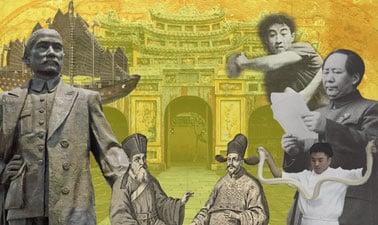
  • How did China confront Western colonialism as a global trend in the early 20th century? Who was Sun Yat-sen? How did he connect China with the rest of the world? How did Pan-Asianism arise and go bankrupt?
  • What is the relationship between rituals, ghosts and alcohol in China? What are the stories behind Chinese medicinal food, correlative cosmology and tea? How many major types of Chinese cuisine are there? What sorts of food were exchanged between China and other countries in history?

Course Design

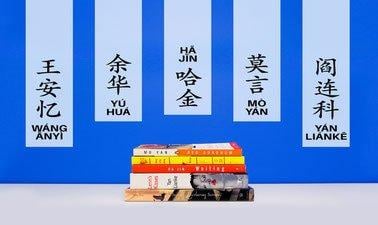
  • A team of 5 experts in Chinese culture has designed the course. They are, in alphabetical order, Prof Han, Dr Ng, Dr Pan, Dr Schoenberger and Dr Tsui.
  • The compact design of the mini-lectures suits the busy schedule of edX learners.
  • Introductions by animation hosts highlight the key questions of each unit.
  • Illustrations and maps are designed to liven up the mini-lectures.
  • Self-learning is supported by review questions and forums.
  • Cross-referencing enhances a fruitful learning experience across the units of the HKPolyUx series on Chinese culture.

This course is part of the Chinese Culture: Tradition, Transformation and Interaction XSeries Program.
What you'll learn

  • The cultural interactions between China and the West
  • The cultural interactions between China and Central Asia
  • The cultural interactions between China and Vietnam
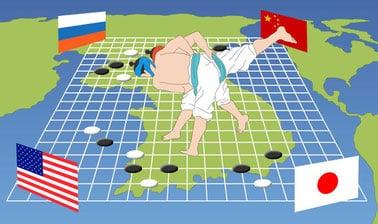
  • China's interactions with Asian countries in the first half of 20th century
  • China's interactions with other countries in food and cuisine

Syllabus

China and the West

  • Introduction
  • Commerce and trade: The Silk Road
  • Religion: Matteo Ricci and Xi Xue Dong Jian
  • Art: Export paintings
  • Colonial experience and Hong Kong
  • Sports: China in the Olympics and the Ping-Pong Politics

China and Central Asia

  • Introduction
  • Geographical setting of Central Asia
  • Central Asia in Han-Tang China
  • Subsequent Islamization and Pax Mongolica
  • Central Asia of contemporary significance
  • An interview with Kazakhstan students

China and Vietnam

  • Introduction
  • Cultural interactions between China and other regions
  • Cultural interactions between China and Vietnam
  • Conditions for Sino-Vietnamese cultural interactions
  • Consequences of Sino-Vietnamese cultural interactions

-Agents of Sino-Vietnamese cultural interactions
Colonialism, Anti-Colonialism and Pan-Asianism

  • Introduction
  • The crumbling empire of the Qing dynasty
  • Anti-Colonialism in China
  • Sun Yat-sen
  • From Lenin to Chiang Kai-shek
  • Pan-Asianism
  • Modern China and One Belt One Road

Chinese Food and Cuisine

  • Introduction
  • Hunting, farming and stir-frying
  • Rituals, ghosts and foods
  • Alcohol
  • Correlative cosmology and medicinal foods
  • Tea
  • Sichuan and Lu cuisine
  • Chinese immigrants and American-style Chinese foods
Go to Class
MOOC List is learner-supported. When you buy through links on our site, we may earn an affiliate commission.

Related Courses

Chinese Politics Part 1 - China and Political Science (Coursera) Coursera
The Hong Kong University of Science and Technology - HKUST

Chinese Politics Part 1 - China and Political Science (Coursera)

This course offers a conceptual framework for understanding China that highlights the intersection of politics and economics. It shows that rather than develop into a full blown market economy, state and party officials at all levels of the political system maintain significant influence in economic development. Such a “political” economy has had both positive and negative outcomes, which we will assess in detail.

Sep 14th 2026
5-12 Weeks
Structuring Values in Modern China (Coursera) Coursera
The Chinese University of Hong Kong

Structuring Values in Modern China (Coursera)

This sequence of four courses will propose a multi-disciplinary approach to the study of Chinese cultural history conceived of as a succession of modes of rationality (philosophical, bureaucratic, and economic). The focus will be on the moments of paradigm shift from one mode of rationality to another. For each of these moments, cultural facts and artifacts—thought, literature, ritual—will be examined in relationship to changing social, political, and economic systems.

Sep 14th 2026
5-12 Weeks
Mao to Now: On Chinese Marxism (edX) EdX
The University of Newcastle, Australia,NewcastleX

Mao to Now: On Chinese Marxism (edX)

An insightful study of Chinese Marxism, socialism and capitalism - critical for anyone who wishes to engage with China today. To make sense of modern China, you simply cannot ignore Marxism. ‘From Mao to Now’ presents current topics that anyone who wishes to engage with China should know. Rather than praising or condemning, the course focuses on building a deeper understanding of this history through two interwoven elements.

No session available
5-12 Weeks
China Humanities: The Individual in Chinese Culture (edX) EdX
HarvardX,Harvard University

China Humanities: The Individual in Chinese Culture (edX)

Explore Chinese history and culture from the perspective of the individual through philosophical texts, literary works, and art. In China’s history, there has been a longstanding belief that being cultured and being moral are necessary for a person to participate in public life. We often think of China in political terms – and focus on the history of government – or in social terms – and study the role of the family in society. But this course looks at the individual and the striving for culture and morality.

Self Paced
Self-Paced
文物精品与文化中国:文字与乐礼 | Relics of Chinese History - Part 3: Writing System, Rites and Music (edX) EdX
Tsinghua University,TsinghuaX

文物精品与文化中国:文字与乐礼 | Relics of Chinese History - Part 3: Writing System, Rites and Music (edX)

Discover how writing systems and music played a major role in Chinese history through the study of artifacts and relics. 本课程以精品文物作引子,将学术界探索中华文明的过程作为线索,介绍古代中国在造船、玉器等诸多领域的杰出成就

Self Paced
Self-Paced
Literati China: Examinations, Neo-Confucianism, and Later Imperial China (edX) EdX
HarvardX,Harvard University

Literati China: Examinations, Neo-Confucianism, and Later Imperial China (edX)

Explore China’s imperial period, with a focus on the Song dynasty and the role of the exam system in government. Fundamental changes in government, the economy, and broader society took place between the 8th and 11th centuries in China. The state aristocracy gave way to new literati elite: educated men who sought to enter government through competitive examinations. A new kind of Confucianism also took shape, which prized the moral autonomy of individuals. With this, the later imperial period of China’s history begins.

Self Paced
Self-Paced
China and Communism (edX) EdX
HarvardX,Harvard University

China and Communism (edX)

Explore the Maoist period of China, from the Communist Party to the death of Mao and the reopening of China. How did the Communists conquer China? What role does culture play? What are the successes and failures of the Chinese Communist Party after seizing power in 1949? What constitutes liberation?

Self Paced
Self-Paced
English for Doing Business in Asia - Speaking (edX) EdX
The Hong Kong University of Science and Technology - HKUST,HKUSTx

English for Doing Business in Asia - Speaking (edX)

Introducing strategies for developing your spoken English communication skills in the context of doing business in Asia. The use of English for doing business in multinational settings is a fact of life for many business people. As Asian economies expand and become more involved in the global economy, a lingua franca – a language used to communicate among groups of people who do not share a mother tongue – is needed to exchange information.

Self Paced
Self-Paced