Big History: Connecting Knowledge (Coursera)

Offered by Macquarie University,
Big History: Connecting Knowledge (Coursera)

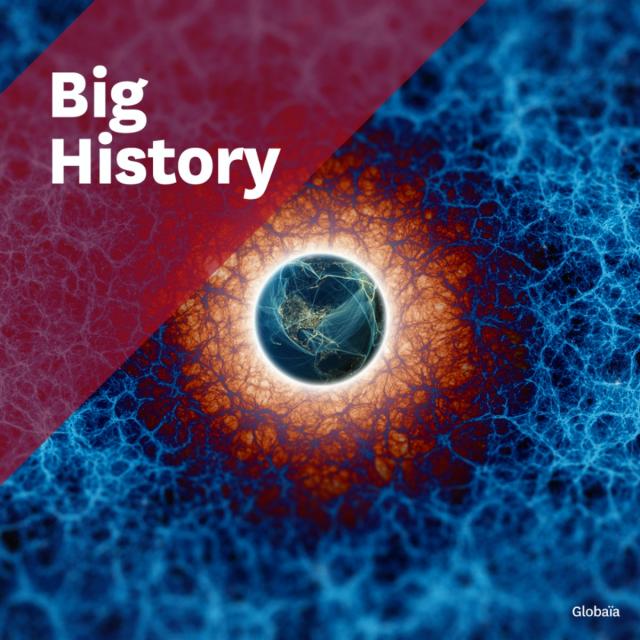
We currently face unprecedented challenges on a global scale. These problems do not neatly fall into disciplines. They are complicated, complex, and connected. Join us on this epic journey of 13.8 billion years starting at the Big Bang and travelling through time all the way to the future. Discover the connections in our world, the power of collective learning, how our universe and our world has evolved from incredible simplicity to ever-increasing complexity.

Class Deals by MOOC List - Click here and see Coursera's Active Discounts, Deals, and Promo Codes.

Experience our modern scientific origin story through Big History and discover the important links between past, current, and future events. You will find two different types of lectures. ‘Zooming In’ lectures from multiple specialists enable you to understand key concepts through the lens of different disciplines, whilst David Christian's ‘Big History Framework’ lectures provide the connective overview for a journey through eight thresholds of Big History.

Syllabus

WEEK 1
Big History, Critical Thinking, & Transdisciplinarity
Welcome to Big History! This is where we use the power of a transdisciplinary perspective to explore broad trends in the grand narrative of 13.8 billion years. In this module you'll learn how Big History works, explore critical-thinking, how we know what we know, and learn about the first "3 Thresholds of Increasing Complexity", milestones around which Big History is organized, starting at the beginning of the Universe, space, time, and everything in existence.

WEEK 2
The Universe, Stars, and Planets
Our journey across space and time has begun. In this module, in a timeline that covers billions of years, we'll explore the origins of the universe, new stars & elements, and the solar system. You'll have the opportunity to examine cosmology, astronomy, physics, chemistry, and geology.

WEEK 3
The Evolutionary Epic
Travel through the evolutionary epic from the origin of life c.3.8 billion years ago, the evolution of complex forms after c.550 million years ago, to the evolution of some very odd primates - humans. Zoom in and explore evolutionary biology, geology, palaeontology, and anthropology.

WEEK 4
Human History
After billions of years of cosmic evolution, our own rather peculiar species has emerged to cultivate even greater heights of increasing complexity. In this module, we will explore the long trend of human development from the origin of our species c.200,000 years ago to the eve of the Industrial Revolution. You will explore archaeology, paleography, and ancient, medieval, and early modern history.

WEEK 5
Modernity
We have now arrived at one of the most dynamically changing periods ever seen in human history - our own times. This module will explore how the agrarian era that had lasted for 10,000 years transitioned to the modern era with its explosion of production and complexity. We will explore modern history, political science, and economics.

WEEK 6
The Future
We've looked far into the deep past, now is the time to take what we've learned and look ahead. In this module we will explore the near and distant future, what challenges we face this century, how we study the future on the scale of billions of years, and where complexity may go from here. The section incorporates climatology, cosmology, physics, and foresight.


Go to Class
MOOC List is learner-supported. When you buy through links on our site, we may earn an affiliate commission.

Related Courses

Fandom, Community, and Identity in Popular Music (Coursera) Coursera
University of Colorado Boulder

Fandom, Community, and Identity in Popular Music (Coursera)

In "Fandom, Community, and Identity in Popular Music," you will explore the intersections of fandom and popular culture using pop music as a framework. You will apply your skills of self-reflection and close reading/analysis to a few case studies of pop musicians and the ways in which their art inhabits and evolves in pop culture spaces. You will learn about what it means to be a music fan, and therefore to be a fan in general. Along the way, you’ll have the chance to express your creativity as a fan by making something to contribute back into your fandom.

Jun 22nd 2026
3 Weeks
GenAI for Everyone (Coursera) Coursera
Fractal Analytics

GenAI for Everyone (Coursera)

This course will explore the various aspects of Generative AI or GenAI. This introductory "GenAI for Everyone" course informs you about the different capabilities of GenAI. By the end of this course, you will be able to discuss the fundamentals of GenAI, discuss some of the applications of GenAI in daily life, such as virtual assistants, chatbots, and personalized recommendations. You would also explore ethical deployment strategies and learn how to apply responsible practices, discuss the impact of GenAi on organizational efficiency, and learn the importance of ethical deployment through human-centered design principles and robust engineering practices.

Jun 22nd 2026
4 Weeks
Introduction to Biology: Evolution (Coursera) Coursera
Rice University

Introduction to Biology: Evolution (Coursera)

Evolution is one of the most interesting fields within biology, and one that’s central to a complete understanding of modern biology. We begin by tracing how Charles Darwin developed a theory of evolution by natural selection and the many ways that biologists have advanced the science of evolution since his lifetime. We then go on to learn about the many applications of evolutionary biology to our everyday lives.

Jun 22nd 2026
4 Weeks
GenAI for Everyone (Coursera) Coursera
Coursera Instructor Network

GenAI for Everyone (Coursera)

This course offers a foundational journey into the world of Generative AI (GenAI), setting the stage for a comprehensive learning path that delves into the nuanced, role-specific applications of AI. Designed to equip learners with essential GenAI knowledge, this primer is the perfect starting point before progressing through a series of courses tailored to various job functions and roles.

Jun 22nd 2026
1 Week
Philosophy, Science and Religion: Science and Philosophy (Coursera) Coursera
University of Edinburgh

Philosophy, Science and Religion: Science and Philosophy (Coursera)

Philosophy, Science and Religion mark three of the most fundamental modes of thinking about the world and our place in it. Are these modes incompatible? Put another way: is the intellectually responsible thing to do to ‘pick sides’ and identify with one of these approaches at the exclusion of others? Or, are they complementary or mutually supportive? As is typical of questions of such magnitude, the devil is in the details. For example, it is important to work out what is really distinctive about each of these ways of inquiring about the world. In order to gain some clarity here, we’ll be investigating what some of the current leading thinkers in philosophy, science and religion are actually doing.

Jun 22nd 2026
5-12 Weeks
Exercer son esprit critique à l’ère informationnelle (Coursera) Coursera
University of Geneva

Exercer son esprit critique à l’ère informationnelle (Coursera)

Aujourd’hui, notamment du fait de l’essor des technologies, nous sommes en permanence assaillis par une multitude d'informations. Pourtant, beaucoup d’entre elles semblent peu fiables voire volontairement mensongères, comme les fake news. Ainsi, même si nous n’avons jamais été aussi bien informés qu’avec Internet et les réseaux sociaux, la société fait paradoxalement face à un phénomène de désinformation.

Jun 22nd 2026
5-12 Weeks
Dino 101: Dinosaur Paleobiology (Coursera) Coursera
University of Alberta

Dino 101: Dinosaur Paleobiology (Coursera)

Dino 101: Dinosaur Paleobiology is a 12-lesson course teaching a comprehensive overview of non-avian dinosaurs. Topics covered: anatomy, eating, locomotion, growth, environmental and behavioral adaptations, origins and extinction. Lessons are delivered from museums, fossil-preparation labs and dig sites. Estimated workload: 3-5 hrs/week.

Jun 27th 2026
5-12 Weeks
Exploring the Origins of Selfhood (Coursera) Coursera
University of Colorado Boulder

Exploring the Origins of Selfhood (Coursera)

This course is an immersive journey that invites learners to unravel the intricate tapestry of selfhood and identity across different periods and contexts. Learners will will develop critical thinking skills, enhance their self-awareness, and foster a deeper understanding of their own identity and its interconnectedness with societal, cultural, and digital influences. What sets this course apart is its interdisciplinary approach, blending historical, philosophical, psychological, sociological, digital, and global perspectives. It provides a holistic exploration of identity, reflecting the complexity of selfhood in the modern world.

Jun 22nd 2026
5-12 Weeks
The Science of the Solar System (Coursera) Coursera
Caltech

The Science of the Solar System (Coursera)

Learn about the science behind the current exploration of the solar system in this free class. Use principles from physics, chemistry, biology, and geology to understand the latest from Mars, comprehend the outer solar system, ponder planets outside our solar system, and search for habitability in our neighborhood and beyond. This course is generally taught at an advanced level assuming a prior knowledge of undergraduate math and physics, but the majority of the concepts and lectures can be understood without these prerequisites.

Jun 22nd 2026
5-12 Weeks
Pensamiento crítico: toma de decisiones razonadas (Coursera) Coursera
Tecnológico de Monterrey

Pensamiento crítico: toma de decisiones razonadas (Coursera)

Tomar decisiones en el mundo de hoy, un mundo en creciente complejidad, con amplios cambios e incertidumbre, crea la necesidad de contar con aproximaciones que nos permitan discernir los verdaderos problemas y las causas que los originan. Identificar cuáles son estos problemas, requiere en la mayoría de los casos, retar las suposiciones en las que basamos nuestros juicios, respecto al mundo y sus realidades. Podríamos definir el pensamiento crítico, como “ese modo de pensar- sobre cualquier tema, contenido o problema- en el cual el pensante mejora la calidad de su pensamiento al apoderarse de las estructuras inherentes del acto de pensar y al someterlas a estándares intelectuales”.

Jun 22nd 2026
4 Weeks
Economics: Society, Markets, and [In]equality (Coursera) Coursera
Parsons School of Design, The New School

Economics: Society, Markets, and [In]equality (Coursera)

Thinking critically about today's economy can help you understand the world around you. Economics: Society, Markets, and [In]equality will pique your curiosity and inspire you to learn more about the power dynamics that determine how people and resources are valued, how goods move around the world, and how we manage our planet and the future.

Jun 27th 2026
5-12 Weeks