AstroTech: The Science and Technology behind Astronomical Discovery (Coursera)

AstroTech: The Science and Technology behind Astronomical Discovery (Coursera)

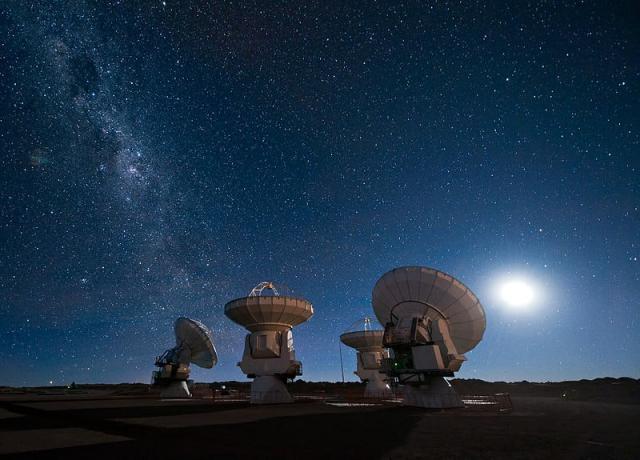
Modern astronomy has made some astonishing discoveries - how stars burn and how black holes form; galaxies from the edge of the universe and killer rocks right next door; where the elements come from and how the expanding universe is accelerating. But how do we know all that? The truth is that astronomy would be impossible without technology, and every advance in astronomy is really an advance in technology. But the technology by itself is not enough. We have to apply it critically with a knowledge of physics to unlock the secrets of the Universe.

Class Deals by MOOC List - Click here and see Coursera's Active Discounts, Deals, and Promo Codes.

Each week we will cover a different aspect of Astronomical technology, matching each piece of technology to a highlight science result. We will explain how the technology works, how it has allowed us to collect astronomical data, and, with some basic physics, how we interpret the data to make scientific discoveries.
The class will consist of video lectures, weekly quizzes, and discussion forums. Each week there will be five videos, totalling approximately 40 minutes. They will be in a regular pattern - a short introduction, an example science story, an explanation of the key technology area, a look at how the technology is used in practice, and finally a look at what the future may hold.

Syllabus

WEEK 1
Science and Technology
Introducing the themes of the course, and a first look at the science and technology we will study.

WEEK 2
Telescopes and Stars
How telescopes work, how we use them to make images in different colours, and how we use those measurements to understand how stars work.

WEEK 3
Space and Black Holes
Hunting for black holes, and why we need to get above the atmosphere to do it.

WEEK 4
Detectors and the First Galaxies
Detectors, how they work, and how we use them to catch the light from the very first galaxies.

WEEK 5
Computers and Killer Rocks
Why computers are crucial in astronomy, and how they are used to find rare objects.

WEEK 6
Spectroscopy and Dark Energy
How to break up light into its component parts, how that allows us to do astrophysics, and why we believe the Universe is full of a mysterious dark energy.

Go to Class
MOOC List is learner-supported. When you buy through links on our site, we may earn an affiliate commission.

Related Courses

Conceptos y Herramientas para la Física Universitaria (Coursera) Coursera
Tecnológico de Monterrey

Conceptos y Herramientas para la Física Universitaria (Coursera)

Este curso provee al estudiante con conceptos y herramientas matemáticas para modelar problemas en física, que al aplicar podrá enfrentar con éxito los cursos de física universitarios. Así pues, la filosofía de este curso consiste en cubrir temas conceptuales relativos a la Física y desarrollar tu capacidad de aprender y aplicarlos en tu vida profesional.

Sep 14th 2026
5-12 Weeks
New Space: Access to space - Basics (Coursera) Coursera
ISAE-SUPAERO

New Space: Access to space - Basics (Coursera)

The spirit of NewSpace is revolutionizing our vision of access to space. Reading keys will enable you to understand the technological and strategic challenges in games with new rules, fixed by ambitious players. Combine the new technologies and management of space access with the classical paradigm of the existing space context.

Sep 14th 2026
3 Weeks
Journey of the Universe: The Unfolding of Life (Coursera) Coursera
Yale University

Journey of the Universe: The Unfolding of Life (Coursera)

Journey of the Universe weaves together the discoveries of the evolutionary sciences together with humanities such as history, philosophy, art, and religion. The course draws on the Emmy-award winning film, Journey of the Universe, and the book from Yale University Press. Journey explores cosmic evolution as a creative process based on connection, interdependence, and emergence. It examines a range of dynamic interactions in the unfolding of galaxies, Earth, life, and human communities. It investigates ways in which we understand evolutionary processes and the implications for humans and our ecological future.

Sep 14th 2026
5-12 Weeks
Biosphere 2 Science for the Future of Our Planet (Coursera) Coursera
University of Arizona

Biosphere 2 Science for the Future of Our Planet (Coursera)

Are you ready to take an incredible journey around Planet Earth and beyond? In this course, you will delve into a world of innovative science and learn from a team of Biosphere 2 and University of Arizona researchers. From plants and soils, to oceans and rainforests, the Moon, Mars, and more, this course is an exciting opportunity for anyone interested in science and Earth stewardship.

Sep 14th 2026
5-12 Weeks
From the Big Bang to Dark Energy (Coursera) Coursera
The University of Tokyo

From the Big Bang to Dark Energy (Coursera)

We have learned a lot recently about how the Universe evolved in 13.7 billion years since the Big Bang. More than 80% of matter in the Universe is mysterious Dark Matter, which made stars and galaxies to form. The newly discovered Higgs-boson became frozen into the Universe a trillionth of a second after the Big Bang and brought order to the Universe.

Sep 7th 2026
4 Weeks
The Brain and Space (Coursera) Coursera
Duke University

The Brain and Space (Coursera)

This course is about how the brain creates our sense of spatial location from a variety of sensory and motor sources, and how this spatial sense in turn shapes our cognitive abilities. Knowing where things are is effortless. But “under the hood,” your brain must figure out even the simplest of details about the world around you and your position in it.

Sep 14th 2026
5-12 Weeks
The Science of the Solar System (Coursera) Coursera
Caltech

The Science of the Solar System (Coursera)

Learn about the science behind the current exploration of the solar system in this free class. Use principles from physics, chemistry, biology, and geology to understand the latest from Mars, comprehend the outer solar system, ponder planets outside our solar system, and search for habitability in our neighborhood and beyond. This course is generally taught at an advanced level assuming a prior knowledge of undergraduate math and physics, but the majority of the concepts and lectures can be understood without these prerequisites.

Sep 21st 2026
5-12 Weeks
Constructivism and Mathematics, Science, and Technology Education (Coursera) Coursera
University of Illinois at Urbana-Champaign

Constructivism and Mathematics, Science, and Technology Education (Coursera)

This course is designed to help participants examine the implications of constructivism for learning and teaching in science, mathematics, and technology focused areas. Course readings, discussions, and assignments will examine constructivist views of learning, research on students' ideas and idea-based interactions, research on instructional approaches taking student ideas into account, and challenges in implementing constructivist perspectives in instruction.

Sep 14th 2026
5-12 Weeks
Archaeoastronomy (Coursera) Coursera
Politecnico di Milano

Archaeoastronomy (Coursera)

Archaeoastronomy is the “science of stars and stones”: it studies the relationships between the ancient monuments and the sky, in order to gain a better understanding of the ideas of the architects of the past and of their religious and symbolic world. The course provides the first complete, easy introduction to this fascinating discipline.

Sep 14th 2026
5-12 Weeks
面向对象技术高级课程 (The Advanced Object-Oriented Technology) (Coursera) Coursera
Peking University

面向对象技术高级课程 (The Advanced Object-Oriented Technology) (Coursera)

如果将软件开发人员看作行走江湖的武侠,那么各种软件开发技术就是武侠赖以傍身的武术秘籍。有的秘籍以易学灵巧见长,练习者很快掌握,并有立竿见影的功效,但失之厚重持久;有的秘籍初学乍练顿显困难,虽冥思苦解仍不得要领,需坚持不断的内功修炼方成正果,却是成为武林大侠必备的至宝。本课程有些类似于后者。

Sep 14th 2026
13-24 Weeks