EdX

Beyond Engineering: Building with Nature (edX)

Beyond Engineering: Building with Nature (edX)

Learn how to use Social Design Principles in developing more effective and sustainable hydraulic infrastructure, with an emphasis on delta, coastal and port environments. If you’re a coastal engineer, ecologist or planner, then this is the course for you. You already know that engineering and ecological principles are not enough to realize nature-friendly solutions in practice. You need people on your side!

Class Deals by MOOC List - Click here and see EdX's Active Discounts, Deals, and Promo Codes.

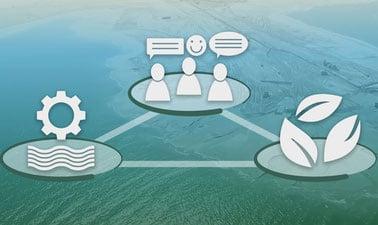
In this course you will learn how to build a relevant coalition of stakeholders to support the design and implementation of ecosystem-based hydraulic infrastructures. After learning basic stakeholder mapping and game theory techniques, you will apply Social Design Principles to a Building with Nature ecosystem-based design case. This will equip you to identify promising collaborative arrangements for your engineering or planning practice.
The course builds on the previous Building with Nature MOOC, which explored the use of natural materials and ecological processes in achieving effective and sustainable hydraulic infrastructure designs, distilling Engineering and Ecological Design Principles. In this course, the missing element of Social Design Principles are developed and taught.
You’ll learn from renowned Dutch engineers and international environmental scientists, who work at the technical- governance interface. Iconic examples such as the Maasvlakte II expansion to Rotterdam Harbor and the Delfland Sand Engine Mega-nourishment serve as study material. The challenges in designing and implementing these nature-friendly hydraulic infrastructures are explored by the eminent professors who were responsible for their genesis.
Join us in becoming one of the new generation of engineers, ecologists and planners who see the Building with Nature integrated design approach as critical to hydraulic engineering, nature and society.

What you'll learn

  • Identify relevant stakeholders for the design and implementation of nature-friendly hydraulic infrastructure.
  • Analyze the power and interests of these stakeholders, including their interdependence in terms of resources.
  • Apply basic game-theory principles in combination with the stakeholder analysis to determine potential coalitions in a Building with Nature project case.
  • Evaluate the suitability of the coalitions for designing and implementing a particular Building with Nature project case.

Syllabus

  1. Necessary Background Knowledge
  2. Why Beyond Engineering?
  3. Stakeholder Identification and Mapping
  4. Game Theory
  5. Social Design Principles
  6. Towards Coalition Building
Go to Class
MOOC List is learner-supported. When you buy through links on our site, we may earn an affiliate commission.

Related Courses

Nanophotonic Modeling (edX) EdX
Purdue University,PurdueX

Nanophotonic Modeling (edX)

Learn a comprehensive set of simulation techniques to predict the performance of photonic nanostructures. This engineering course is an introduction to photonic materials and devices structured on the wavelength scale. Generally, these systems will be characterized as having critical dimensions at the nanometer scale. These can include nanophotonic, plasmonic, and metamaterial components and systems.

Feb 12th 2024
5-12 Weeks
Introduction to Water and Climate (edX) EdX
Delft University of Technology,DelftX

Introduction to Water and Climate (edX)

Water is a crucial element in climate and for society. Find out about the latest engineering interventions for water management in rivers, coasts and the urban environment. Water is essential for life on Earth and of crucial importance for society. Water also plays a major role in affecting climate. Its natural cycle, from ocean to atmosphere by evaporation, then by precipitation back to land returning via rivers and aquifers to the oceans, has a decisive impact on regional and global climate patterns.

Self Paced
Self-Paced
Climate Change Science and Negotiations (edX) EdX
SDGAcademyX,SDG Academy

Climate Change Science and Negotiations (edX)

Humanity is up against a tight timeline to address climate change. Learn how we can deeply decarbonize the global energy systems, and put the world on a 2°C pathway. In this course, learn solutions to mitigate the effects of the global greenhouse gas emissions causing temperature rise, and how to apply these solutions in different national contexts improvements.

Self Paced
Self-Paced
Introduction to Quantum Transport (edX) EdX
Purdue University,PurdueX

Introduction to Quantum Transport (edX)

This course introduces the non-equilibrium Green’s function (NEGF) method widely used to describe quantum effects in nanoscale devices, along with its applications to spintronic devices. This course introduces the Schrödinger equation, using the tight-binding method to discuss the concept of bandstructure and E(k) relations, followed by an introduction to the NEGF method with simple illustrative examples. Concept of spinors is introduced along with the application of the NEGF method to spintronic devices.

Feb 12th 2024
5-12 Weeks
Worldviews - From Sustainability to Regeneration (edX) EdX
ETH Zurich,ETHx

Worldviews - From Sustainability to Regeneration (edX)

To deal with sets of environmental and social crises, we need a cultural and mental transformation. This MOOC is the first part of an interconnected series of four MOOCS which bring together science, design and transformative praxis as a fluid, intervention-based and synergistic process for addressing complex challenges. This is explored through broadening worldviews, reframing complexity, designing as nature, activating our minds through physical movement, and connecting with new communities.

May 9th 2022
3 Weeks
Engineering the Space Shuttle (edX) EdX
MIT,MITx

Engineering the Space Shuttle (edX)

Learn all about the world’s first reusable spacecraft - the Space Shuttle - from the very people who designed, built, and operated it for 30 years. This course examines how the Space Shuttle was designed and how its design was influenced by economics and politics. The course goes into detail on many of the Shuttle’s subsystems (e.g. rocket engines, thermal protection, aerodynamics, environmental control and life support, communications, etc.) and explains how the Shuttle was operated (launch, mission control, payloads, etc.). The course also uses the Space Shuttle to present the fundamentals of Systems Engineering.

Feb 16th 2022
5-12 Weeks
Robot Mechanics and Control, Part II (edX) EdX
Seoul National University,SNUx

Robot Mechanics and Control, Part II (edX)

A mathematical introduction to the mechanics and control of robots. This course is Part II of a two-part mathematical introduction to the mechanics and control of robots that can be modeled as kinematic chains. Topics covered include the concept of a robot’s configuration space and degrees of freedom, static grasp analysis, the description of rigid body motions, kinematics of open and closed chains, and the basics of robot control.

No sessions available
4 Weeks