EdX

Modeling and Simulation of Multibody Systems - Part II (edX)

Modeling and Simulation of Multibody Systems - Part II (edX)

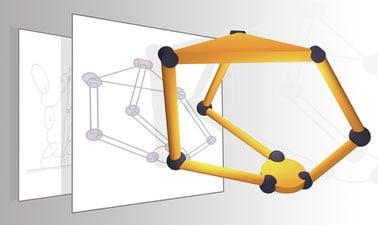
90% of daily life multibody systems contain loops of bodies, e.g. vehicle or bike suspensions, parallel manipulators or robots, and musculoskeletal systems. They can also include joint constraints. In this second course about multibody systems, learn how to model them and how to deal with more advanced numerical analyses.

Class Deals by MOOC List - Click here and see EdX's Active Discounts, Deals, and Promo Codes.

This course aims at acquainting you with the modeling and simulation of constrained multibody systems, and especially mechanical systems with kinematic loops, such as real vehicle or bicycle suspensions, parallel manipulators or robots, musculoskeletal systems, etc.
You will also learn to deal with more advanced numerical analyses:
• Direct kinematics;
• Inverse kinematics;
• Equilibrium;
• Modal analysis;
• Direct Dynamics;
• Inverse Dynamics.
This course is based on (1) video clips focusing on the main theoretical background and concepts, (2) well-illustrated written sections given more details about the mathematical formulation, and (3) questions, exercises and modeling projects.
Despite the intrinsic complexity of such systems in terms of morphology and motions, basic skills in Newtonian mechanics, linear algebra and numerical methods are sufficient to model them, provided that the endless and tedious computation related to their internal kinematics and dynamics are at our disposal. This is the purpose of the symbolic program ROBOTRAN, which can be used with this course and can automatically generate the full set of equations of motion of a constrained MBS, in a symbolic manner, i.e. exactly as if you were writing them by hand, whatever the size and their morphological complexity of the application. Hence, this course will instead teach you how to intervene upstream and downstream this generation step.
Upstream the latter, you will learn how to translate a real system, e.g. a car suspension, into a virtual multibody model comprising algebraic constraints between joints, kinematic loops, etc.
Downstream the symbolic generation, your intervention will consist in:
• Completing the symbolic model with features that are specific for your system, e.g. a tire force model or the tuning of a motion controller, among other things;
• Selecting and implementing under the form of a program (in Python, Matlab, or C) the suitable numerical method to solve the differential equations of motion, given the original question; (1) an equilibrium solution can give you the static forces and the system deflection, (2) a time simulation can compute any transient motion of the system submitted to forces and torques, (3) a modal analysis will provide you with the eigenmodes that inform you about the system stability and damping characteristics, (4) an inverse dynamics study can provide you with the necessary forces and torques for any prescribed motion of the system, (5) etc.
• Selecting the most suitable results, including self-explanatory - and sometimes funny - video animations of your multibody system in motion.
In sum, this course, based on the use of the ROBOTRAN symbolic generator, will allow you to focus on the most interesting aspects of the multibody modeling process, by entirely mastering your computer model from the input data to the results, instead of using a black-box multibody program that clearly goes against the educational objective of such a course.
Enjoy Multibody Dynamics!
Note: The course was built to teach modeling and simulation of multibody systems, and not to teach any specific software. However, we suggest that you use the symbolic ROBOTRAN program to model and study the various multibody systems proposed in this course.
This course is part of the Modeling and Simulation of Multibody Systems Professional Certificate.

What you'll learn
In this course devoted to constrained multibody systems, you will learn how to:
• translate a real constrained mechanical system in the light of the issue to solve, into a multibody model;
• complete your model with features and sub-models that are specific to your application;
• build and master a program (in Python, Matlab or C) to select the appropriate numerical analysis, simulate the system and produce the expected results.

Prerequisites:
Part 1: MOOC in “Modeling and simulation of multibody systems – Part I” (Louv25X.1x); or equivalent

Go to Class
MOOC List is learner-supported. When you buy through links on our site, we may earn an affiliate commission.

Related Courses

A System View of Communications: From Signals to Packets (Part 1) (edX) EdX
The Hong Kong University of Science and Technology - HKUST,HKUSTx

A System View of Communications: From Signals to Packets (Part 1) (edX)

Explore the tradeoffs in designing communication systems like mobile phones, and the engineering tools to handle them. Have you ever wondered how information is transmitted using your mobile phone or a WiFi hotspot? This introductory course seeks to enable you to understand the basic engineering tools used and tradeoffs encountered in the design of these systems.

Self Paced
Self-Paced
Foundations of Data Analysis - Part 1: Statistics Using R (edX) EdX
University of Texas at Austin,UTAustinX

Foundations of Data Analysis - Part 1: Statistics Using R (edX)

This is a hands on course with a data lab to teach fundamental statistical topics such as descriptive statistics, inferential testing, and modeling. In this first part of a two part course, we’ll walk through the basics of statistical thinking – starting with an interesting question. Then, we’ll learn the correct statistical tool to help answer our question of interest – using R and hands-on Labs.

No sessions available
5-12 Weeks
Nanophotonic Modeling (edX) EdX
Purdue University,PurdueX

Nanophotonic Modeling (edX)

Learn a comprehensive set of simulation techniques to predict the performance of photonic nanostructures. This engineering course is an introduction to photonic materials and devices structured on the wavelength scale. Generally, these systems will be characterized as having critical dimensions at the nanometer scale. These can include nanophotonic, plasmonic, and metamaterial components and systems.

Feb 12th 2024
5-12 Weeks
Operations Research: an Active Learning Approach (edX) EdX
The Hong Kong Polytechnic University,HKPolyUx

Operations Research: an Active Learning Approach (edX)

Learn the methodology and some prominent techniques of Operations Research to make informed decisions for solving your operational problems without the need of advanced mathematics. Operations management deals with operational planning and control issues, and is needed in all sectors of the society. One of the challenges to operations manager is how to make use of the available resources in the best way for meeting a certain objective. Quantitative approaches are inevitably needed in tackling many of such problems.

Jul 4th 2022
5-12 Weeks
Thermodynamics (edX) EdX
IIT Bombay,IITBombayX

Thermodynamics (edX)

Introduction to basic concepts and applications of thermodynamics in mechanical engineering. ME209x is a basic course in thermodynamics, designed for students of mechanical engineering. We will study the terms and concepts used in thermodynamics, with precise definitions. The three laws of thermodynamics (zeroth, first, and second) will be explored in detail, and the properties of materials will be studied.

No sessions available
5-12 Weeks
Solid State Devices 1 (edX) EdX
Purdue University,PurdueX

Solid State Devices 1 (edX)

Semiconductor are everywhere in human activities, from your credit card to space exploration. This graduate-level introduction brings aspects of physics, chemistry, and engineering together to understand, analyze, and design transistors and solar cells. This course provides the graduate-level introduction to understand, analyze, characterize and design the operation of semiconductor devices such as transistors, diodes, solar cells, light-emitting devices, and more.

Jan 9th 2023
13-24 Weeks
Railway Engineering: An Integral Approach (edX) EdX
Delft University of Technology,DelftX

Railway Engineering: An Integral Approach (edX)

Discover the science and complexity behind the exciting world of metro, tram and railway systems. Have you ever wondered what it takes to get your train on the right platform at the scheduled time every day? Understanding the complexity behind today’s sophisticated railway systems will give you a better insight into how this safe and reliable transportation system works. We will show you the many factors which are involved and how multiple people, behind the scenes, have a daily task that enables you to get from home to work. Journey with us into the world of rail - a complex system that connects people, cities and countries.

Apr 10th 2024
5-12 Weeks
Hypersonics - from Shock Waves to Scramjets (edX) EdX
University of Queensland,UQx

Hypersonics - from Shock Waves to Scramjets (edX)

Understand flight at speeds greater than Mach 5 and discover how to analyse the performance of a scramjet. A flow is called hypersonic if the Mach number is greater than 5. This means that the flow speed is more than five times the speed of sound. In air at room temperature, the speed of sound is around 340 m/s, so a Mach 5 flow would have a flow speed of 1.7 km/s or just over 6,000 km/h. When a rocket launches a satellite into earth orbit, when a probe enters the atmosphere of another planet or when an aircraft is propelled by a supersonic combustion ramjet engine (a scramjet), hypersonic flows are encountered.

Self Paced
Self-Paced
Wave-Based NDT Methods (edX) EdX
Purdue University,PurdueX

Wave-Based NDT Methods (edX)

Learn how to use wave-based NDT techniques, ultrasonic testing, acoustic emission, etc, to inspect the structural integrity of civil engineering structures, including highways, bridges, dams, and buildings. Wave-based NDT methods allow for reliable and rapid evaluation of civil engineering infrastructure. These methods are particularly useful in long-range inspection; for example, in pipelines, where the wave-based NDT can provide data on hundreds of meters of piping in a matter of seconds.

Feb 14th 2022
5-12 Weeks
Robot Mechanics and Control, Part II (edX) EdX
Seoul National University,SNUx

Robot Mechanics and Control, Part II (edX)

A mathematical introduction to the mechanics and control of robots. This course is Part II of a two-part mathematical introduction to the mechanics and control of robots that can be modeled as kinematic chains. Topics covered include the concept of a robot’s configuration space and degrees of freedom, static grasp analysis, the description of rigid body motions, kinematics of open and closed chains, and the basics of robot control.

No sessions available
4 Weeks
Quantum Detectors (edX) EdX
Purdue University,PurdueX

Quantum Detectors (edX)

Learn about quantum sensors and devices that extract maximal information from the world around us. Classical detectors and sensors are ubiquitous around us from heat sensors in cars to light detectors in a camera cell phone. Leveraging advances in the theory of noise and measurement, an important paradigm of quantum metrology has emerged. Here, ultra-precision measurement devices collect maximal information from the world around us at the quantum limit.

Feb 12th 2024
5-12 Weeks