EdX

Advanced Fluid Mechanics 3: Potential Flows & Boundary Layers (edX)

Offered by MIT, MITx,
Advanced Fluid Mechanics 3: Potential Flows & Boundary Layers (edX)

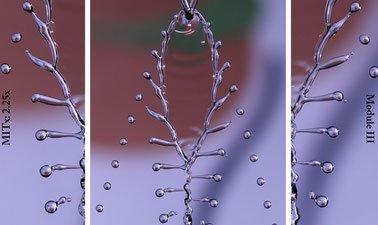
Learn to analyze the structure of high Reynolds number inviscid flows using potential flow theory, the roles of vorticity generation in viscous boundary layers, circulation and lift, flow separation, and transition to turbulence. A separate final short module briefly introduces the role of surface tension in engineering fluid mechanics. This course features lecture and demo videos, lecture concept checks, practice problems, and extensive problem sets.

Class Deals by MOOC List - Click here and see EdX's Active Discounts, Deals, and Promo Codes.

This course is the final module of a three-course sequence in incompressible fluid mechanics: Advanced Fluid Mechanics:1. Fundamentals; Advanced Fluid Mechanics: 2. The Navier-Stokes Equations for Viscous Flows, and Advanced Fluid Mechanics: 3. Potential Flows, Lift, Circulation & Boundary Layers. The series is based on material in MIT’s class 2.25 Advanced Fluid Mechanics, one of the most popular first-year graduate classes in MIT’s Mechanical Engineering Department. This series is designed to help people gain the ability to apply the governing equations, the principles of dimensional analysis and scaling theory to develop physically-based, approximate models of complex fluid physics phenomena. People who complete these three consecutive courses will be able to apply their knowledge to analyze and break down complex problems they may encounter in industrial and academic research settings.
The material is of relevance to engineers and scientists across a wide range of mechanical, chemical and process industries who must understand, analyze and optimize flow processes and fluids handling problems. Applications are drawn from hydraulics, aero & hydrodynamics as well as the chemical process industries.

What you'll learn

  • Inviscid flows
  • Potential flow solutions
  • Vorticity
  • Circulation
  • Drag and lift
  • Boundary layers
  • Flow Separation and transition to turbulence
  • Surface Tension Phenomena in engineering systems

Prerequisites
Comfort with undergraduate-level fluid mechanics, multivariable calculus and undergraduate differential equations: elementary vector and tensor manipulation, Fourier transforms, solving second order linear ODEs and PDEs. Students without this background will find there is a steep learning curve and may have to put in more than the estimated time effort.

Syllabus

  1. Potential Flow Solutions for Ideal Inviscid Flows
  2. Vorticity, Circulation and Lift
  3. The Viscous Boundary layer and transition to turbulence
  4. Flow Separation, and the effect on drag and lift
  5. Brief introduction to surface tension phenomena in fluid mechanics
Go to Class
MOOC List is learner-supported. When you buy through links on our site, we may earn an affiliate commission.

Related Courses

Is this Physics or Magic? Learning Physics through Minds-on Science Demonstration (edX) EdX
National University of Singapore,NUS

Is this Physics or Magic? Learning Physics through Minds-on Science Demonstration (edX)

Is this MOOC an introduction to Physics or Magic? Here's calling all curious minds from every corner of the globe to join us to learn physics via science demonstrations which are exciting, visually appealing and thought provoking. In this MOOC, you'll get to witness how demonstrations can add reality and vividness to the process of concept formation, and pick up one or two scientific nuggets along the way.

Sep 5th 2023
5-12 Weeks
Quantum Detectors (edX) EdX
Purdue University,PurdueX

Quantum Detectors (edX)

Learn about quantum sensors and devices that extract maximal information from the world around us. Classical detectors and sensors are ubiquitous around us from heat sensors in cars to light detectors in a camera cell phone. Leveraging advances in the theory of noise and measurement, an important paradigm of quantum metrology has emerged. Here, ultra-precision measurement devices collect maximal information from the world around us at the quantum limit.

Feb 12th 2024
5-12 Weeks
Science & Cooking: From Haute Cuisine to Soft Matter Science (chemistry) (edX) EdX
HarvardX,Harvard University

Science & Cooking: From Haute Cuisine to Soft Matter Science (chemistry) (edX)

Top chefs and Harvard researchers explore how everyday cooking and haute cuisine can illuminate basic principles in chemistry, physics, and engineering. Learn about food molecules and how chemical reactions can affect food texture and flavor. During each module of this course, chefs reveal the secrets behind some of their most famous culinary creations — often right in their own restaurants. Inspired by such cooking mastery, the Harvard team will then explain the science behind the recipe.

Self Paced
Self-Paced
On-Ramp to AP* Physics C: Mechanics (edX) EdX
Weston High School

On-Ramp to AP* Physics C: Mechanics (edX)

This course will help the students who have taken intro-level high-school physics to get ready for more advanced courses including AP Physics C: Mechanics. This short course is intended for the high-school students who have taken an introductory-level physics course, acquired some background in Mechanics and intend to take a more advanced course – for instance, AP Physics C.

Self Paced
Self-Paced
Hypersonics - from Shock Waves to Scramjets (edX) EdX
University of Queensland,UQx

Hypersonics - from Shock Waves to Scramjets (edX)

Understand flight at speeds greater than Mach 5 and discover how to analyse the performance of a scramjet. A flow is called hypersonic if the Mach number is greater than 5. This means that the flow speed is more than five times the speed of sound. In air at room temperature, the speed of sound is around 340 m/s, so a Mach 5 flow would have a flow speed of 1.7 km/s or just over 6,000 km/h. When a rocket launches a satellite into earth orbit, when a probe enters the atmosphere of another planet or when an aircraft is propelled by a supersonic combustion ramjet engine (a scramjet), hypersonic flows are encountered.

Self Paced
Self-Paced