Your first Arduino project: Design and Build a Colorful Musical Toy. (Skillshare)

Offered by Skillshare,
Your first Arduino project: Design and Build a Colorful Musical Toy. (Skillshare)

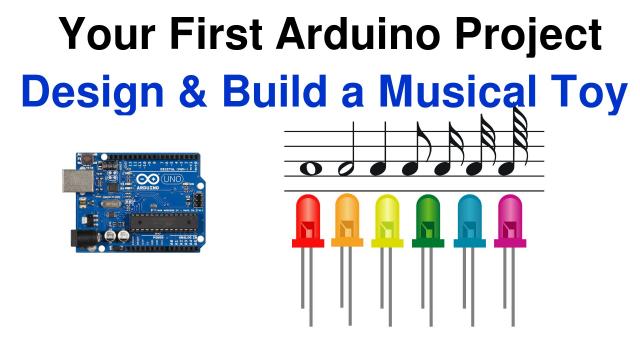
Arduino’s are a family of inexpensive single-board computers that allow you to create just about anything you can dream of with minimal technical skills. This class will teach you to build your first Arduino project, a fun device that plays a tune and flashes colored LED lights. You can design it to play your national anthem while flashing your country's colors or get creative and make a unique tribute to your favorite sports team!

Don't worry if you've never worked with electronics or programed before, it's not a prerequisite. Just come prepared to learn something new and have some fun!
Design a unique musical toy with your country's (or teams) anthem and colors.
You will be building a unique electronic toy that flashes LEDs while playing the tune of your choice. As you create your project you learn about the Arduino, Electronics and even a little bit about music.
You can create your toy on a temporary breadboard or assemble it permanently as your own unique creation. I can't wait to see what you come up with!
To build this project you’ll need to gather together the following items:

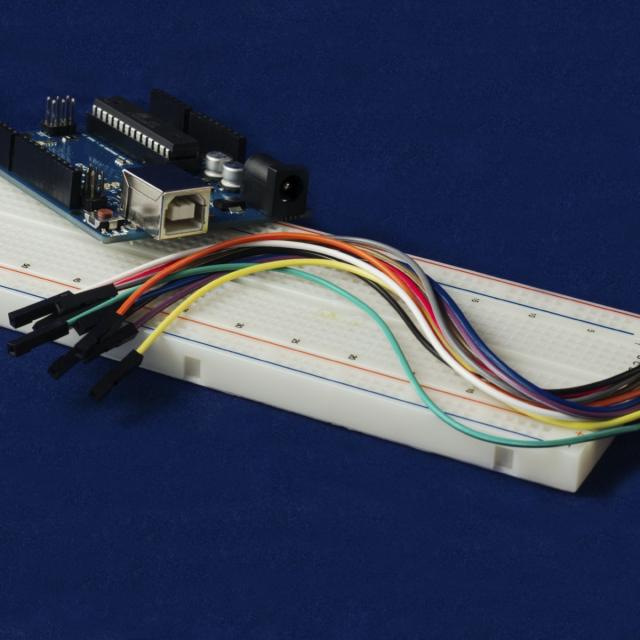
  • An Arduino, Genuino or Arduino clone board. I use an Arduino Uno clone in the lessons, this is the most popular Arduino board and is available for less than 20 dollars. You can use it later for other projects.
  • A computer with a spare USB port. This a desktop or notebook and it can be Windows, Mac or Linux. You’ll use it to program your Arduino board.
  • A USB type A to B cable. This Is the type of USB cable you use with a printer. Your Arduino board may have come with one.
  • (3) Colored LED lights. Pick the colors to match your country's flag or your sports team's logo. LED’s come in all shapes and sizes, I recommend the 3mm or 5mm ones which are dirt cheap and commonly available.
  • (3) 330 ohm ¼ watt resistors. Actually any value from 150 to 470 ohms will be fine.
  • (1) 10K (10,000 ohm) ¼ watt resistor. Actually any value from 5.6K to 22K will be fine.
  • A pushbutton switch. This is also called an “SPST momentary contact” switch.
  • A piezo element or tiny speaker rated at 6 volts.
  • A solderless breadboard. This is a plastic board used for prototyping electronic circuits. It should be available from the same place you bought your Arduino and the other electronic components.
  • Hookup wire for the breadboard. This may have come with your breadboard, otherwise you can use standard 22 or 24 gauge solid insulated wire.

Optionally you’ll need a few things to exercise your creativity and make your project permanent:

  • A box or enclosure for your device. Use something you have around the house or explore your Dollar Store for a small plastic box.
  • A small “perfboard”, this is a circuit board with holes surrounded by copper pads. It’s optional, but it will make it easier to permanently wire your circuit.
  • Solder and a soldering iron.
  • A 9 volt battery and a battery clip with a 2.1 mm power connector OR a small USB power supply.
  • Your Imagination!

You don't really need any tools, although a small pair of needle-nose pliers would be handy.

Go to Class
MOOC List is learner-supported. When you buy through links on our site, we may earn an affiliate commission.

Related Courses

Sustainable Business Enterprises (Coursera) Coursera
University of Illinois at Urbana-Champaign

Sustainable Business Enterprises (Coursera)

This course will explore current challenges and opportunities facing firms in the area of environmental sustainability. It will begin with an introduction to sustainability, with a particular focus on how environmental sustainability is relevant to business. Topics such as unsustainable consumption/consumer behavior, market research sustainable product design, sustainable value chains and communications will be covered. The bottom-up approach in terms of immersion, emersion, and design as applied to sustainable business enterprise will be covered.

Aug 31st 2026
4 Weeks
Aplicaciones musicales con Arduino (Coursera) Coursera
Universidad Nacional Autónoma de México

Aplicaciones musicales con Arduino (Coursera)

En este curso nos adentraremos en el terreno del hardware. Concretamente, aprenderemos a utilizar la placa de desarrollo de hardware de código abierto, llamada Arduino, enfocándonos en las aplicaciones que esta ofrece para la experimentación musical. De manera más específica, aprenderemos en este curso a construir nuestros propios generadores de sonido, y a partir de ello haremos instalaciones sonoras que nos permitirán expandir nuestra creatividad hacia el terreno de las cosas materiales, y ya no solo de los datos informáticos.

Aug 31st 2026
4 Weeks
Designing for Inclusivity: A Primer on Gender-Neutral Product Design (Skillshare) Skillshare
Skillshare

Designing for Inclusivity: A Primer on Gender-Neutral Product Design (Skillshare)

The heartbeat of all great design is empathy—and understanding the process of gender-neutral product design is a crucial skill for all designers! At a time when technology connects us more than ever, prioritizing inclusivity in your product design approach is crucial. You want your products to be accessible, usable, and inspirational to all users. This is the core of great design.

Self Paced
Self-Paced
UI/UX: You already know more than you think (Skillshare) Skillshare
Skillshare

UI/UX: You already know more than you think (Skillshare)

Have you ever given thought to who your audience is for a specific project? Tried to make your piece as user-friendly as possible? Done a dry run on how someone interacts with your book/brochure/website? Tried to establish the most effective hierarchy for the information you’re conveying? Then you’ve already done interface and experience design.

Self Paced
Self-Paced
Design Thinking for the Greater Good: Innovation in the Social Sector (Coursera) Coursera
University of Virginia

Design Thinking for the Greater Good: Innovation in the Social Sector (Coursera)

Do you work for a nonprofit or in the social sector? Are you struggling to solve the problems and meet the needs of the people you serve? Come learn more about how design thinking, a human-centered approach to problem solving, can help you truly understand an issue, generate ideas worth testing and iterate to find solutions that make a real difference. Through global stories from areas as diverse as government, health care, and education, we’ll show you the tools, techniques and mindset needed to use design thinking to uncover new and creative solutions in the social sector.

Aug 31st 2026
4 Weeks
Machine Learning Rapid Prototyping with IBM Watson Studio (Coursera) Coursera
IBM

Machine Learning Rapid Prototyping with IBM Watson Studio (Coursera)

An emerging trend in AI is the availability of technologies in which automation is used to select a best-fit model, perform feature engineering and improve model performance via hyperparameter optimization. This automation will provide rapid-prototyping of models and allow the Data Scientist to focus their efforts on applying domain knowledge to fine-tune models. This course will take the learner through the creation of an end-to-end automated pipeline built by Watson Studio’s AutoAI experiment tool, explaining the underlying technology at work as developed by IBM Research.

Sep 14th 2026
4 Weeks
Intro to UX: Conducting Smart User Research  (Skillshare) Skillshare
Skillshare

Intro to UX: Conducting Smart User Research (Skillshare)

Join UserTesting's Janelle Estes for a straightforward look at how to gain smart, useful feedback about how users experience your product, service, or business. What: Understanding your users' experience — behaviors, attitudes, and perceptions — helps you gain gain user empathy, see new opportunities for change, and prioritize product improvements. But: how do you gain that understanding? This 45-minute gives you an approach for 4 popular research methods so that you can truly understand your product's user experience.

Self Paced
Self-Paced
How to Animate a Sketch UI using Principle (Skillshare) Skillshare
Skillshare

How to Animate a Sketch UI using Principle (Skillshare)

This class will show you how to add motion to a User Interface that has been designed in Sketch using Prototype. It’s perfect for any designer who creates their UI using Sketch and wants to add motion and interaction to their designs. No prior experience of Principle is required to take the class as I’ll explain how to use it. The only thing you need to do before you take this is to download the Principle app on your machine.

Self Paced
Self-Paced
User Experience & Interaction Design for AR/VR/MR/XR (Coursera) Coursera
University of Michigan

User Experience & Interaction Design for AR/VR/MR/XR (Coursera)

This second course in the XR for Everybody specialization looks at how to design new user experiences for XR technologies. The course provides learners with a design thinking mindset and equips them with a fundamental toolbox for creating XR applications using rapid prototyping. It starts with a broad overview of the complete XR design process, discussing different paths to becoming an XR creator, what is generally involved in making XR experiences, and how to best get started.

Aug 31st 2026
4 Weeks
Fundamentals of Audio and Music Engineering: Part 1 Musical Sound & Electronics (Coursera) Coursera
University of Rochester

Fundamentals of Audio and Music Engineering: Part 1 Musical Sound & Electronics (Coursera)

In this course students learn the basic concepts of acoustics and electronics and how they can applied to understand musical sound and make music with electronic instruments. Topics include: sound waves, musical sound, basic electronics, and applications of these basic principles in amplifiers and speaker design.

Aug 31st 2026
5-12 Weeks
Interfacing with the Arduino (Coursera) Coursera
University of California, Irvine

Interfacing with the Arduino (Coursera)

Arduino senses the environment by receiving inputs from add-on devices such as sensors, and can control the world around it by adjusting lights, motors, and other actuators. In this class you will learn how and when to use the different types of sensors and how to connect them to the Arduino. Since the external world uses continuous or analog signals and the hardware is digital you will learn how these signals are converted back-and-forth and how this must be considered as you program your device. You'll also learn about the use of Arduino-specific shields and the shields software libraries to interface with the real world.

Aug 31st 2026
4 Weeks
Introduction to the Internet of Things and Embedded Systems (Coursera) Coursera
University of California, Irvine

Introduction to the Internet of Things and Embedded Systems (Coursera)

The explosive growth of the “Internet of Things” is changing our world and the rapid drop in price for typical IoT components is allowing people to innovate new designs and products at home. In this first class in the specialization you will learn the importance of IoT in society, the current components of typical IoT devices and trends for the future. IoT design considerations, constraints and interfacing between the physical world and your device will also be covered. You will also learn how to make design trade-offs between hardware and software. We'll also cover key components of networking to ensure that students understand how to connect their device to the Internet.

Aug 31st 2026
4 Weeks