The Arduino Platform and C Programming (Coursera)

The Arduino Platform and C Programming (Coursera)

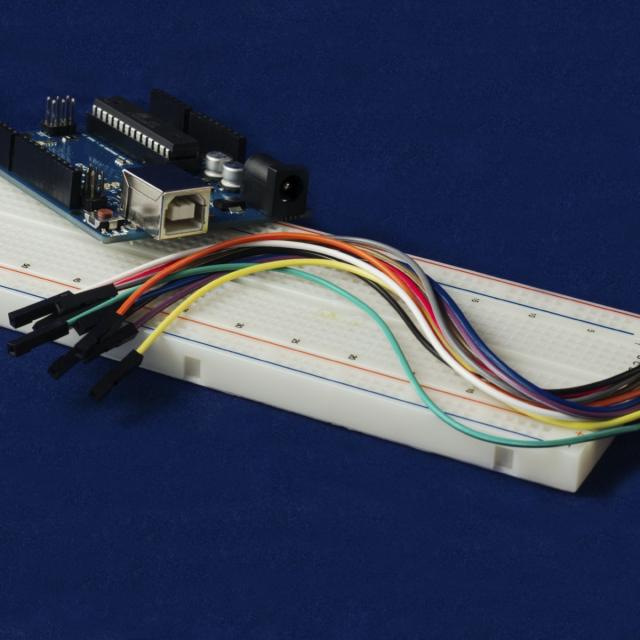
The Arduino is an open-source computer hardware/software platform for building digital devices and interactive objects that can sense and control the physical world around them. In this class you will learn how the Arduino platform works in terms of the physical board and libraries and the IDE (integrated development environment). You will also learn about shields, which are smaller boards that plug into the main Arduino board to perform other functions such as sensing light, heat, GPS tracking, or providing a user interface display. The course will also cover programming the Arduino using C code and accessing the pins on the board via the software to control external devices.

Class Deals by MOOC List - Click here and see Coursera's Active Discounts, Deals, and Promo Codes.

Upon completing this course, you will be able to:

  1. Outline the composition of the Arduino development board
  2. Describe what it means to program the board's firmware
  3. Read board schematics
  4. Install Arduino IDE
  5. Describe what "shields" are and how they are used
  6. Specify the role of libraries in the use of shields
  7. Compile and run a program
  8. Name C Variables and Types
  9. Name common C operators
  10. Use conditionals and loops
  11. Explain functions, their definition and invocation
  12. Explain the implications of global variables
  13. Undertake the Arduino build process
  14. Describe the role of the tools behind the IDE
  15. Describe how to invoke functions in classes
  16. Explain the structure of an Arduino sketch
  17. Access the pins of the Arduino
  18. Differentiate between digital and analog pin
  19. Debug embedded software
  20. Explain the importance of controllability and observability in the debugging process
  21. Describe common debugging architectures for embedded systems
  22. Explain how the UART Serial communication protocol works
  23. Describe how the Arduino Serial library performs serial communication

Course 2 of 6 in the An Introduction to Programming the Internet of Things (IOT) Specialization

Syllabus

WEEK 1
Arduino Environment
This module provides an introduction to the Arduino environment which is composed of three things: the Arduino board, the Arduino IDE, and the Arduino-compatible shields together with their libraries. We first investigate the board, discussing all of its main components, inputs, and outputs. We discuss how each component is used and we examine the board schematic to see how they are connected. We then discuss the Arduino Integrated Development Environment (IDE) which is used primarily to write, compile, and upload code. We survey the interface of the IDE and discuss how to install and use it. We also examine the use of shields to extend the functionality of an Arduino-based system. We discuss how shield libraries provide a useful abstraction to facilitate programming.

WEEK 2
C Programming
This module covers the basics of the C programming language which will be used to write code for the Arduino. The course first covers basic syntax, variables, and types. Most of the basic C operators are presented. Conditional statements (if, switch) and loops (while, for) are described. The concept of functions is presented together with how to define and call functions. Creation and use of global variables is explained.

WEEK 3
Arduino Programs
This module describes the composition of an Arduino program, or sketch, and the process by which it is compiled and uploaded. The Arduino IDE is a user interface for the software tools which actually compile and upload the program. We outline the use of these tools in the build process. We describe the basic structure of a sketch, including the use of the setup() and loop() functions. The main interface of an Arduino is through its pins, so we describe how to access those pins from a sketch.

WEEK 4
This module is an introduction on debugging embedded software on an Arduino. We discuss the basic debugging requirements: controllability and observability. The debugging environment available for an Arduino UNO is limited, so we describe how to use the UART communication protocol to gain controllability and observability. We present the use of the Serial library to communicate with the Arduino through the serial monitor.


Go to Class
MOOC List is learner-supported. When you buy through links on our site, we may earn an affiliate commission.

Related Courses

Using Python to Interact with the Operating System (Coursera) Coursera
Google

Using Python to Interact with the Operating System (Coursera)

By the end of this course, you’ll be able to manipulate files and processes on your computer’s operating system. You’ll also have learned about regular expressions -- a very powerful tool for processing text files -- and you’ll get practice using the Linux command line on a virtual machine. And, this might feel like a stretch right now, but you’ll also write a program that processes a bunch of errors in an actual log file and then generates a summary file. That’s a super useful skill for IT Specialists to know.

Jun 9th 2026
5-12 Weeks
Functional Programming Principles in Scala (Coursera) Coursera
École Polytechnique Fédérale de Lausanne

Functional Programming Principles in Scala (Coursera)

Functional programming is becoming increasingly widespread in industry. This trend is driven by the adoption of Scala as the main programming language for many applications. Scala fuses functional and object-oriented programming in a practical package. It interoperates seamlessly with both Java and Javascript. Scala is the implementation language of many important frameworks, including Apache Spark, Kafka, and Akka. It provides the core infrastructure for sites such as Twitter, Tumblr and also Coursera.

Jun 8th 2026
5-12 Weeks
How To Create a Website in a Weekend! (Project-Centered Course) (Coursera) Coursera
The State University of New York

How To Create a Website in a Weekend! (Project-Centered Course) (Coursera)

In this project-centered course*, you’ll design, build, and publish a basic website that incorporates text, sound, images, hyperlinks, plug-ins, and social media interactivity. We’ll provide you with step-by-step instructions, exercises, tips, and tools that enable you to set up a domain name, create an attractive layout for your pages, organize your content properly, ensure that your site functions well across different operating systems and on mobile devices, keep your site safe, and finally, let people know your site is online. We’ll even show you how to track your visitors.

Jun 8th 2026
3 Weeks
Code Yourself! An Introduction to Programming (Coursera) Coursera
University of Edinburgh,Universidad ORT Uruguay

Code Yourself! An Introduction to Programming (Coursera)

Have you ever wished you knew how to program, but had no idea where to start from? This course will teach you how to program in Scratch, an easy to use visual programming language. More importantly, it will introduce you to the fundamental principles of computing and it will help you think like a software engineer.

Jun 8th 2026
5-12 Weeks
Mastering the Software Engineering Interview (Coursera) Coursera
University of California, San Diego

Mastering the Software Engineering Interview (Coursera)

You’ve hit a major milestone as a computer scientist and are becoming a capable programmer. You now know how to solve problems, write algorithms, and analyze solutions; and you have a wealth of tools (like data structures) at your disposal. You may now be ready for an internship or (possibly) an entry-level software engineering job. But can you land the internship/job? It depends in part on how well you can solve new technical problems and communicate during interviews. How can you get better at this? Practice!

Jun 8th 2026
4 Weeks
Learn to code with AI (Coursera) Coursera
Scrimba

Learn to code with AI (Coursera)

Imagine waking up tomorrow as a web developer. What would you want to build? With AI tools like ChatGPT, you're already a developer, regardless of your experience, if you know how to work with them. So in this course, you'll build functional, interactive front-end projects while learning how to write effective prompts and debug and refine your code with the help of AI.

Jun 10th 2026
2 Weeks
Agile Planning for Software Products (Coursera) Coursera
University of Alberta

Agile Planning for Software Products (Coursera)

This course covers the techniques required to break down and map requirements into plans that will ultimately drive software production. Upon successful completion of this course, you will be able to: create effective plans for software development; map user requirements to developer tasks; assess and plan for project risks; apply velocity-driven planning techniques; generate work estimates for software products.

Jun 8th 2026
4 Weeks
Client Needs and Software Requirements (Coursera) Coursera
University of Alberta

Client Needs and Software Requirements (Coursera)

This course covers practical techniques to elicit and express software requirements from client interactions. Upon successful completion of this course, you will be able to: Create clear requirements to drive effective software development; visualize client needs using low-fidelity prototypes; maximize the effectiveness of client interactions - adapt to changing product requirements.

Jun 8th 2026
4 Weeks
Introduction to CSS3 (Coursera) Coursera
University of Michigan

Introduction to CSS3 (Coursera)

The web today is almost unrecognizable from the early days of white pages with lists of blue links. Now, sites are designed with complex layouts, unique fonts, and customized color schemes. This course will show you the basics of Cascading Style Sheets (CSS3). The emphasis will be on learning how to write CSS rules, how to test code, and how to establish good programming habits.

Jun 8th 2026
4 Weeks
Introduction to the Internet of Things and Embedded Systems (Coursera) Coursera
University of California, Irvine

Introduction to the Internet of Things and Embedded Systems (Coursera)

The explosive growth of the “Internet of Things” is changing our world and the rapid drop in price for typical IoT components is allowing people to innovate new designs and products at home. In this first class in the specialization you will learn the importance of IoT in society, the current components of typical IoT devices and trends for the future. IoT design considerations, constraints and interfacing between the physical world and your device will also be covered. You will also learn how to make design trade-offs between hardware and software. We'll also cover key components of networking to ensure that students understand how to connect their device to the Internet.

Jun 8th 2026
4 Weeks
Algorithmic Toolbox (Coursera) Coursera
University of California, San Diego,Higher School of Economics - HSE University

Algorithmic Toolbox (Coursera)

The course covers basic algorithmic techniques and ideas for computational problems arising frequently in practical applications: sorting and searching, divide and conquer, greedy algorithms, dynamic programming. We will learn a lot of theory: how to sort data and how it helps for searching; how to break a large problem into pieces and solve them recursively; when it makes sense to proceed greedily; how dynamic programming is used in genomic studies. You will practice solving computational problems, designing new algorithms, and implementing solutions efficiently (so that they run in less than a second).

Jun 8th 2026
5-12 Weeks