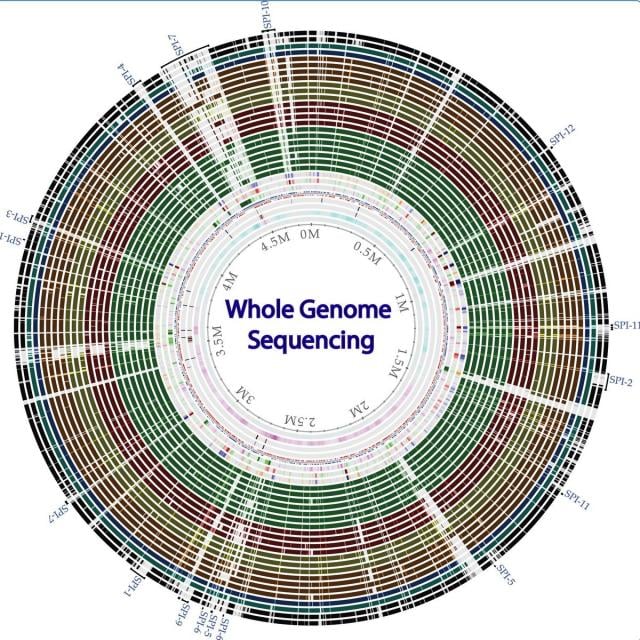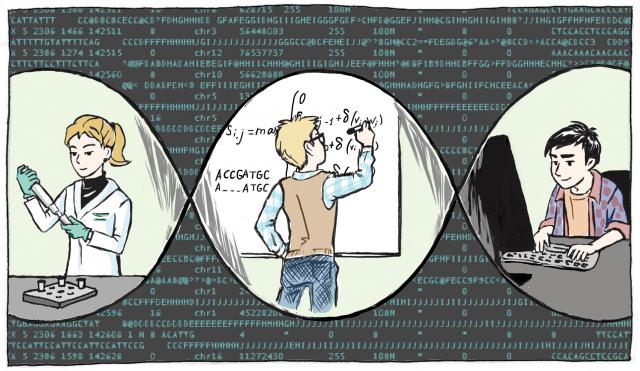
Введение в биоинформатику (Introduction to Bioinformatics) (Coursera)

Введение в биоинформатику (Introduction to Bioinformatics) (Coursera)

Курс «Введение в биоинформатику» адресован тем, кто хочет получить расширенное представление о том, что такое биоинформатика и как она помогает биологам и медикам в их работе. The course is aimed at those who would like to have a better idea of what bioinformatics is and how it helps biologists and medical scientists in research and clinical work.

Class Deals by MOOC List - Click here and see Coursera's Active Discounts, Deals, and Promo Codes.

Syllabus

WEEK 1
Неделя 1 - Введение (Week 1 - Introducton)
Первая неделя нашего курса посвящена основным концепциям геномной биоинформатики. Вы узнаете об истории этой дисциплины, основных методах и алгоритмах. Также вас ждет знакомство с реальной лабораторной работой - мы расскажем, как выделяется ДНК и откуда берутся данные, с которыми нам предстоит работать в дальнейшем.

The first week of our course covers the basic concepts of genome bioinformatics. You will learn about the history of this discipline, the main methods and algorithms. Also you will familiarize yourself with actual laboratory work - we will explain how DNA is extracted and where the sequencing data comes from.

WEEK 2
Неделя 2 - Технологии секвенирования (Sequencing Technologies)
Добро пожаловать на вторую неделю нашего курса! Эта неделя будет посвящена обзору методов секвенирования ДНК. Вы узнаете об истории развития этих технологий и принципах, на которых они основаны.

Welcome to the second week of the course! This week will be dedicated to Next Generation DNA Sequencing technologies. You will learn about the new methods development and main approaches that gave base to NGS.

WEEK 3
Неделя 3 - Контроль качества (Quality Control)
На этой неделе вы уже можете приступить к работе над геномным проектом. В лекциях мы поговорим о формате представления исходных данных и контроле качества. Также мы подготовили для вас небольшое введение в операционную систему Linux, так как большинство необходимых нам программ разработаны именно для нее.

This week your can start working on the real genome project. This week lectures will cover raw data formats and aspects of quality control. Also we offer you a brief introduction to the Linux, because the majority of bioinformatics tools developed for this operation system.

WEEK 4
Неделя 4 - Сборка ДНК de novo (De novo DNA assembly)
Добро пожаловать на четвертую неделю нашего курса. Она будет посвящена сборке геномов de novo. Вы узнаете о различных подходах к секвенированию малоизученных организмов, и о проблемах, которые при этом возникают. Также мы расскажем о работе алгоримов, используемых при сборке новых геномов. Оставайтесь с нами!

Welcome to the fourth week of our course. It will be dedicated to de novo genome assembly. You will hear about different sequencing approaches of unknown organisms, and the problems associated with this task. We will also talk about algorithms used for the assembly of new genomes. Stay tuned!

WEEK 5
Неделя 5 - Выравнивание коротких фрагментов (Short read alignment)
Пятая неделя нашего курса посвящена выравниванию коротких фрагментов на референс - подходу, который используется при работе с уже изученными геномами. В лекциях разбираются наиболее популярные программы для решения таких задач, а также основные алгоритмы для работы со строками.

Fifth week of our course is devoted to short read alignment to the reference genome, which is used when we work with the already studied organisms. In lectures we will talk about the most popular software for solving such problems, as well as basic algorithms for working with strings.

WEEK 6
Неделя 6 - Поиск и аннотация генов (Gene Finding and Annotation)
В завершающей неделе курса мы разберем методы поиска генов в собранных последовательностях и их аннотации.

In the final week of the course we will examine methods of gene finding and annotation in assembled sequences.

WEEK 7
Геномный проект (Genome Project)
В этом практическом задании вам предстоит собрать и проаннотировать бактериальный геном, проинтерпретировать результаты и найти причину ужасной эпидемии, охватившей Европу в 2011 году.

In this practice challenge you will have to assemble and annotate bacterial genome, interpret the results and find the cause of the terrible epidemic in Europe in 2011.
Go to Class
MOOC List is learner-supported. When you buy through links on our site, we may earn an affiliate commission.

Related Courses

Hacking COVID-19: Metabolic Pathway Analysis Yields SARS-CoV-2 Drug Targets (Coursera) Coursera
University of California, San Diego

Hacking COVID-19: Metabolic Pathway Analysis Yields SARS-CoV-2 Drug Targets (Coursera)

Pathway Bioinformatics is a subfield of Bioinformatics that is concerned with computationally deriving functional insights from genomic data through analysis of molecular networks. This course will present principles and techniques from Pathway Bioinformatics, and will apply these methodologies to the search for drug targets for SARS-CoV-2.

Aug 10th 2026
1 Week
Nanotechnology and Nanosensors, Part 2 (Coursera) Coursera
Technion - Israel Institute of Technology

Nanotechnology and Nanosensors, Part 2 (Coursera)

Learn about novel sensing tools that make use of nanotechnology to screen, detect and monitor various events in personal or professional life. Together, we will lay the groundwork for infinite innovative applications, starting from diagnosis and treatments of diseases, continuing with quality control of goods and environmental aspects, and ending with monitoring security issues.

Aug 10th 2026
5-12 Weeks
Paleontology: Early Vertebrate Evolution (Coursera) Coursera
University of Alberta

Paleontology: Early Vertebrate Evolution (Coursera)

Paleontology: Early Vertebrate Evolution is a four-lesson course teaching a comprehensive overview of the origin of vertebrates. Students will explore the diversity of Palaeozoic lineages within a phylogenetic and evolutionary framework .This course examines the evolution of major vertebrate novelties including the origin of fins, jaws, and tetrapod limbs. Students also explore key Canadian fossil localities, including the Burgess Shale (British Columbia), Miguasha (Quebec), and Man On The Hill (Northwest Territories).

Aug 5th 2026
4 Weeks
DNA Decoded (Coursera) Coursera
McMaster University

DNA Decoded (Coursera)

Are you a living creature? Then, congratulations! You’ve got DNA. But how much do you really know about the microscopic molecules that make you unique? Why is DNA called the “blueprint of life”? What is a “DNA fingerprint”? How do scientists clone DNA? What can DNA teach you about your family history? Are Genetically Modified Organisms (GMOs) safe? Is it possible to revive dinosaurs by cloning their DNA?

Aug 10th 2026
4 Weeks
Engineering Genetic Circuits: Design (Coursera) Coursera
University of Colorado Boulder

Engineering Genetic Circuits: Design (Coursera)

This course gives an introduction to the biology and biochemistry necessary to understand genetic circuits. It starts by providing an engineering viewpoint on genetic circuit design and a review of cells and their structure. The second module introduces genetic parts and the importance of standards followed by a discussion of genetic devices used within circuit design. The last two modules cover experimental techniques and construction methods and principles applied during the design process.  

Aug 17th 2026
5-12 Weeks
Emergence of Life (Coursera) Coursera
University of Illinois at Urbana-Champaign

Emergence of Life (Coursera)

How did life emerge on Earth? How have life and Earth co-evolved through geological time? Is life elsewhere in the universe? Take a look through the 4-billion-year history of life on Earth through the lens of the modern Tree of Life. This course will evaluate the entire history of life on Earth within the context of our cutting-edge understanding of the Tree of Life. This includes the pioneering work of Professor Carl Woese on the University of Illinois Urbana-Champaign campus which revolutionized our understanding with a new "Tree of Life."

Aug 10th 2026
5-12 Weeks
Dynamical Modeling Methods for Systems Biology (Coursera) Coursera
Icahn School of Medicine at Mount Sinai

Dynamical Modeling Methods for Systems Biology (Coursera)

An introduction to dynamical modeling techniques used in contemporary Systems Biology research. We take a case-based approach to teach contemporary mathematical modeling techniques. The course is appropriate for advanced undergraduates and beginning graduate students. Lectures provide biological background and describe the development of both classical mathematical models and more recent representations of biological processes. The course will be useful for students who plan to use experimental techniques as their approach in the laboratory and employ computational modeling as a tool to draw deeper understanding of experiments.

Aug 10th 2026
5-12 Weeks
The Brain and Space (Coursera) Coursera
Duke University

The Brain and Space (Coursera)

This course is about how the brain creates our sense of spatial location from a variety of sensory and motor sources, and how this spatial sense in turn shapes our cognitive abilities. Knowing where things are is effortless. But “under the hood,” your brain must figure out even the simplest of details about the world around you and your position in it.

Aug 17th 2026
5-12 Weeks
Comparing Genes, Proteins, and Genomes (Bioinformatics III) (Coursera) Coursera
University of California, San Diego

Comparing Genes, Proteins, and Genomes (Bioinformatics III) (Coursera)

Once we have sequenced genomes in the previous course, we would like to compare them to determine how species have evolved and what makes them different. In the first half of the course, we will compare two short biological sequences, such as genes (i.e., short sequences of DNA) or proteins. We will encounter a powerful algorithmic tool called dynamic programming that will help us determine the number of mutations that have separated the two genes/proteins.

Aug 17th 2026
5-12 Weeks