EdX

Visualizing Imperialism & the Philippines, 1898-1913 (edX)

Offered by MIT, MITx,
Visualizing Imperialism & the Philippines, 1898-1913 (edX)

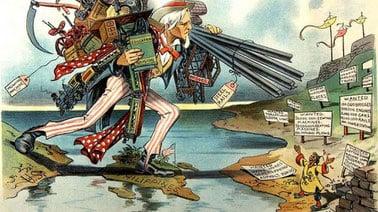
Remarkable political cartoons and photography at the turn of the 20th century reveal debates over US entry into global imperialism through the conquest and occupation of the Philippines. Historians tour this rich content drawn from MIT Visualizing Cultures.

Class Deals by MOOC List - Click here and see EdX's Active Discounts, Deals, and Promo Codes.

In this course we use visual records as a way of understanding history at the turn of the 20th century. Learners will learn how to navigate visual primary sources and use them to investigate:

  • the historical debates that emerged in political cartoons;
  • issues of race and prejudice in both cartooning and photography;
  • photography as a tool of power in conquest and colonization;
  • the often forgotten Philippine-American war;
  • ethnographic photography;
  • how the theme of civilization and barbarism appeared to justify imperial wars;
  • early use of cross-cultural photography in mass media.

The roundtable discussion format of the course will set up a discursive and exploratory style of learning. Learners will be exposed to multiple points of view as the teaching team brings together scholars who have studied the topics from different disciplines. Learners will also learn how to work with visual evidence as primary sources to assemble arguments.
For teachers, the course presents a number of units developed for the MIT Visualizing Cultures (VC) project. The instructors are the authors who created the VC resource, and the course provides a pathway into the VC website content. The VC website is widely taught in both secondary and college courses, and is the primary resource for this course. Educators can selectively pick modules that target needs in their classrooms; the course can be used in a “flipped” classroom where students are assigned modules as homework.

What you'll learn
This course invites learners into the process of exploring history through content that looks back at a complex millennial time. Learners will acquire background and skills that will help with:

  • the study of history and how it uses visual sources
  • how political and cultural debates that occurred then shed light on similar issues today
  • how to work with visual images
  • how to engage challenging, at times disturbing, historical sources
  • the study of databases and visual communication.

Course Syllabus

Module I—Introduction
This module introduces the MIT Visualizing Cultures project and approach to history through the visual record, the source for the content and methodology.
Overview of course content, methods of visual analysis, and background on Philippine and US history.
Instructional team introduce their approaches to visual history, and present critical questions of race, power, and intercultural exchange that will frame discussion throughout the course.
The evolution of digital education.

Module II—Civilization & Barbarism: Cartooning and Global Imperialism
Based on the Visualizing Cultures unit, “Civilization and Barbarism: Cartoon Commentary & the ‘White Man’s Burden’ (1898-1902)”.
This unit explores pro- and anti-imperialist imagery in the United States and international cartooning on the subject of “civilization” and colonialism at the turn of the century.
How did Americans learn about U.S. colonialism in the Philippines?
How did Filipinos and US-based critics of empire challenge and question American policies?
How can visual evidence from the past serve as the basis for new digital forms of history?

Module III—Photography and Power I: the Philippine-American War
Based on the Visualizing Cultures unit: “Photography & Power in the Colonial Philippines l: Conquest by the Camera (1898–1902)”.
This module explores the role of photography in the Philippine American War (1898-1902).
How did soldiers represent war experiences for themselves and for audiences in the United States?
How did Filipinos respond to US colonization, and what role did visual images play in their responses?

Module IV—Photography & Power II: How Photography Colonized the Philippines
Based on the Visualizing Cultures unit: “Photography & Power in the Colonial Philippines ll: Dean Worcester’s Photographic Record of the Philippines (1898–1913)”.
This module uses the photographic archive of US colonial official Dean Worcester to consider relationship of photography to anthropology and colonial governance.
How did photography serve as a basis for cultural engagement—both in positive and negative ways?
What are the “ethics of looking”? What responsibilities do we have today when confronting potentially difficult images?

Module V—Conclusion: Images of Power/the Power of Images
A roundtable discussion on the relationship between visual images and US expansion, as well as the contemporary implications of teaching and disseminating images in a digital environment.
Go to Class
MOOC List is learner-supported. When you buy through links on our site, we may earn an affiliate commission.

Related Courses

Globalization: Past and Future (edX) EdX
SDGAcademyX,SDG Academy

Globalization: Past and Future (edX)

Is globalization a new phenomenon or a cyclical pattern throughout human history? In this four-part mini-course, Professor Jeffrey Sachs argues that we have always lived in a global world. He takes students on a historical and anthropological tour of six distinct waves of globalization and outlines the key factors that drove innovation, technology dispersal and development during these epochs.

Self Paced
Self-Paced
Søren Kierkegaard - Subjectivity, Irony and the Crisis of Modernity (Coursera) Coursera
University of Copenhagen

Søren Kierkegaard - Subjectivity, Irony and the Crisis of Modernity (Coursera)

In this course created by former associate professor at the Søren Kierkegaard Research Centre, Jon Stewart, we will explore how Kierkegaard deals with the problems associated with relativism, the lack of meaning and the undermining of religious faith that are typical of modern life. His penetrating analyses are still highly relevant today and have been seen as insightful for the leading figures of Existentialism, Post-Structuralism and Post-Modernism.

Jun 22nd 2026
5-12 Weeks
Tangible Things: Discovering History Through Artworks, Artifacts, Scientific Specimens, and the Stuff Around You (edX) EdX
HarvardX,Harvard University

Tangible Things: Discovering History Through Artworks, Artifacts, Scientific Specimens, and the Stuff Around You (edX)

Gain an understanding of history, museum studies, and curation by looking at, organizing, and interpreting art, artifacts, scientific curiosities, and the stuff of everyday life. Have you ever wondered about how museum, library, and other kinds of historical or scientific collections all come together? Or how and why curators, historians, archivists, and preservationists do what they do?

Self Paced
Self-Paced
Journey of the Universe: The Unfolding of Life (Coursera) Coursera
Yale University

Journey of the Universe: The Unfolding of Life (Coursera)

Journey of the Universe weaves together the discoveries of the evolutionary sciences together with humanities such as history, philosophy, art, and religion. The course draws on the Emmy-award winning film, Journey of the Universe, and the book from Yale University Press. Journey explores cosmic evolution as a creative process based on connection, interdependence, and emergence. It examines a range of dynamic interactions in the unfolding of galaxies, Earth, life, and human communities. It investigates ways in which we understand evolutionary processes and the implications for humans and our ecological future.

Jun 22nd 2026
5-12 Weeks
The History of Medieval Medicine Through Jewish Manuscripts (edX) EdX
University of Pennsylvania,PennX

The History of Medieval Medicine Through Jewish Manuscripts (edX)

Learn about medieval Jewish medical training and thought by exploring and interpreting medical manuscripts. This mini-course is a general introduction to both to medieval medicine and to the value of using manuscripts. Professor Y. Tzvi Langermann presents a case study that builds from a unique 15th-century volume in which three important medical manuscripts in Hebrew and Judeo-Arabic (Arabic in Hebrew characters) are sewn together.

Self-Paced
Self-Paced
Arab-Islamic History: From Tribes to Empires (edX) EdX
Tel Aviv University,IsraelX,TAUx

Arab-Islamic History: From Tribes to Empires (edX)

Learn about the history of the Arab and Muslim world during its first millennium, including political, social and cultural aspects. You will study this course in two parts. The first presents the main political events that set the chronological framework for the course, namely 6th century to the arrival of the Ottomans in the Middle East in the beginning of the 16th century. The second part delves into social and cultural realities of the medieval Middle East.

Self Paced
Self-Paced
The Kennedy Half Century (Coursera) Coursera
University of Virginia

The Kennedy Half Century (Coursera)

When John F. Kennedy entered the presidential limousine at Love Field in Dallas, Texas on November 22, 1963, he began his ride into history. That journey continues even today and we call it the Kennedy legacy. This course will explore the Presidency, assassination, and lasting legacy of President John F. Kennedy. Students will learn how JFK’s life, administration, and tragic death have influenced the general public, the media, and each of the nine U.S. presidents who followed.

Jun 22nd 2026
4 Weeks
Creating Modern China: The Republican Period to the Present (edX) EdX
HarvardX,Harvard University

Creating Modern China: The Republican Period to the Present (edX)

Explore the birth of modern China with a focus on the time between the fall of the Qing and the end of World War II. What does it mean to be modern? What constitutes modern politics, modern institutions, a modern military, and modern infrastructure? In this period of great excitement and experimentation, the country is asking itself: How do you become modern and remain true to the Chinese national identity?

Self Paced
Self-Paced
Arts and Culture: Towards a New Management Paradigm (edX) EdX
Indian Institute of Management, Bangalore,IIMBx

Arts and Culture: Towards a New Management Paradigm (edX)

Covering concepts that detail management strategies for professionals in arts and culture enterprises, ‘Arts and Culture: Towards a New Management Paradigm’ is designed to equip learners with a practitioner’s knowledge of management. The course details topics such as economics of culture and heritage, and the global policy landscape for decision making.

No sessions available
5-12 Weeks
Pyramids of Giza: Ancient Egyptian Art and Archaeology (edX) EdX
HarvardX,Harvard University

Pyramids of Giza: Ancient Egyptian Art and Archaeology (edX)

Explore the archaeology, history, art, and hieroglyphs surrounding the famous Egyptian Pyramids at Giza. Learn about Old Kingdom pharaohs and elites, tombs, temples, the Sphinx, and how new technology is unlocking their secrets. Where is Giza? How were the Pyramids built? How did the cemeteries and hundreds of decorated tombs around them develop? What was Giza’s contribution to this first great age of ancient Egyptian civilization, the Old Kingdom?

Self Paced
Self-Paced
Magic in the Middle Ages (Coursera) Coursera
University of Barcelona

Magic in the Middle Ages (Coursera)

Magical thought has always attracted human imagination. In this course we will introduce you to the Middle Ages through a wide conception of magic. Students will have an approach to medieval culture, beliefs and practices from the perspective of History and History of Science. Popular magic, as well as learned magic (alchemy, geomancy and necromancy) will be addressed. Moreover, we will also deal with how eastern practices and texts influenced western culture. In July 2016, the course will contain a brand-new module devoted to astrology. Magic in the Middle Ages offers a captivating overview of medieval society and promotes reflection about certain stereotypes associated with this period.

Jun 22nd 2026
5-12 Weeks
La percepción del paisaje (edX) EdX
Universidad Autonoma de Madrid,UAMx

La percepción del paisaje (edX)

En este MOOC nos proponemos dos objetivos: recrear la historia del paisaje y percibirlo no sólo por la vista, sino por los cinco sentidos. De forma que veremos cómo se ha ido pasando de una percepción frontal del paisaje (la del caminante y el navegante), a una lateral (la de las ventanillas del ferrocarril) y a otra vertical (la de los submarinos y los satélites espaciales). Y desde la aparición de internet ha surgido otra dimensión: el paisaje virtual.

Self Paced
Self-Paced